Punctuate the Following Sentences (With Answers)
What Does “Punctuate the Following Sentence” Mean?
Four words that turn up on worksheets, homework sheets and exam papers everywhere: punctuate the following sentence. The words of the sentence are already there — your job is to supply what has been left out.
The instruction means that you must add the punctuation marks that are missing from a sentence. An unpunctuated sentence may contain all the necessary words, but without punctuation its meaning can be difficult to understand.
For example:
where are you going
Where are you going?
The corrected sentence has two important changes:
- W is capitalized because it is the first letter of the sentence.
- A question mark (?) is added because the sentence asks a question.
Another example is:
My favorite fruits are apples oranges bananas and mangoes
My favorite fruits are apples, oranges, bananas, and mangoes.
So, punctuation is not simply about putting marks into random spaces. You need to understand the meaning and structure of the sentence before deciding which punctuation marks it needs.
Why Is Punctuation Important?
Punctuation helps readers understand how words and ideas are connected. It shows where a sentence begins and ends, where a pause may occur, and whether the writer is asking a question, making a statement, giving a command, or expressing strong emotion.
Compare these two examples:
Let’s eat, Grandma.
The comma shows that Grandma is being spoken to. She is invited to the table.
Let’s eat Grandma.
With no comma, Grandma becomes the meal.
The first sentence uses a comma to address Grandma. The second sentence gives a very different and rather alarming impression! This simple example shows why punctuation matters: the words have not changed, but the punctuation changes the meaning.
Good punctuation helps you:
- make your writing easier to read
- express your intended meaning
- separate ideas clearly
- avoid confusion
- show questions and emotions
- organize lists and information
- make your writing grammatically correct
How to Punctuate a Sentence Correctly
When you see an unpunctuated sentence, do not immediately start adding commas and full stops. First, read the entire sentence and understand what it is saying. You can then use the following steps.
-
Start with a Capital Letter
The first word of a sentence normally begins with a capital letter.
- Incorrect: my brother lives in Lahore.
- Correct: My brother lives in Lahore.
Capital letters are also used for proper nouns such as people’s names, countries, cities, days, and months.
ExampleAhmed visited Islamabad on Monday.
-
Identify the Type of Sentence
Ask yourself what the sentence is doing. Is it:
- making a statement?
- asking a question?
- giving a command or request?
- expressing strong emotion?
The type of sentence often tells you which punctuation mark belongs at the end.
Sentence type and the mark it usually ends with Sentence type End mark Example Statement . She works in a bank. Question ? Where does she work? Command . Close the door. Exclamation ! What a beautiful view! -
Look for Places That Need Commas
Commas are often used to separate items in a list, introductory words or phrases, and certain parts of a sentence.
Without punctuationI bought apples oranges bananas and grapes.
With punctuationI bought apples, oranges, bananas, and grapes.
The commas make the individual items easier to identify.
The comma before and in a list is a style choice — common in American writing, often left out in British writing. Whichever you choose, use it the same way every time. -
Look for Direct Speech
When a sentence contains someone’s exact words, quotation marks are usually needed.
UnpunctuatedAli said I am feeling tired
PunctuatedAli said, “I am feeling tired.”
Notice that the corrected sentence contains:
- a comma before the quotation
- quotation marks around the exact words
- a capital letter at the beginning of the quoted sentence
- a full stop at the end
-
Check for Possession and Contractions
An apostrophe can show possession or indicate missing letters in a contraction.
PossessionThis is Sarah’s book.
ContractionI don’t know the answer.
Be careful not to use an apostrophe simply because a word ends in s.
- Incorrect: The car’s are new.
- Correct: The cars are new.
-
Decide How the Sentence Should End
Finally, check the last part of the sentence.
Use a full stop for most statements.
The children are playing outside.
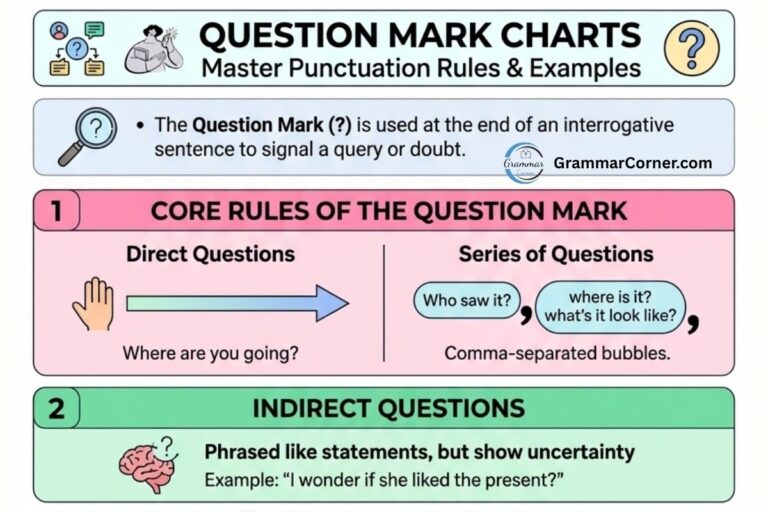
Use a question mark for a direct question.
Where are the children?
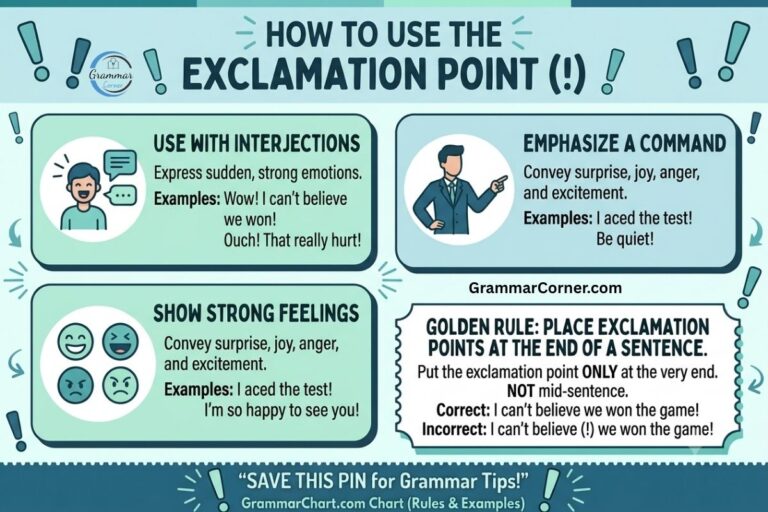
Use an exclamation mark when the sentence expresses strong emotion, surprise, excitement, or emphasis.
What a wonderful surprise!
Common Punctuation Marks and Their Uses
Understanding the main punctuation marks makes punctuation exercises much easier.
| Punctuation mark | Name | Main use | Example |
|---|---|---|---|
| . | Full stop | Ends a statement | She is my friend. |
| , | Comma | Separates items or parts of a sentence | I bought bread, milk, and eggs. |
| ? | Question mark | Ends a direct question | Where do you live? |
| ! | Exclamation mark | Shows strong emotion or emphasis | What a great idea! |
| ’ | Apostrophe | Shows possession or contraction | John’s car; don’t |
| “ ” | Quotation marks | Show direct speech or quoted words | She said, “Come in.” |
| : | Colon | Introduces a list or explanation | Bring these things: a pen, paper, and a ruler. |
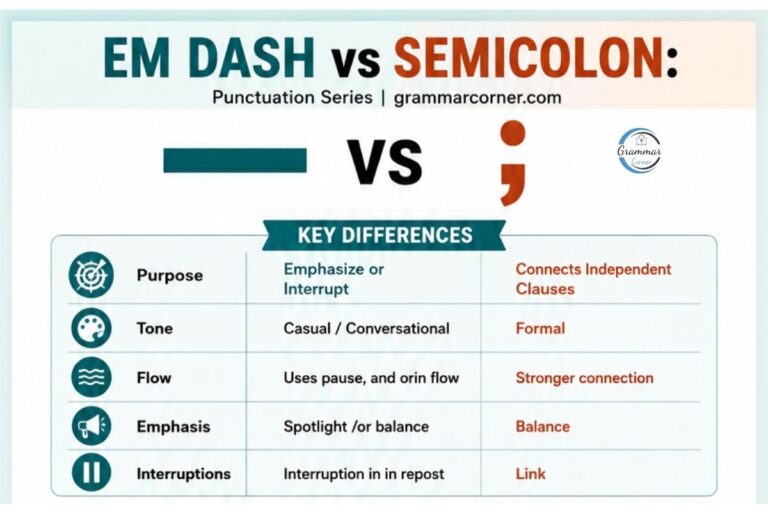
| ; | Semicolon | Links closely related independent clauses | It was raining; we stayed inside. |
| – | Hyphen | Joins certain words | well-known writer |
| — | Em dash | Adds emphasis or an interruption | She finally arrived—but she was late. |
| ( ) | Parentheses | Add extra information | Hamza (my cousin) lives nearby. |
You do not need to use every punctuation mark in every sentence. The correct mark depends on the sentence’s meaning and grammatical structure.
Punctuate the Following Sentences: Easy Examples
Let’s begin with some simple sentences. Try to punctuate each one yourself before looking at the answer.
-
where is your brother
AnswerWhere is your brother?
Why: the sentence asks a question, so it begins with a capital letter and ends with a question mark.
-
i like reading books
AnswerI like reading books.
Why: this is a statement, so it begins with a capital letter and ends with a full stop.
-
what a beautiful painting
AnswerWhat a beautiful painting!
Why: the sentence expresses strong admiration, so an exclamation mark is appropriate.
-
my favorite colors are blue green and yellow
AnswerMy favorite colors are blue, green, and yellow.
Why: commas separate the three items in the list.
-
ali please bring me a glass of water
AnswerAli, please bring me a glass of water.
Why: a comma separates the person’s name from the rest of the sentence, because Ali is being directly addressed.
-
did you finish your homework
AnswerDid you finish your homework?
Why: this is a direct question, so it ends with a question mark.
-
my father works in a hospital
AnswerMy father works in a hospital.
Why: it is a statement, so it ends with a full stop.
-
hurry the bus is leaving
AnswerHurry! The bus is leaving.
Why: the first part is a command expressing urgency, so an exclamation mark helps separate it from the following statement.
-
sara bought a notebook a pen and a ruler
AnswerSara bought a notebook, a pen, and a ruler.
Why: commas separate the items in the list.
-
wow that was an amazing performance
AnswerWow! That was an amazing performance.
Why: “Wow!” expresses strong emotion and is treated as a separate exclamation.
Punctuate the Following Sentences: Intermediate Examples
Once you understand the basic rules, punctuation exercises become more interesting. The following examples contain commas, conjunctions, direct address, apostrophes, and quotation marks.
-
after dinner we went for a walk
AnswerAfter dinner, we went for a walk.
Why: the introductory phrase “After dinner” is followed by a comma.
-
although it was raining we went outside
AnswerAlthough it was raining, we went outside.
Why: the introductory dependent clause is separated from the main clause with a comma.
-
i wanted to call you but my phone was dead
AnswerI wanted to call you, but my phone was dead.
Why: a comma is used before but when it joins two independent clauses.
-
my sister said i will help you
AnswerMy sister said, “I will help you.”
Why: the exact words spoken by the sister are enclosed in quotation marks.
-
this is my brothers bicycle
AnswerThis is my brother’s bicycle.
Why: the apostrophe shows that the bicycle belongs to the brother.
-
dont forget to bring your notebook
AnswerDon’t forget to bring your notebook.
Why: the apostrophe in don’t replaces the missing o in do not.
-
yes i understand the question
AnswerYes, I understand the question.
Why: a comma follows the introductory word Yes.
-
if you finish early you can go home
AnswerIf you finish early, you can go home.
Why: the introductory if-clause is followed by a comma.
-
mary john and david attended the meeting
AnswerMary, John, and David attended the meeting.
Why: commas separate the three names in the list, and each name takes a capital letter.
-
the teacher asked why are you late
AnswerThe teacher asked, “Why are you late?”
Why: the sentence reports the teacher’s exact words, so quotation marks are used. Because the quoted words form a direct question, a question mark appears inside the quotation marks, not after them.
A Quick Trick for Punctuation Exercises
When solving a punctuation question, do not focus only on individual words. Look at the sentence as a whole.
For example:
when the rain stopped we went outside
Instead of asking, “Where should I put a comma?” first identify the structure:
When the rain stopped
we went outside
Now the punctuation becomes easier:
When the rain stopped, we went outside.
Understanding sentence structure is often more useful than simply memorizing punctuation rules.
Punctuate the Following Sentences: Your Turn
Now try these sentences without looking for the answers immediately.
where did you put my keys
my mother bought apples oranges and bananas
ali said i will come tomorrow
after school we went to the library
what an exciting match
dont touch that machine
sara please close the window
if you need help call me
is this your brothers jacket
yes i would love to come
Answers
- Where did you put my keys?
- My mother bought apples, oranges, and bananas.
- Ali said, “I will come tomorrow.”
- After school, we went to the library.
- What an exciting match!
- Don’t touch that machine.
- Sara, please close the window.
- If you need help, call me.
- Is this your brother’s jacket?
- Yes, I would love to come.
Punctuate the Following Sentences Using Different Punctuation Marks
Not every punctuation exercise can be solved by simply adding a full stop or question mark. As sentences become longer, you may need commas, apostrophes, quotation marks, colons, or semicolons. The following examples will help you practice different punctuation marks in context.
-
Use a Comma in a List
UnpunctuatedI need a notebook a pencil an eraser and a ruler
CorrectI need a notebook, a pencil, an eraser, and a ruler.
Why? Commas separate the items in a series. The comma before and is called the Oxford comma, and it is commonly used to make the list easier to read.
-
Use a Comma After an Introductory Phrase
UnpunctuatedIn the morning we went for a walk
CorrectIn the morning, we went for a walk.
Why? The phrase “In the morning” introduces the main idea, so a comma separates it from the main clause.
-
Use a Comma Before a Coordinating Conjunction
UnpunctuatedI wanted to go outside but it started raining
CorrectI wanted to go outside, but it started raining.
Why? A comma is normally placed before but when it joins two independent clauses.
-
Use an Apostrophe for Possession
UnpunctuatedThis is Ahmeds notebook
CorrectThis is Ahmed’s notebook.
Why? The apostrophe shows that the notebook belongs to Ahmed.
-
Use an Apostrophe in a Contraction
UnpunctuatedShe doesnt like coffee
CorrectShe doesn’t like coffee.
Why? Doesn’t is a contraction of does not. The apostrophe stands in for the missing letter o.
-
Use Quotation Marks for Direct Speech
UnpunctuatedThe teacher said please open your books
CorrectThe teacher said, “Please open your books.”
Why? Quotation marks show the exact words spoken by the teacher, and a comma separates the reporting clause from the quotation.
-
Use a Question Mark for a Direct Question
UnpunctuatedCan you tell me where the station is
CorrectCan you tell me where the station is?
Why? The entire sentence is a direct question, so it ends with a question mark.
-
Use an Exclamation Mark to Express Strong Emotion
UnpunctuatedThat was an incredible goal
CorrectThat was an incredible goal!
Why? The exclamation mark emphasizes excitement or strong feeling.
-
Use a Colon to Introduce a List
UnpunctuatedYou need three things for the experiment water salt and a glass
CorrectYou need three things for the experiment: water, salt, and a glass.
Why? A colon introduces the list that follows.
-
Use a Semicolon Between Closely Related Clauses
UnpunctuatedThe weather was terrible we decided to stay home
CorrectThe weather was terrible; we decided to stay home.
Why? Both parts can stand alone as complete sentences, but their ideas are closely connected. A semicolon can join them without using a conjunction.
Punctuate the Following Sentences: Direct Speech
Direct speech is one of the areas where students often make mistakes. When punctuating direct speech, pay attention to the quotation marks, commas, capital letters, and end punctuation.
Maria said I am ready
Maria said, “I am ready.”
where are you going asked Ahmed
“Where are you going?” asked Ahmed.
the teacher said you should complete your homework today
The teacher said, “You should complete your homework today.”
please help me said the old man
“Please help me,” said the old man.
i am tired said Sara but i will finish the work
“I am tired,” said Sara, “but I will finish the work.”
Notice how the punctuation changes depending on where the reporting clause appears.
Punctuate the Following Sentences with Apostrophes
Apostrophes are small, but they can cause considerable confusion. They are mainly used to show possession and contractions.
Possessive Examples
This is the teachers desk.
This is the teacher’s desk.
The boys shoes are dirty.
The boy’s shoes are dirty.
The girls bags are on the table.
The girls’ bags are on the table.
Why the last one is different: girls is plural. The apostrophe comes after the s because the bags belong to more than one girl.
Compare: the boy’s shoes (one boy) and the girls’ bags (several girls). The position of the apostrophe tells the reader how many people are involved.
Contraction Examples
I cannot understand this question.
I can’t understand this question.
We are not ready.
We aren’t ready.
She will not attend the meeting.
She won’t attend the meeting.
One to memorize: can’t and aren’t simply drop letters, but will not becomes won’t — the vowel changes too, so this one has to be learned as it is.
Punctuate the Following Sentences with Commas
Commas have many uses, so students need to look at the structure of the sentence rather than insert commas wherever they might pause while speaking.
-
Comma with a List
Missing commasWe visited Lahore Islamabad Multan and Peshawar.
CorrectWe visited Lahore, Islamabad, Multan, and Peshawar.
-
Comma After an Introductory Word
Missing commaHowever I decided to continue.
CorrectHowever, I decided to continue.
-
Comma with Direct Address
Missing commaAli please sit down.
CorrectAli, please sit down.
-
Comma After an Introductory Clause
Missing commaWhen the class ended the students left.
CorrectWhen the class ended, the students left.
-
Comma Before a Coordinating Conjunction
Missing commaShe studied hard but she did not pass the test.
CorrectShe studied hard, but she did not pass the test.
Punctuate the Following Paragraphs
Punctuating a complete paragraph is more challenging than punctuating individual sentences. You have to identify where sentences begin and end, and determine where commas and other punctuation marks are needed.
Try to punctuate each paragraph before checking the answer.
last sunday ali woke up early he looked outside and noticed that the sky was clear after breakfast he decided to visit the park
Last Sunday, Ali woke up early. He looked outside and noticed that the sky was clear. After breakfast, he decided to visit the park.
What changed?
- Last Sunday is followed by a comma.
- The first sentence ends with a full stop.
- He begins a new sentence and therefore needs a capital letter.
- After breakfast is an introductory phrase followed by a comma.
- The paragraph is divided into three complete sentences.
sara went to the market she wanted to buy several things including bread milk eggs and vegetables but the shop was closed
Sara went to the market. She wanted to buy several things, including bread, milk, eggs, and vegetables, but the shop was closed.
What changed? The first idea is a complete sentence, so it ends with a full stop. Commas separate the items in the list, and another comma helps set off the phrase “including bread, milk, eggs, and vegetables.”
The comma after vegetables does two jobs at once: it closes that phrase and it also comes before but, which joins the two halves of the sentence.
when john arrived at the station he checked his ticket and looked at the clock unfortunately the train had already left
When John arrived at the station, he checked his ticket and looked at the clock. Unfortunately, the train had already left.
What changed? The introductory clause is followed by a comma. The first complete thought ends with a full stop, and Unfortunately is followed by a comma because it introduces the second sentence.
the teacher entered the classroom and said good morning everyone please take out your books and turn to page twenty
The teacher entered the classroom and said, “Good morning, everyone. Please take out your books and turn to page twenty.”
What changed? The teacher’s exact words are placed inside quotation marks. A comma separates Good morning from the direct address everyone, and the two spoken sentences are separated by a full stop.
How to Punctuate a Long Sentence
Long sentences can seem difficult because they often contain several ideas. The best approach is to break the sentence into meaningful parts.
Consider this example:
although the weather was cold we decided to go hiking because we had planned the trip for several weeks
Read it once, then separate the parts:
Although the weather was cold
we decided to go hiking
because we had planned the trip for several weeks
The corrected sentence is:
Although the weather was cold, we decided to go hiking because we had planned the trip for several weeks.
Note: you do not need a comma before because here, because the final clause is closely connected to the main idea.
Common Mistakes When Punctuating Sentences
Learning punctuation is not only about knowing where to put marks. It is also about knowing where not to put them.
-
Forgetting the Capital Letter
❌ Incorrectwhere is my book?
✅ CorrectWhere is my book?
Why? Every sentence should begin with a capital letter.
-
Using a Full Stop Instead of a Question Mark
❌ IncorrectWhat time does the class start.
✅ CorrectWhat time does the class start?
Why? The sentence asks a direct question, so it needs a question mark.
-
Adding a Comma Between the Subject and Verb
❌ IncorrectMy best friend, lives in Karachi.
✅ CorrectMy best friend lives in Karachi.
Why? A comma should not normally separate a simple subject from its verb.
-
Joining Two Complete Sentences with Only a Comma
❌ IncorrectI was tired, I went to bed.
✅ CorrectI was tired, so I went to bed.
Why? The original contains two independent clauses joined only by a comma. This is called a comma splice. A conjunction, semicolon, or full stop can fix the problem.
-
Confusing “Its” and “It’s”
❌ IncorrectThe dog wagged it’s tail.
✅ CorrectThe dog wagged its tail.
Why? Its shows possession. It’s is a contraction of it is or it has.
-
Forgetting the Apostrophe in Possessive Nouns
❌ IncorrectThis is Amirs phone.
✅ CorrectThis is Amir’s phone.
Why? The apostrophe shows that the phone belongs to Amir.
-
Using Too Many Exclamation Marks
❌ IncorrectThat is amazing!!!
✅ BetterThat is amazing!
Why? One exclamation mark is normally enough in formal writing. Multiple exclamation marks can make writing look excessive or informal.
-
Forgetting Punctuation in Direct Speech
❌ IncorrectAhmed said “I am ready”
✅ CorrectAhmed said, “I am ready.”
Why? The reporting clause and the direct quotation need appropriate punctuation: a comma after the reporting clause, and a full stop inside the closing quotation mark.
Tips for Solving “Punctuate the Following Sentence” Questions in Exams
If you are solving punctuation questions in a school test or examination, a systematic approach can save time and prevent mistakes.
-
Read the Sentence Completely
Do not add punctuation after every few words as you read. First understand the entire sentence.
-
Find the Beginning and End
Make sure the sentence starts with a capital letter and ends with the appropriate punctuation mark.
-
Identify Questions
Words such as who, what, where, when, why, how, and can help you recognize questions, but do not rely on these words alone. The sentence’s meaning determines whether it is actually a question.
-
Look for Lists
If several nouns, adjectives, or phrases appear one after another, check whether commas are needed.
-
Look for Direct Speech
Words such as said, asked, replied, shouted, whispered, and explained may introduce direct speech.
-
Check Apostrophes
Look for possessive nouns and contractions.
- Ali’s book
- the teachers’ room
- don’t
- can’t
- we’re
-
Check Sentence Boundaries
If a sentence contains several complete thoughts, determine whether they should be separated with a full stop, a semicolon, or an appropriate conjunction.
-
Read Your Answer Again
After adding punctuation, read the complete sentence aloud or silently. Ask yourself:
Does it make sense?If the sentence still feels confusing, look at its structure again.
Punctuation Does More Than Create Pauses
A common misconception is that punctuation simply tells readers when to pause. While punctuation can sometimes indicate a pause, its purpose is much broader: it helps show relationships between ideas.
Compare:
The teacher said, “Ali is hardworking.”
The quotation marks present these as the teacher’s own words — direct speech.
The teacher said Ali is hardworking.
Without them, the same words read as reported information.
Similarly:
Let’s eat, Grandma.
Grandma is being invited to eat.
Let’s eat Grandma.
The comma is gone, and so is the meaning you wanted.
This is why good punctuation should be based on grammar, meaning, and sentence structure, not simply on where you would naturally pause when speaking.
How Can You Improve Your Punctuation Skills?
The best way to become better at punctuation is to combine learning with regular practice.
Start by mastering the most common punctuation marks:
- full stops
- commas
- question marks
- exclamation marks
- apostrophes
- quotation marks
Then move on to more advanced punctuation:
- colons
- semicolons
- dashes
- parentheses
When you read books, articles, or well-edited websites, pay attention to punctuation. Notice where writers place commas, how they introduce quotations, and how they separate long sentences.
You can also take an unpunctuated paragraph and try to correct it yourself. Afterward, compare your version with a properly edited version and identify the differences.
The goal is not to memorize hundreds of isolated rules. It is to understand why a particular punctuation mark is needed in a particular sentence.
Final Punctuation Challenge
Here is one final paragraph for you to punctuate on your own:
yesterday my friend called me and said are you free this evening i told him yes but i have to finish my homework first he replied dont worry we can meet after you finish
Yesterday, my friend called me and said, “Are you free this evening?” I told him, “Yes, but I have to finish my homework first.” He replied, “Don’t worry. We can meet after you finish.”
This single paragraph requires you to identify several punctuation rules:
- capitalization
- commas after introductory information
- quotation marks
- question marks
- full stops
- apostrophes
- commas within direct speech
That is exactly why practicing with complete passages can be more useful than practicing only individual sentences.
Related posts