Phrases That Start With W (Meaning & Examples)
Phrases that start with W are groups of two or more words in which the first word begins with the letter W, helping learners express ideas, describe situations, and add natural depth to sentences.
This article is especially useful for students in Grades 4 to 7, though English learners of all ages can benefit from exploring these expressions along with their clear definitions and practical examples.
Here are some common and useful phrases starting with W to explore:
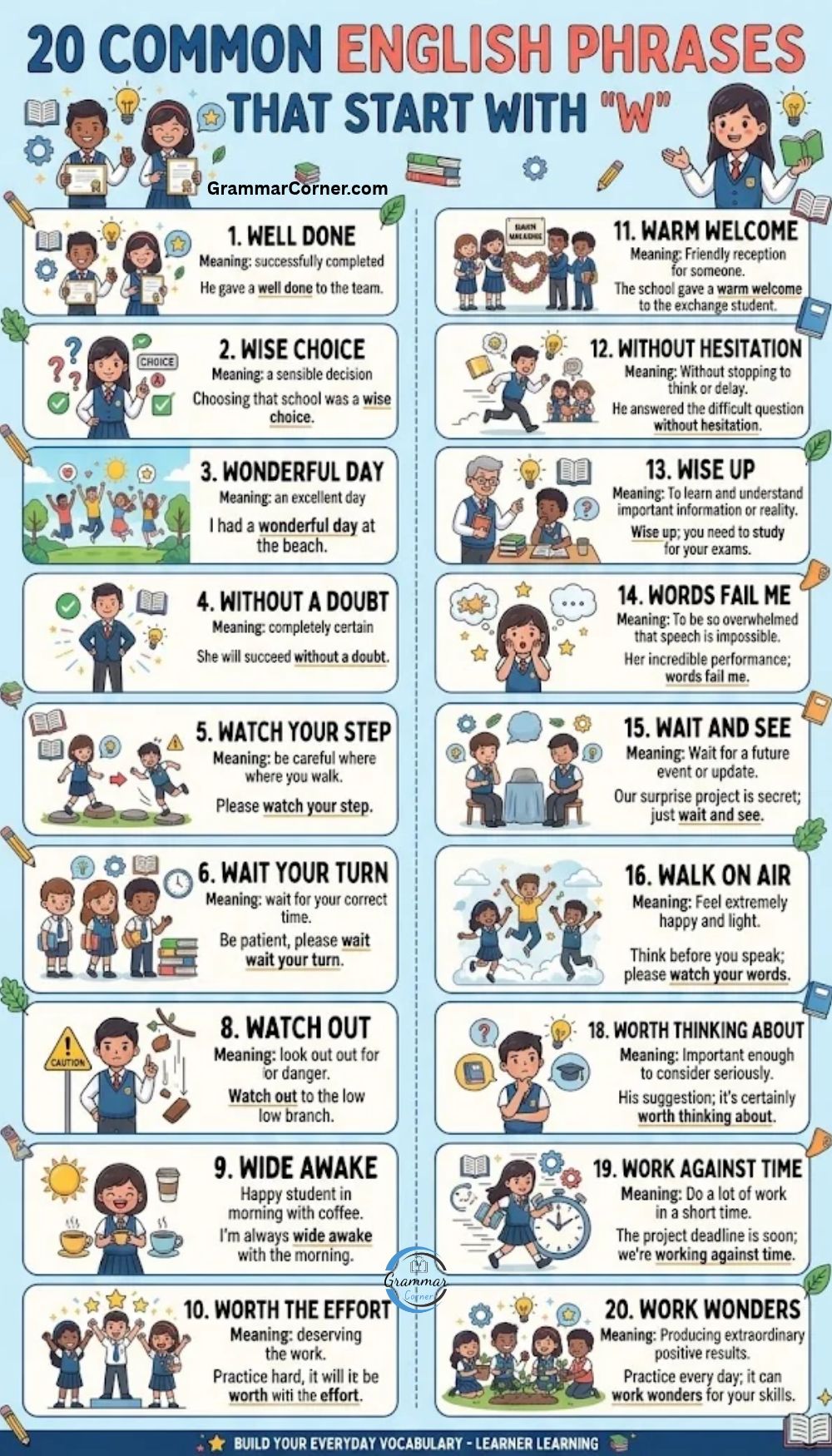
- Warm welcome – a friendly and pleasant greeting
- Waste of time – something that does not make good use of time
- With flying colors – with great success
- Word of mouth – information shared through conversations
- Walk on air – to feel extremely happy
Some phrases have straightforward meanings, while others are idiomatic expressions whose figurative meanings enrich storytelling, assignments, and everyday conversations.
Complete List of Phrases that Start with W
- 1. Warm welcome
- 2. Warm smile
- 3. Warm wishes
- 4. Warm feelings
- 5. Warm embrace
- 6. Warm clothing
- 7. Warm sunshine
- 8. Warm atmosphere
- 9. Warm greeting
- 10. Warm reception
- 11. Wise decision
- 12. Wise choice
- 13. Wise words
- 14. Wise advice
- 15. Wise leader
- 16. Wise teacher
- 17. Wise person
- 18. Wise saying
- 19. Wise approach
- 20. Wise investment
- 21. Wonderful day
- 22. Wonderful time
- 23. Wonderful news
- 24. Wonderful gift
- 25. Wonderful place
- 26. Wonderful weather
- 27. Wonderful story
- 28. Wonderful friend
- 29. Wonderful teacher
- 30. Wonderful moment
- 31. Wild animals
- 32. Wild flowers
- 33. Wild imagination
- 34. Wild adventure
- 35. Wild forest
- 36. Wild nature
- 37. Wild excitement
- 38. Wild celebration
- 39. Wild landscape
- 40. Wild behavior
- 41. Worth remembering
- 42. Worth reading
- 43. Worth watching
- 44. Worth learning
- 45. Worth sharing
- 46. Worth knowing
- 47. Worth visiting
- 48. Worth mentioning
- 49. Worth appreciating
- 50. Worth the price
- 51. Wonderful experience
- 52. Wonderful opportunity
- 53. Wonderful surprise
- 54. Wonderful achievement
- 55. Wonderful idea
- 56. Wonderful memories
- 57. Wonderful journey
- 58. Wonderful performance
- 59. Wonderful celebration
- 60. Wonderful discovery
- 61. Well done
- 62. Well prepared
- 63. Well organized
- 64. Well behaved
- 65. Well educated
- 66. Well informed
- 67. Well written
- 68. Well known
- 69. Well respected
- 70. Well maintained
- 71. Well deserved
- 72. Well balanced
- 73. Well developed
- 74. Well designed
- 75. Well equipped
- 76. Well protected
- 77. Well trained
- 78. Well managed
- 79. Well planned
- 80. Well presented
- 81. Wide awake
- 82. Wide open
- 83. Wide range
- 84. Wide variety
- 85. Wide smile
- 86. Wide road
- 87. Wide audience
- 88. Wide selection
- 89. Wide experience
- 90. Wide difference
- 91. Worth trying
- 92. Worth considering
- 93. Worth discussing
- 94. Worth exploring
- 95. Worth celebrating
- 96. Worth keeping
- 97. Worth waiting for
- 98. Worth thinking about
- 99. Worth the effort
- 100. Worth the risk
- 101. Without a doubt
- 102. Without delay
- 103. Without warning
- 104. Without permission
- 105. Without hesitation
- 106. Without question
- 107. Without exception
- 108. Without fail
- 109. Without complaint
- 110. Without reason
- 111. Without difficulty
- 112. Without support
- 113. Without fear
- 114. Without effort
- 115. Without interruption
- 116. Without any doubt
- 117. Without further notice
- 118. Without a trace
- 119. Without a second thought
- 120. Without a care
- 121. Work hard
- 122. Work together
- 123. Work carefully
- 124. Work efficiently
- 125. Work independently
- 126. Work as a team
- 127. Work under pressure
- 128. Work towards a goal
- 129. Work with confidence
- 130. Work for a living
- 131. Work against time
- 132. Work out a solution
- 133. Work through a problem
- 134. Work from home
- 135. Work around the clock
- 136. Wait a minute
- 137. Wait and see
- 138. Wait your turn
- 139. Wait in line
- 140. Wait patiently
- 141. Watch carefully
- 142. Watch closely
- 143. Watch your step
- 144. Watch the clock
- 145. Watch your words
- 146. Watch out
- 147. Watch the road
- 148. Watch the sunset
- 149. Watch the stars
- 150. Watch the sunrise
Practicing these phrases regularly will enhance vocabulary, improve reading comprehension, and bring greater natural fluency to written and spoken English.
1. Common Phrases That Start With W With Meanings and Examples
These widely used expressions include idioms and everyday sayings that help describe actions, experiences, and situations clearly.
| Phrase | Meaning | Example Sentence |
|---|---|---|
| Waste of time | An activity that does not produce a useful result | Playing games all day instead of studying can be a waste of time. |
| Walk on air | To feel extremely happy or excited | Sara was walking on air after winning the school competition. |
| Word of mouth | Information passed from one person to another through conversation | News about the new restaurant spread by word of mouth. |
| With flying colors | To achieve something with great success | Ahmed passed his final examination with flying colors. |
| When pigs fly | An expression used to describe something that is extremely unlikely to happen | My brother says he will stop eating chocolate when pigs fly. |
| Wear your heart on your sleeve | To show your feelings openly | My younger sister wears her heart on her sleeve, so everyone knows when she is upset. |
| Water under the bridge | A past problem or disagreement that is no longer important | We argued last year, but it is all water under the bridge now. |
| Walk in someone’s shoes | To imagine another person’s experiences or difficulties | Before judging others, try to walk in their shoes. |
| Weather the storm | To successfully deal with a difficult situation | The family worked together to weather the storm during difficult times. |
| Win someone’s heart | To gain someone’s love, respect, or affection | The kind teacher won her students’ hearts through patience and care. |
| With open arms | In a friendly and welcoming manner | The villagers welcomed the visitors with open arms. |
| Write it down | To record something in writing so it can be remembered | If you want to remember the instructions, write them down. |
| Wake up early | To stop sleeping at an early hour | I wake up early every morning to prepare for school. |
| Work your way up | To gradually reach a better position through effort and experience | My uncle worked his way up from an assistant to a manager. |
| Wrap your head around something | To understand a difficult or confusing idea | It took me some time to wrap my head around the new mathematics lesson. |
2. W Phrases for Everyday Conversations
Many phrases beginning with W are used in ordinary conversations. These expressions help people ask questions, share feelings, and communicate politely.
| Phrase | Meaning | Example Sentence |
|---|---|---|
| What’s going on? | Asking what is happening | What’s going on outside the classroom? |
| What’s the matter? | Asking what is wrong | You look upset. What’s the matter? |
| What a surprise! | Expressing surprise | What a surprise! I did not expect to see you here. |
| What a relief! | Expressing happiness that a worry has ended | What a relief! We found the missing bag. |
| What do you think? | Asking for someone’s opinion | What do you think about this story? |
| Would you mind? | Making a polite request | Would you mind closing the window? |
| Why not? | Asking for a reason or showing agreement | Why not? We can play after finishing our homework. |
| Welcome back | Greeting someone who has returned | Welcome back! We missed you at school. |
| Wish me luck | Asking someone to hope for your success | Wish me luck before my speech. |
| Whatever happens | No matter what takes place | Whatever happens, we will support each other. |
Why Are These Expressions Useful? Everyday expressions make conversations more natural and meaningful. Students can use them when talking with friends, asking teachers questions, greeting visitors, or discussing daily activities. For example, “Would you mind?” is useful when making polite requests, while “What a relief!” helps express happiness after a stressful situation ends.
3. W Phrases About Feelings and Emotions
Some English expressions beginning with W describe happiness, sadness, excitement, fear, or other emotions.
| Phrase | Meaning | Example Sentence |
|---|---|---|
| Weep with joy | Cry because of great happiness | The mother wept with joy when her son returned. |
| Worry about the future | Feel anxious about what may happen | Students sometimes worry about the future. |
| Wish for happiness | Hope to experience happiness | Everyone wishes for happiness in life. |
| Welcome the change | Accept a new situation positively | The students welcomed the change in their timetable. |
| Wear a happy face | Show a cheerful expression | She tried to wear a happy face despite her disappointment. |
| Wipe away tears | Remove tears from the face | The child wiped away his tears and smiled. |
| Warm someone’s heart | Make someone feel happy or touched | The children’s kindness warmed their grandmother’s heart. |
| Wonder with excitement | Feel curious and excited | The children wondered with excitement about the surprise trip. |
4. Phrases for School and Learning
Students frequently encounter expressions beginning with W in classroom instructions, textbooks, and educational activities.
| Phrase | Meaning | Example Sentence |
|---|---|---|
| Write a paragraph | Create a short piece of writing | The teacher asked us to write a paragraph about our school. |
| Write in complete sentences | Use full sentences in writing | Always write in complete sentences during the examination. |
| Work on an assignment | Spend time completing schoolwork | I need to work on an assignment tonight. |
| Widen your knowledge | Increase what you know | Reading different books can widen your knowledge. |
| Work out the answer | Find the correct solution | Try to work out the answer without using a calculator. |
| Word for word | Using exactly the same words | She repeated the poem word for word. |
| Write a summary | Present the main ideas briefly | We were asked to write a summary of the chapter. |
| Work at your own pace | Complete tasks at a comfortable speed | During the activity, students could work at their own pace. |
| Weigh the evidence | Carefully examine the available facts | Good researchers weigh the evidence before reaching a conclusion. |
| Work on your weaknesses | Try to improve areas where you have difficulties | Regular practice will help you work on your weaknesses. |
These expressions are particularly helpful for students in Grades 4 to 7 because they are commonly used in classroom instructions and educational discussions.
5. W Phrases About Success and Hard Work
Many expressions beginning with W describe effort, determination, achievement, and personal improvement.
| Phrase | Meaning | Example Sentence |
|---|---|---|
| Win against the odds | To succeed even when success seems unlikely | The small school team won against the odds and became the district champion. |
| Work your fingers to the bone | To work extremely hard | The farmer worked his fingers to the bone to support his family. |
| Whatever it takes | Doing everything necessary to achieve a goal | Ayesha promised to do whatever it takes to improve her reading skills. |
| Win the day | To achieve success after facing difficulties or competition | Careful planning helped our team win the day. |
| Work towards success | To make continuous efforts to achieve something | Students should work towards success through discipline and regular practice. |
| With all your might | Using all your strength or effort | The children pushed the heavy cart with all their might. |
| Worth your while | Valuable enough to justify the time or effort spent | Learning a new language is worth your while. |
| Walk the extra mile | To make an additional effort beyond what is expected | Our teacher always walks the extra mile to help struggling students. |
6. W Idioms and Expressions With Special Meanings
Idioms are expressions whose meanings may differ from the literal meanings of their words. Learning idioms helps students understand stories, conversations, and more advanced English.
| Phrase | Meaning | Example Sentence |
|---|---|---|
| Wolf in sheep’s clothing | A person who appears kind or harmless but has dishonest intentions | The dishonest trader was a wolf in sheep’s clothing. |
| Wild goose chase | A search or activity that is unlikely to succeed | Looking for the lost key in the empty garden was a wild goose chase. |
| Wake-up call | An event that makes someone realise they need to change their behaviour | His poor examination result was a wake-up call to study harder. |
| Walking on thin ice | Being in a risky situation where a small mistake may cause trouble | Bilal was walking on thin ice after repeatedly breaking the school rules. |
| When it rains, it pours | Several problems or events happen within a short period | First the car broke down, and then the electricity went out. When it rains, it pours. |
| Wheels are turning | Plans or activities are beginning to develop | The wheels are turning for the school’s annual science exhibition. |
| Whole new ball game | A completely different situation that requires a new approach | Moving from primary school to secondary school was a whole new ball game. |
| Wear many hats | To perform several different roles or responsibilities | Our school principal wears many hats as a leader, teacher, and organiser. |
| Win hands down | To win easily | The experienced runner won hands down. |
| Worth its weight in gold | Extremely useful or valuable | Good advice from an experienced teacher is worth its weight in gold. |
Quick Challenges: Test Your Knowledge of W Phrases will help check your comprehension of idiomatic meanings and common expressions before attempting full practice exercises.
Try these two short challenges before moving to the practice exercises.
Quick Challenge 1: Guess the Phrase
Read the meanings and identify the correct W phrases.
- To feel extremely happy.
- To understand a difficult idea.
- To successfully handle a difficult situation.
- To gain someone’s affection or respect.
- To accept someone in a friendly manner.
Answers (Quick Challenge 1)
- Walk on air
- Wrap your head around something
- Weather the storm
- Win someone’s heart
- With open arms
Quick Challenge 2: Choose the Correct Meaning
- What does “wild goose chase” mean?
- What does “word of mouth” mean?
- What does “walking on thin ice” mean?
- What does “win hands down” mean?
- What does “wear many hats” mean?
Answers (Quick Challenge 2)
- B — A search that is unlikely to succeed
- A — Information shared through conversations
- A — Being in a risky situation
- B — To win easily
- B — To perform several roles
Practice Exercises on Phrases That Start With W will help students consolidate phrase meanings, test comprehension, and practice building natural, well-formed sentences.
The following exercises will help students practise the meanings and correct usage of W phrases.
Exercise 1: Fill in the Blanks
Instructions: Complete each sentence using a suitable phrase from the word bank.
- If you want to catch the school bus, you must ____________________.
- Reading educational books is always ____________________.
- Ahmed passed the examination ____________________.
- If you cannot remember the telephone number, ____________________.
- Arguing about unimportant matters can be a ____________________.
Answers (Exercise 1)
- Wake up early
- Worth your while
- With flying colors
- Write it down
- Waste of time
Exercise 2: Match the Phrases With Their Meanings
Instructions: Match each expression in Column A with its correct meaning in Column B.
| # | Column A | Column B |
|---|---|---|
| 1 | Water under the bridge | A. A person who hides dishonest intentions |
| 2 | Wolf in sheep’s clothing | B. A problem from the past that is no longer important |
| 3 | Walk the extra mile | C. An event that makes someone realise change is needed |
| 4 | Wake-up call | D. Make more effort than expected |
| 5 | Worth its weight in gold | E. Extremely useful or valuable |
Answers (Exercise 2)
- B — A problem from the past that is no longer important
- A — A person who hides dishonest intentions
- D — Make more effort than expected
- C — An event that makes someone realise change is needed
- E — Extremely useful or valuable
Exercise 3: Make Sentences Using W Phrases
Instructions: Write a meaningful sentence using each of the following phrases.
- Warm welcome
- Wise decision
- Wonderful experience
- Work together
- Without hesitation
Sample Answers (Exercise 3)
- Our teacher gave the new students a warm welcome.
- It was a wise decision to complete my homework before playing.
- Visiting the museum was a wonderful experience.
- We should work together to keep our classroom clean.
- The brave boy helped the injured bird without hesitation.
Frequently Asked Questions About Phrases That Start With W address common expressions, idioms, grade-level relevance, and effective study methods for teachers and learners.
1. What are some common phrases that start with W?
Some common phrases beginning with W include warm welcome, wise decision, wonderful experience, waste of time, and word of mouth. These expressions are useful in everyday English conversations and writing.
2. What are five easy W phrases for students?
- Warm smile
- Wise choice
- Wonderful day
- Work hard
- Wait patiently
These expressions are simple to understand and can be used in daily conversations.
3. What are some idioms that start with W?
Common W idioms include walk on air, wild goose chase, wolf in sheep’s clothing, weather the storm, and walking on thin ice. These idioms have special meanings that may not be clear from their individual words.
4. How can students learn W phrases easily?
Students can learn W phrases by reading their meanings, writing example sentences, and using them in everyday conversations. Practising five to ten expressions daily can help improve vocabulary and memory.
5. Why is learning English phrases important?
Learning phrases helps students understand how words work together to express ideas. It also improves reading comprehension, speaking confidence, writing skills, and communication.
6. Are W phrases useful for Grades 4 to 7?
Yes. Many W phrases are suitable for students in Grades 4 to 7 because they describe familiar activities, feelings, and situations. More advanced idioms can also help students develop stronger language skills.
7. What is the difference between a phrase and an idiom?
A phrase is a group of words that works together to express meaning. An idiom is a special type of expression whose meaning is not always clear from its individual words. For example, warm welcome has a straightforward meaning, while walk on air means feeling extremely happy rather than literally walking in the air.