Phrases That Start With T (Meaning & Examples)
Phrases that start with T provide a useful way for students to improve vocabulary, reading comprehension, speaking, and writing skills in everyday conversations, school activities, and real-life situations.
Students in Grades 4 to 7 will learn essential phrases that start with T, explore their clear definitions, and discover how to use them naturally in sentences.
Here are some common and useful phrases starting with T to explore:
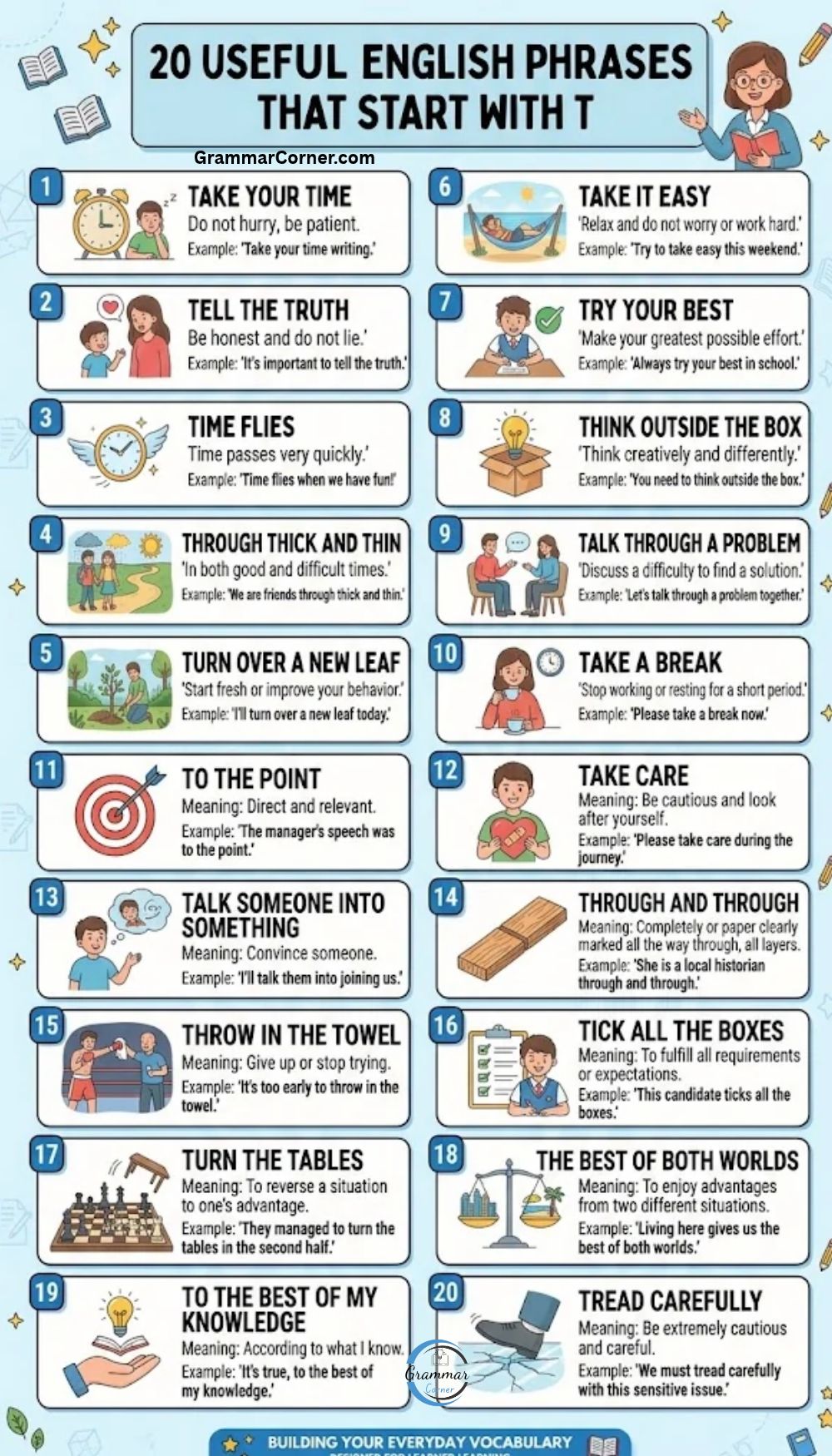
- Take your time – do something without rushing
- Tell the truth – say what is true
- Through thick and thin – during both good and difficult times
- Turn over a new leaf – make a fresh start and improve your behaviour
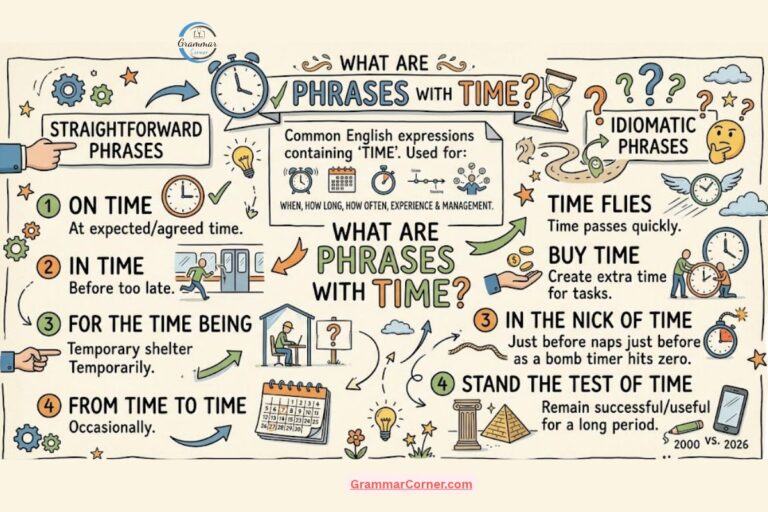
- Time flies – time passes quickly
These phrases are useful in everyday conversations, school assignments, stories, and creative writing. Learning them helps students understand English more naturally and use a wider range of expressions.
Complete List of Phrases that start with T
- 1. Take your time
- 2. Tell the truth
- 3. Time flies
- 4. Through thick and thin
- 5. Turn over a new leaf
- 6. To the point
- 7. Take it easy
- 8. Thanks a lot
- 9. Talk of the town
- 10. Take care
- 11. Time will tell
- 12. Try your best
- 13. Take a seat
- 14. Turn it down
- 15. Turn it up
- 16. Take a look
- 17. Tell me more
- 18. Think it over
- 19. To be honest
- 20. To make matters worse
- 21. To each their own
- 22. To no avail
- 23. To some extent
- 24. To tell the truth
- 25. To the best of my knowledge
- 26. To be on the safe side
- 27. To put it simply
- 28. To begin with
- 29. To make a long story short
- 30. To name a few
- 31. To be fair
- 32. To cut a long story short
- 33. To put it mildly
- 34. To some degree
- 35. To make ends meet
- 36. To keep in mind
- 37. To be on time
- 38. To no one’s surprise
- 39. To one’s delight
- 40. To make a difference
- 41. To have a point
- 42. To be in charge
- 43. To keep a promise
- 44. To break the ice
- 45. To lend a hand
- 46. To make a choice
- 47. To get the hang of it
- 48. To keep an eye on
- 49. To lose track of time
- 50. To get straight to the point
- 51. To make up your mind
- 52. To get out of hand
- 53. To keep your word
- 54. To put your foot down
- 55. Turn a blind eye
- 56. Take a rain check
- 57. Think outside the box
- 58. Throw in the towel
- 59. The best of both worlds
- 60. The ball is in your court
- 61. The last straw
- 62. The tip of the iceberg
- 63. The whole nine yards
- 64. The early bird catches the worm
- 65. The sky’s the limit
- 66. The more, the merrier
- 67. The apple of someone’s eye
- 68. The calm before the storm
- 69. The writing is on the wall
- 70. The best is yet to come
- 71. The other side of the coin
- 72. The end of the road
- 73. The grass is always greener
- 74. The last laugh
- 75. The bottom line
- 76. The final straw
- 77. The best thing since sliced bread
- 78. The devil is in the details
- 79. The light at the end of the tunnel
- 80. The world is your oyster
- 81. The proof is in the pudding
- 82. The more you know
- 83. The sooner, the better
- 84. The time of your life
- 85. The best of luck
- 86. The right place at the right time
- 87. The more the better
- 88. The sooner, the better
- 89. The first step is the hardest
- 90. The bigger picture
- 91. The best laid plans
- 92. The heart of the matter
- 93. The long and short of it
- 94. The powers that be
- 95. The same old tune
- 96. The best part of the day
- 97. The real deal
- 98. The way forward
- 99. The final word
- 100. The whole picture
- 101. The turning point
- 102. The natural order
- 103. The order of the day
- 104. The point of no return
- 105. The root of the problem
- 106. The way things are
- 107. The bigger they are, the harder they fall
- 108. The best way forward
- 109. Talk through a problem
- 110. Take a deep breath
- 111. Take a wrong turn
- 112. Take the lead
- 113. Take the plunge
- 114. Take the blame
- 115. Take responsibility
- 116. Take a chance
- 117. Take a break
- 118. Take action
- 119. Take control
- 120. Take pride in
- 121. Take notes
- 122. Take a shortcut
- 123. Take a stand
- 124. Take a step forward
- 125. Take turns
- 126. Take something seriously
- 127. Take your pick
- 128. Take the initiative
- 129. Take the opportunity
- 130. Take a chance on
- 131. Take a closer look
- 132. Take a message
- 133. Take the scenic route
- 134. Take a deep dive
- 135. Take a moment
- 136. Take the next step
- 137. Take a firm stance
- 138. Take the pressure off
- 139. Take the hint
- 140. Take a wild guess
- 141. Take it or leave it
- 142. Take the rough with the smooth
- 143. Take someone under your wing
- 144. Take the world by storm
- 145. Take a leaf out of someone’s book
- 146. Take something with a grain of salt
- 147. Take the bull by the horns
- 148. Take the cake
- 149. Take the edge off
- 150. Take the plunge into
- 151. Talk a mile a minute
- 152. Talk shop
- 153. Talk turkey
- 154. Talk someone into something
- 155. Talk someone out of something
- 156. Think on your feet
- 157. Think twice
- 158. Throw caution to the wind
- 159. Throw someone off
- 160. Turn the tables
Practicing these phrases regularly will enhance vocabulary, improve reading comprehension, and bring greater natural fluency to written and spoken English.
1. Everyday Phrases That Start With T
These practical phrases are frequently used for directions, daily habits, household routines, and simple conversations.
| Phrase | Meaning | Example Sentence |
|---|---|---|
| Turn left at the corner | Change direction to the left at a corner | Turn left at the corner to reach the library. |
| Turn right at the lights | Change direction to the right at the traffic lights | Turn right at the lights to find the park. |
| Try again tomorrow | Make another attempt the next day | If you cannot solve it today, try again tomorrow. |
| Treat someone kindly | Behave in a caring way toward someone | We should treat everyone kindly. |
| Travel by train | Go somewhere using a train | We will travel by train during the holidays. |
| Tidy up your room | Make your room neat and organized | Please tidy up your room before dinner. |
| Turn off the tap | Stop the flow of water from a tap | Turn off the tap while brushing your teeth. |
| Turn on the lights | Make the lights start working | Please turn on the lights because it is getting dark. |
| Take out the rubbish | Remove waste from the house | My brother helps take out the rubbish. |
| Try something new | Do or experience something unfamiliar | I want to try something new this weekend. |
2. Positive and Motivational Phrases That Start With T
These encouraging expressions inspire dedication, teamwork, resilience, and personal achievement.
| Phrase | Meaning | Example Sentence |
|---|---|---|
| Trust the process | Have patience while working toward a goal | Trust the process and keep practising your handwriting. |
| Triumph over adversity | Succeed despite serious difficulties | The athlete managed to triumph over adversity. |
| Turn dreams into reality | Make your ambitions come true through action | Hard work can turn dreams into reality. |
| Treasure every moment | Appreciate the time you have | Treasure every moment with your family. |
| Think positively | Focus on hopeful and constructive ideas | Think positively when facing a difficult task. |
| Try your hardest | Make your greatest effort | Try your hardest in the spelling competition. |
| Teamwork makes the dream work | Cooperation helps a group succeed | Our class learned that teamwork makes the dream work. |
| Take the first step | Begin working toward a goal | Take the first step toward learning a new language. |
| Turn failure into success | Learn from mistakes and improve | She used her experience to turn failure into success. |
| Thrive under pressure | Perform well in difficult situations | Some students thrive under pressure during competitions. |
3. Idiomatic Phrases That Start With T
Idioms offer creative and figurative ways to describe complex situations, subtle feelings, and dramatic changes.
| Phrase | Meaning | Example Sentence |
|---|---|---|
| Talk through one’s hat | Speak without knowing the facts | He was talking through his hat about the science experiment. |
| The cat’s whiskers | Someone or something considered excellent | He thinks his new bicycle is the cat’s whiskers. |
| The cold shoulder | An unfriendly way of treating someone | She gave her classmate the cold shoulder after their argument. |
| The penny drops | Someone finally understands something | When the teacher explained it again, the penny dropped. |
| The tables have turned | A situation has changed, especially who has the advantage | The tables have turned, and now our team is winning. |
| The gift of the gab | The ability to speak confidently and persuasively | Our class monitor has the gift of the gab. |
| The last word | The final statement or decision in a discussion | The principal had the last word on the school trip. |
| The upper hand | An advantage over someone else | Our team gained the upper hand in the second half. |
| Throw a spanner in the works | Cause a problem that interrupts a plan | The sudden rain threw a spanner in the works. |
| Tread on someone’s toes | Offend or interfere with someone | Be careful not to tread on your teammate’s toes. |
| Turn a blind eye to something | Pretend not to notice something wrong | We should not turn a blind eye to bullying. |
| Take someone for a ride | Trick or deceive someone | The dishonest seller tried to take the customer for a ride. |
| Tip of the tongue | Almost remembered but not yet recalled | Her name is on the tip of my tongue. |
| Touch wood | Say something to express hope that good luck continues | I have not been ill this year, touch wood. |
| Twists and turns | Unexpected changes or difficulties | The adventure was full of twists and turns. |
4. Phrases That Start With T for School and Learning
These academic expressions assist students in following classroom instructions, discussing projects, and improving analytical thinking skills.
| Phrase | Meaning | Example Sentence |
|---|---|---|
| Test your knowledge | Check how much you know | This quiz will test your knowledge of grammar. |
| Translate into English | Change words from another language into English | Translate the short paragraph into English. |
| Take part in a competition | Participate in a contest | I will take part in a competition next week. |
| Turn in your assignment | Submit your completed schoolwork | Turn in your assignment before Friday. |
| Think critically about | Examine something carefully before deciding | Think critically about the information you read. |
| Trace the steps | Follow the stages of a process | Trace the steps used to solve the equation. |
| Tell a story | Describe events in a spoken or written form | The teacher asked us to tell a story. |
| Talk about your ideas | Explain your thoughts to others | We talked about our ideas for the project. |
| Take a spelling test | Complete an assessment of spelling | We will take a spelling test on Monday. |
| Track your progress | Keep a record of improvement | Track your progress in a reading diary. |
5. Phrases That Start With T for Feelings and Relationships
These phrases help students communicate emotions sincerely, show consideration for others, and build mutual trust.
| Phrase | Meaning | Example Sentence |
|---|---|---|
| Tell someone how you feel | Explain your emotions to another person | Tell someone how you feel when you need help. |
| Thank someone from the bottom of your heart | Express deep and sincere gratitude | I thank my parents from the bottom of my heart. |
| Trust each other | Believe that others are honest and reliable | Good friends learn to trust each other. |
| Talk things out | Discuss a problem to find a solution | The friends decided to talk things out. |
| Treat others with respect | Behave politely and considerately toward others | We must treat others with respect. |
| Think of others first | Consider other people’s needs before your own | A helpful person often thinks of others first. |
| Take someone’s feelings into account | Consider how another person may feel | Take your friend’s feelings into account before joking. |
| Tell someone a secret | Share private information with someone | He decided to tell his brother a secret. |
| Thank someone for their help | Show appreciation for assistance | Remember to thank someone for their help. |
| Try to understand someone | Make an effort to understand another person’s thoughts or feelings | Try to understand someone before judging them. |
Practice Exercises: Phrases That Start With T help test your understanding, reinforce key meanings, and practice using these expressions correctly in context.
Exercise 1: Fill in the Blanks
Complete each sentence using the correct phrase from the word bank. Use each phrase only once.
- You should always ____________________, even when it is difficult.
- Please ____________________ while solving this difficult maths problem.
- After making a mistake, he decided to ____________________ and improve his behaviour.
- As we grow older, we realize that ____________________.
- Good students ____________________ for their actions.
Answers (Exercise 1)
- tell the truth
- take your time
- turn over a new leaf
- time flies
- take responsibility
Exercise 2: Match the Phrases With Their Meanings
Match each phrase in Column A with the correct meaning in Column B.
| # | Column A: Phrase | Column B: Meaning |
|---|---|---|
| 1 | Throw in the towel | A. Explain something clearly |
| 2 | Think outside the box | B. Give up |
| 3 | Turn a blind eye | C. Think creatively |
| 4 | To put it simply | D. Pretend not to notice something |
| 5 | Take the lead | E. Be the first to guide or direct others |
Answers (Exercise 2)
- B — Give up.
- C — Think creatively.
- D — Pretend not to notice something.
- A — Explain something clearly.
- E — Be the first to guide or direct others.
FAQs of Phrases That Start with T
1. What are phrases that start with T?
Phrases that start with T are groups of words beginning with the letter T that work together to express an idea. They may describe actions, emotions, experiences, or situations.
2. What are some common phrases that start with T?
Examples include take care, try your best, take a seat, time will tell, and to be honest. These expressions are useful in everyday conversations and school assignments.
3. What are some positive phrases that start with T?
Positive expressions include trust the process, triumph over adversity, treasure every moment, and turn dreams into reality. They encourage students to remain hopeful, appreciate others, and work toward their goals.
4. What are some idioms that start with T?
Examples include the cold shoulder, the penny drops, twists and turns, and the upper hand. These expressions often have meanings that go beyond their literal words.
5. What is an easy T phrase for children?
“Take your time” is an easy expression for children to understand. It means doing something without rushing. For example, a teacher might say, “Take your time while answering the questions.”
6. How can students use T phrases in sentences?
Students should learn the meaning of each expression and then use it in an appropriate sentence. Reading examples, writing original sentences, and completing short quizzes are effective ways to practise.
7. What is the difference between a phrase and an idiom?
A phrase is a group of words that work together to express an idea. An idiom is an expression whose meaning is not always clear from its individual words. For example, “take care” is a common expression, while “the tables have turned” describes a change in circumstances.
8. Why should students learn phrases that start with T?
Learning these expressions improves vocabulary, reading comprehension, speaking, and writing. It also helps students understand stories and communicate more confidently in everyday situations.
9. How many T phrases should students learn each week?
Students can begin with five to ten phrases each week. They should focus on understanding the meanings and using the expressions correctly instead of simply memorizing long lists.
10. How can students remember phrases that start with T?
Students can read each expression aloud, write its meaning, create their own example sentence, and review it regularly. Flashcards, matching activities, and quizzes can also make learning easier.