Adjectives That Start With U (Positive, Negative & Neutral)
What Are Adjectives That Start with U?
The letter U hides some of English’s most useful describing words, and they carry real weight in everyday English.
U adjectives help you praise a coworker, describe a character in a story, answer an interview question without sounding rehearsed, and write essays that feel precise instead of vague.
At Work
Praising a coworker
In Stories
Describing a character
In Interviews
Answering without sounding rehearsed
In Essays
Writing precisely instead of vaguely
The un- Shortcut
Many U adjectives start with the prefix un-, which makes them easier to learn than you might expect. Once you understand that pattern, dozens of words fall into place at once.
Quick Vocabulary Challenge
Three of these four words are adjectives. One is not. Can you spot it?
Umbrella is the odd one out. It’s a noun — a thing you hold. The other three describe something: an unusual smell, an urgent message, an upset friend. A quick test: if you can put very in front of a word and it still sounds right, it’s usually an adjective. “Very urgent” works. “Very umbrella” doesn’t.
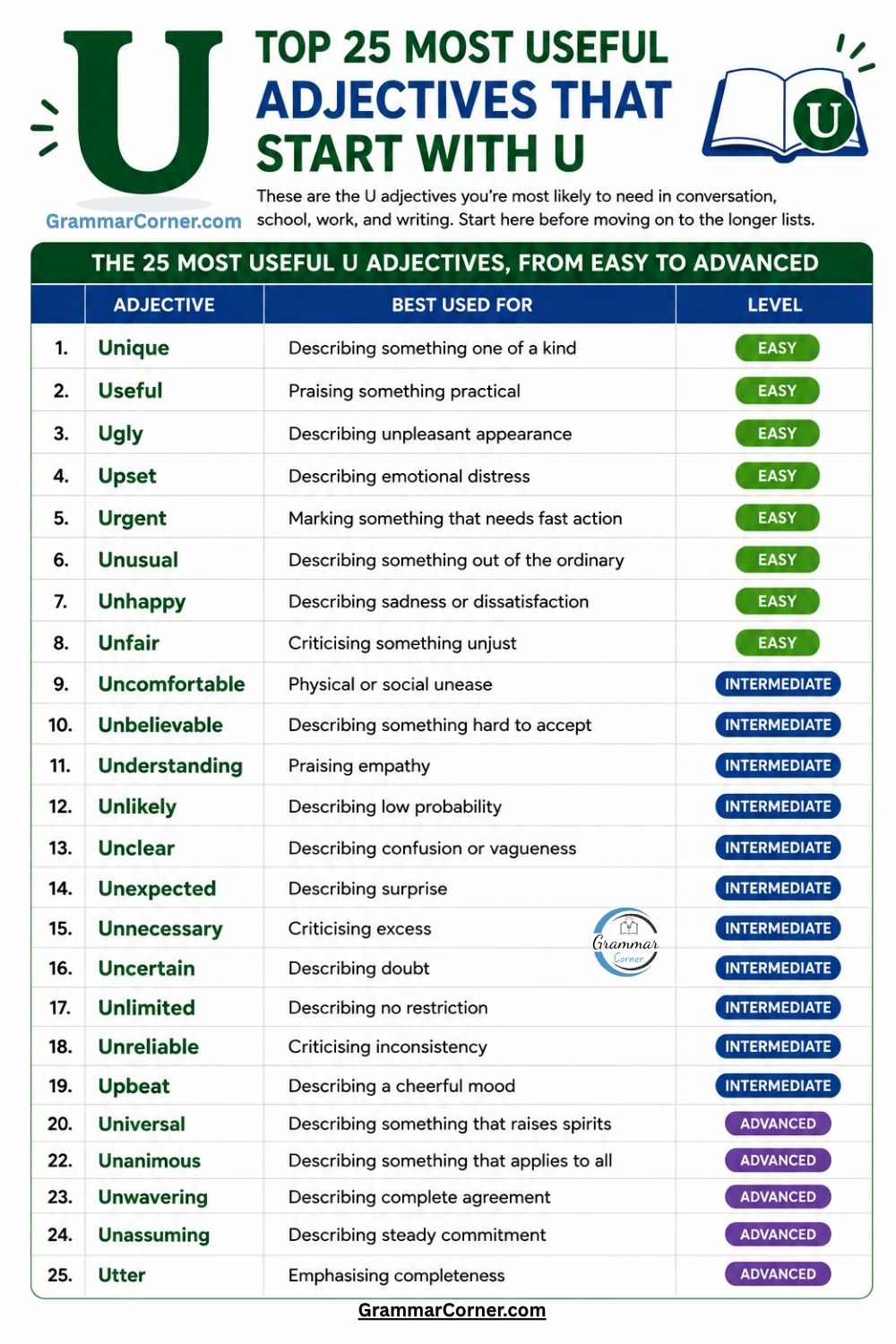
Top 25 Most Useful Adjectives That Start with U
These are the U adjectives you’re most likely to need in conversation, school, work, and writing. Start here before moving on to the longer lists.
| Adjective | Best Used For | Example Sentence |
|---|---|---|
| Unique | Describing something one of a kind Easy | Her handwriting is so unique that I recognise it instantly. |
| Useful | Praising something practical Easy | This app is surprisingly useful for splitting restaurant bills. |
| Ugly | Describing unpleasant appearance Easy | We repainted the kitchen because that mustard colour was ugly. |
| Upset | Describing emotional distress Easy | My brother was upset when the match got cancelled. |
| Urgent | Marking something that needs fast action Easy | The clinic said the test results needed an urgent review. |
| Unusual | Describing something out of the ordinary Easy | It’s unusual for the bakery to close on a Saturday. |
| Unhappy | Describing sadness or dissatisfaction Easy | Customers were unhappy about the new delivery charges. |
| Unfair | Criticising something unjust Easy | Charging students full price felt unfair to everyone. |
| Uncomfortable | Physical or social unease Intermediate | Those chairs look nice but they’re uncomfortable after ten minutes. |
| Unbelievable | Describing something hard to accept Intermediate | The traffic this morning was unbelievable. |
| Understanding | Praising empathy Intermediate | My manager was understanding when I asked for a later start. |
| Unlikely | Describing low probability Intermediate | Rain is unlikely this week, so pack light. |
| Unclear | Describing confusion or vagueness Intermediate | The instructions were unclear, so half the class did it wrong. |
| Unexpected | Describing surprise Intermediate | Her promotion was unexpected but well deserved. |
| Unnecessary | Criticising excess Intermediate | Printing four copies was unnecessary since we all had laptops. |
| Uncertain | Describing doubt Intermediate | The team is uncertain about next season’s schedule. |
| Unlimited | Describing no restriction Intermediate | The gym membership includes unlimited weekend classes. |
| Unreliable | Criticising inconsistency Intermediate | That old laptop is too unreliable for client meetings. |
| Upbeat | Describing a cheerful mood Intermediate | She kept the whole team upbeat during a difficult quarter. |
| Uplifting | Describing something that raises spirits Intermediate | The film ended on an uplifting note. |
| Universal | Describing something that applies to all Advanced | Kindness is close to a universal value. |
| Unanimous | Describing complete agreement Advanced | The vote was unanimous, which almost never happens. |
| Unwavering | Describing steady commitment Advanced | His unwavering support got her through nursing school. |
| Unassuming | Praising quiet modesty Advanced | Our unassuming neighbour turned out to be a published poet. |
| Utter | Emphasising completeness Advanced | The meeting was an utter waste of everyone’s afternoon. |
Quick Tip
Utter only works before a noun.
utter nonsense
the nonsense was utter
Adjectives like this are called attributive — they must sit in front of the noun they describe.
Positive Adjectives That Start with U
Positive
Positive adjectives express approval, admiration, or warmth. These fifteen work well for compliments, references, character descriptions, and any time you want to describe someone’s better qualities.
| Adjective | Meaning |
|---|---|
| Understanding | Able to see things from another person’s point of view |
| Unselfish | Willing to put others’ needs first |
| Uplifting | Making people feel happier or more hopeful |
| Upbeat | Cheerful and positive in outlook |
| Unstoppable | Impossible to slow down or defeat |
| Unwavering | Firm and steady, never weakening |
| Unflappable | Calm and composed under pressure |
| Unassuming | Modest, not seeking attention |
| Unpretentious | Genuine and free of showing off |
| Unifying | Bringing people or groups together |
| Untiring | Working hard without losing energy |
| Upstanding | Honest and respected in the community |
| Useful | Helpful and practical |
| Unbiased | Fair and free from prejudice |
| Unblemished | Perfect, with no faults or marks |
Word Spotlight: Unflappable
Negative Adjectives That Start with U
Negative adjectives point out flaws, problems, or unpleasant qualities. You’ll need them for honest feedback, realistic fiction, and describing difficult situations.
| Adjective | Meaning |
|---|---|
| Unreliable | Cannot be depended on |
| Unkind | Lacking care or consideration for others |
| Ungrateful | Failing to appreciate what others do |
| Unpleasant | Causing discomfort or dislike |
| Unprofessional | Behaving in a way unsuitable for the workplace |
| Unstable | Likely to change suddenly; not steady |
| Untrustworthy | Cannot be trusted with responsibility or secrets |
| Unruly | Difficult to control or discipline |
| Unscrupulous | Willing to act dishonestly to get results |
| Uncooperative | Unwilling to work with others |
| Uninspired | Dull and lacking imagination |
| Unmotivated | Lacking the drive to make an effort |
| Unbearable | Too painful or annoying to tolerate |
| Unpredictable | Changing in ways nobody can anticipate |
| Uptight | Tense and unable to relax |
| Uncouth | Rude and lacking good manners |
| Underhanded | Secretive and dishonest |
| Unhygienic | Dirty in a way that risks health |
Common Mistake
❌ He is very unpredictable, which makes him a great manager.
✅ He is very adaptable, which makes him a great manager.
Unpredictable almost always signals a problem in professional contexts. If you mean someone adjusts well to change, adaptable or flexible carries the compliment you intended.
Which Word Fits Best?
Your teammate promised to send a file three times and never did. Which adjective describes them?
Neutral Adjectives That Start with U
A neutral adjective simply reports a fact. It doesn’t praise or criticize on its own — the situation decides whether it sounds good or bad. Unpaid leave might be a relief or a hardship depending on who’s taking it.
| Adjective | Meaning | Why It Is Neutral |
|---|---|---|
| Urban | Relating to towns and cities | Describes location, not quality |
| Upper | Higher in position or rank | Purely positional |
| Underground | Below the surface of the earth | A physical fact |
| Uniform | The same throughout | Sameness can be good or dull |
| Ultimate | Final or last in a series | Depends entirely on what ends |
| Unmarried | Not currently married | A status, not a judgement |
| Unopened | Still sealed | Simply reports a condition |
| Unpaid | Not paid for | Could be volunteer work or missed wages |
| Unwritten | Not recorded in writing | Neither good nor bad by itself |
| Unspoken | Not said aloud | Context decides the tone |
| Utilitarian | Designed for use rather than beauty | Practical, though some hear it as plain |
| Ubiquitous | Found everywhere | Neutral for coffee shops, negative for litter |
| Undated | Having no date shown | A plain factual detail |
| Unsalted | Containing no added salt | A description of a product |
| Upcoming | Happening soon | Reports timing only |
Did You Know?
Ubiquitous comes from the Latin word ubique, meaning “everywhere.” It was originally used in religious writing to describe God’s presence in all places. Today you’re more likely to see it describing smartphones and chain coffee shops.
Adjectives That Start with U to Describe a Person
When you describe a person, you’re usually talking about one of a few things: their nature, their looks, how they act, how they think, or how they feel. This table groups useful U adjectives across all of those areas.
| Adjective | Meaning |
|---|---|
| Unpretentious | Genuine, not putting on an act |
| Understanding | Sympathetic to how others feel |
| Upstanding | Honest and well respected |
| Unassuming | Modest about their own abilities |
| Untidy | Messy in appearance or habits |
| Unshaven | Not having shaved recently |
| Unkempt | Neglected in appearance; not cared for |
| Uninjured | Free from physical harm |
| Unwell | Not in good health |
| Undernourished | Not getting enough food to stay healthy |
| Unwavering | Steady in belief or commitment |
| Uncooperative | Unwilling to help or take part |
| Unruly | Hard to control or manage |
| Unfriendly | Cold or distant towards others |
| Unaware | Not noticing what is happening |
| Unimaginative | Lacking creative ideas |
| Understated | Quietly stylish without drawing attention |
| Unassailable | So strong it cannot be challenged |
| Unsettled | Restless and not at ease |
| Uneasy | Slightly anxious or worried |
| Upset | Distressed or hurt by something |
| Unfazed | Not bothered or shaken by a problem |
| Unsociable | Preferring not to spend time with others |
| Unambitious | Content without seeking advancement |
| Unqualified | Lacking the necessary training or credentials |
Quick Note
Unkempt and untidy look similar but land differently. Untidy is mild and often about a room or desk. Unkempt suggests longer neglect and usually describes a person’s hair, beard, or overall appearance. Calling a colleague unkempt is far harsher than calling their desk untidy.
Adjectives That Start with U to Describe Character and Personality
Character words describe who a person is on the inside — the traits that stay consistent over time, not passing moods.
Unselfish
Puts other people’s needs ahead of their own without expecting credit.
Unassuming
Genuinely modest; doesn’t announce their own achievements.
Unwavering
Holds steady on values and commitments even when it costs them something.
Uncompromising
Refuses to lower their standards. This one swings both ways: uncompromising about safety is admirable, uncompromising about seating arrangements is exhausting.
Unflappable
Stays level-headed when everyone else is panicking.
Untiring
Keeps working with energy long after most people would quit.
Unforgiving
Holds onto grudges; slow to give second chances.
Unpredictable
Behaves in ways others can’t anticipate, which makes trust difficult.
Uptight
Tense, easily bothered by small things, uncomfortable with spontaneity.
Upright
Morally honest and principled. Slightly formal; you’ll see it more in writing than in speech.
Unscrupulous
Willing to cut ethical corners to win.
Understanding
Patient with other people’s mistakes and circumstances.
Unbiased
Judges situations fairly without letting personal feelings interfere.
Unpretentious
Comfortable being themselves; no performance, no name-dropping.
Ungracious
Rude in situations that call for warmth, such as receiving a gift or losing a game.
Guess the Meaning
A friend describes her grandmother as uncompromising about honesty. Is this praise or criticism?
It’s praise in this context. Being uncompromising about honesty means she refuses to bend the truth, ever. The word itself leans slightly negative, but the thing a person won’t compromise on changes everything. Uncompromising about ethics reads as admirable; uncompromising about which brand of tea to buy reads as difficult.
Adjectives That Start with U to Describe Yourself
Describing yourself is a balancing act. You want words that sound confident but not boastful. The safest choices are adjectives that a reference could reasonably confirm.
Strong choices for interviews and applications
- Unflappable — good for roles involving pressure, deadlines, or difficult customers.
I stay unflappable when a shift goes sideways.
- Understanding — useful for teaching, healthcare, customer service, and team roles.
- Unselfish — works well when describing teamwork or volunteer experience.
- Untiring — suits demanding roles, though it’s stronger in writing than speech.
- Upbeat — natural for customer-facing and collaborative work.
- Unbiased — valuable for research, journalism, HR, and decision-making roles.
- Unassuming — best used by someone else about you. Calling yourself unassuming is a small contradiction.
Words to handle with care
Unstoppable and unique sound impressive but say very little. An interviewer hears them constantly and they carry no evidence. If you use unique, follow it immediately with the specific thing that makes you different.
Quick Tip
Pair every self-describing adjective with a one-line example.
“I’m understanding.” — a claim
“I’m understanding — I spent two years handling billing complaints and learned that most angry callers just want to be heard.” — proof
Choose the Better Adjective
You’re writing a personal statement for a scholarship. Which sentence works better?
Option B wins because it names a specific action that backs up the adjective. Option A stacks two big words with nothing behind them, and admissions readers see that pattern hundreds of times.
Adjectives That Start with U to Describe Someone at Work
Professional vocabulary needs to be accurate. A word that’s slightly too strong sounds like flattery; one that’s slightly too weak reads as a complaint.
| Adjective | Suitable For |
|---|---|
| Unflappable | Performance reviews, high-pressure roles, customer service references |
| Unwavering | Recommendation letters describing commitment or reliability |
| Untiring | Reviews praising sustained effort on long projects |
| Unifying | Leadership and team-lead assessments |
| Unbiased | Hiring, research, HR, and audit roles |
| Understanding | Management, mentoring, and people-facing positions |
| Unselfish | Teamwork sections of reviews and references |
| Upbeat | Sales, hospitality, teaching, and team-morale contexts |
| Unassuming | Recommendation letters for quietly capable people |
| Upstanding | Character references and integrity-focused roles |
| Unpretentious | Descriptions of approachable colleagues and managers |
| Up-to-date | Describing current technical knowledge or certifications |
| Uncomplaining | Describing someone who handles difficult tasks without fuss |
| Unhurried | Roles requiring careful, methodical work such as editing or lab testing |
| Unrivalled (BrE) / Unrivaled (AmE) | Describing genuinely exceptional expertise |
| Unfailing | Describing consistency, as in “unfailing attention to detail” |
| Unmatched | Describing standout skills, used sparingly |
| Unqualified | Factual statements about credentials, not insults |
| Uncooperative | Documenting genuine team problems in formal HR records |
| Unprofessional | Formal complaints and disciplinary documentation |
Common Mistake
She has unrivaled skills, unmatched dedication, and unfailing brilliance.
She has unfailing attention to detail, which caught three costly errors last quarter.
Why: Stacking superlatives makes a reference sound unreliable. One strong adjective with evidence carries far more weight than three without.
Adjectives That Start with U to Describe a Leader
Leadership vocabulary works best when it points to something observable. These U adjectives describe how leaders decide, communicate, and hold their ground.
- Unwavering describes a leader who doesn’t abandon a decision the moment it gets difficult.
Her unwavering focus on safety changed how the whole plant operated.
- Unifying is one of the most valuable words in this group. It describes someone who pulls a divided group into one direction.
The new principal had a unifying effect on a staff that had been split for years.
- Unflinching suggests a leader who faces hard truths directly, including bad news and difficult conversations.
He gave an unflinching account of what went wrong in the second quarter.
- Unassuming describes a leader who doesn’t need credit. This is quiet praise, and it lands well in written references.
- Upstanding points to integrity — the leader others trust because their behaviour matches their words.
- Unflappable covers composure. A team watches a leader’s face during a crisis, and this word says the face stayed steady.
- Undaunted describes someone who keeps going after setbacks.
Undaunted by the first rejection, she rebuilt the proposal and won the contract.
- Untiring works for leaders who set the pace through sustained effort rather than speeches.
- Unbiased matters most where fairness is visible: promotions, hiring, conflict resolution.
- Uncompromising fits when the standard itself deserves protection — safety, ethics, or quality. Be specific about what they won’t compromise on, or the word reads as stubbornness.
Did You Know?
Undaunted comes from an old verb daunt, meaning “to tame” or “to subdue.” An undaunted person is one who hasn’t been tamed by difficulty. The base word survives mainly in the phrase “nothing daunted,” which sounds distinctly old-fashioned today.
Adjectives That Start with U to Describe Things and Objects
These words help you describe products, food, clothing, technology, and everyday items with more precision than “good” or “bad.”
| Adjective | Meaning | Example Sentence |
|---|---|---|
| Upholstered | Covered in padded fabric or leather | The upholstered dining chairs were far comfier than the wooden ones. |
| Unbreakable | Impossible to break | She bought unbreakable tumblers after the third glass shattered. |
| Ultralight | Extremely light in weight | His ultralight tent weighed less than his sleeping bag. |
| Unsweetened | Containing no added sugar | Try unsweetened yoghurt with fresh mango instead. |
| Upgraded | Improved to a better version | The upgraded router fixed the dead zone in the back bedroom. |
| Used | Previously owned | A used hatchback made more sense than financing a new one. |
| Unfinished | Not yet completed | The unfinished bookshelf still sits in the garage. |
| Underpowered | Lacking sufficient strength or performance | That laptop is underpowered for video editing. |
| Ultra-modern | Very new and advanced in style | The café had an ultra-modern look, all glass and steel. |
| Unlaced | With laces untied | He walked to the shop in unlaced trainers. |
Learning Shortcut
ultra-
means “beyond” or “extremely”
ultralight, ultra-modern, ultrasonic, ultra-thin
under-
means “not enough”
underpowered, undercooked, underpaid
Once you know these two prefixes, whole groups of words make sense immediately.
Adjectives That Start with U to Describe Feelings and Emotions
Emotion words are easy to get wrong because the difference between them is often a matter of intensity. Uneasy is mild worry; unnerved is real alarm.
| Positive Feelings | Negative Feelings | Mixed or Neutral Feelings |
|---|---|---|
| Upbeat — cheerful and optimistic | Upset — distressed or hurt | Uncertain — unsure which way things will go |
| Uplifted — emotionally raised | Unhappy — sad or dissatisfied | Unmoved — feeling no emotional reaction |
| Untroubled — free from worry | Uneasy — mildly anxious | Undecided — unable to choose |
| Unburdened — relieved of a weight | Unnerved — shaken and alarmed | Unfazed — not affected either way |
Fill in the Blank
She felt _______ about the exam results — not exactly worried, but she couldn’t stop checking her phone.
The answer is uneasy. The sentence describes mild, background anxiety rather than sadness or unbearable pain. Unbearable describes a thing, not a person’s mood — an unbearable wait, not “she felt unbearable” — and unhappy would be too strong for someone who is simply checking her phone too often.
Easy Adjectives That Start with U for Kids
These words are short, common, and easy for primary school students to use in sentences.
| Word | Simple Meaning |
|---|---|
| Ugly | Not nice to look at |
| Upset | Sad or hurt |
| Useful | Helpful |
| Under | Below something |
| Unhappy | Not happy |
| Untidy | Messy |
| Unkind | Not nice to others |
| Unlucky | Having bad luck |
| Upstairs | On a higher floor |
| Unwell | A bit sick |
Tip for Teachers and Parents
Many of these words are just a familiar word with un- attached. Show children the pair and they’ll learn ten words for the effort of five.
Then let them test the pattern: does unsad work? No — and noticing that is part of learning the rule.
Adjectives That Start with U for Creative Writing
Creative writing rewards specific words. These U adjectives carry atmosphere, which makes them useful for characters, settings, and tension.
| Word | Meaning |
|---|---|
| Umbral | Relating to shadow; shadowy |
| Uncanny | Strange in a way that feels unsettling |
| Unearthly | Not of this world; eerily strange |
| Undulating | Moving in smooth, wavelike motion |
| Unrelenting | Never easing or letting up |
| Unspoken | Felt but never said aloud |
| Untamed | Wild and never controlled |
| Unbidden | Coming without being asked for |
| Unquenchable | Impossible to satisfy |
| Unsullied | Pure and untouched by harm |
Word Spotlight: Uncanny
This is one of the most useful words in horror, mystery, and literary fiction. The unease comes from familiarity gone slightly wrong: a doll whose eyes seem to follow you, a house identical to your childhood home but with the wrong door.
Adjectives That Start with U for Resume and Interview Success
| Adjective | Meaning | Where to Use It | Where NOT to Use It |
|---|---|---|---|
| Unwavering | Steady and committed | Cover letters describing long-term commitment | Casual conversation — it sounds overly formal |
| Unflappable | Calm under pressure | Interviews for high-stress roles | Formal written resumes, where it reads as slang |
| Unbiased | Fair and objective | Applications for HR, research, journalism, auditing | Creative roles where a point of view is the job |
| Unselfish | Puts the team first | Teamwork examples in interviews | Leadership claims — it undersells decision-making |
| Untiring | Consistently energetic | Recommendation letters written about you | Your own resume — it sounds self-congratulatory |
| Up-to-date | Current with skills and standards | Skills sections and technical summaries | Describing personal qualities |
| Upbeat | Cheerful and positive | Customer-facing and teaching interviews | Serious analytical roles, where it can read as unserious |
| Understanding | Empathetic and patient | Care, education, and service applications | Roles requiring firm enforcement of rules |
| Unifying | Brings people together | Leadership and management applications | Entry-level roles with no team responsibility |
| Upstanding | Honest and principled | Character references and integrity-based roles | Skills-focused technical resumes |
Remember
Resumes reward evidence over adjectives. If you must choose between “unwavering commitment to quality” and “reduced product defects by 18% over two years,” choose the number every time. Adjectives work best in cover letters and interviews, where you have room to explain them.
Common Mistakes When Using Adjectives That Start with U
-
Confusing unique with unusual
That restaurant is very unique.
That restaurant is unique. / That restaurant is very unusual.
Unique means one of a kind — there’s only one. Something can’t be “very” one of a kind. If you want degrees, use unusual or distinctive.
-
Using utter after the noun
The confusion was utter.
It was utter confusion.
Utter only sits before a noun. It’s an attributive-only adjective.
-
Mixing up uninterested and disinterested
The judge was uninterested, so the ruling was fair.
The judge was disinterested, so the ruling was fair.
disinterested
Having nothing to gain; impartial
uninterested
Bored; not paying attention
A disinterested judge is exactly what you want; an uninterested one is a problem. This distinction is blurring in casual speech, but formal writing still holds the line.
-
Adding un- where it doesn’t belong
Her explanation was unclear and unlogical.
Her explanation was unclear and illogical.
Not every negative takes un-. English also uses:
- il- illogical
- im- impossible
- in- incorrect
- dis- dishonest
There’s no rule that predicts which — these have to be learned word by word.
-
Using unqualified as an insult by accident
He gave the project his unqualified attention.
He gave the project his undivided attention.
Unqualified has two meanings: lacking credentials, and complete or absolute (as in “an unqualified success”). Because the first meaning dominates, it’s safer to choose a clearer word.
-
Choosing unbelievable when you mean incredible
Her unbelievable performance won the competition.
Her incredible performance won the competition.
Unbelievable often carries doubt or exasperation in everyday speech, so praise can land the wrong way.
Practice Exercises
Exercise 1: Fill in the Blanks
The instructions were so _______ that nobody knew where to start.
She stayed _______ even when the projector failed halfway through her presentation.
Buying a third charger was _______ since he already had two.
The committee’s decision was _______ — all nine members agreed.
His _______ support helped her finish the degree.
Exercise 2: Choose the Correct Adjective
My cousin’s handwriting is completely (unique / unusual) — I’ve never seen anything like it.
The referee was (uninterested / disinterested), which is why both teams accepted the result.
It was (utter / uttered) chaos in the arrivals hall.
That old printer is too (unreliable / unlikely) for the office to keep using.
She felt (uneasy / unbearable) walking home after dark.
Exercise 3: Match the Adjective with the Meaning
| Adjective | Meaning |
|---|---|
| 1. Unassuming | A. Found everywhere |
| 2. Ubiquitous | B. Modest, not seeking attention |
| 3. Unflappable | C. Strange in an unsettling way |
| 4. Uncanny | D. Willing to act dishonestly |
| 5. Unscrupulous | E. Calm under pressure |
Exercise 4: Correct the Mistake
The silence between them was utter.
This coffee shop is very unique in our neighbourhood.
Her argument was unlogical from the start.
He was unfazing by the criticism.
The manager was unbias when reviewing applications.
Show Answers
Exercise 1
- unclear
- unflappable (or unfazed)
- unnecessary
- unanimous
- unwavering
Exercise 2
- unique
- disinterested
- utter
- unreliable
- uneasy
Exercise 3
- 1 – B
- 2 – A
- 3 – E
- 4 – C
- 5 – D
Exercise 4
- The silence between them was complete. Utter can’t follow the noun.
- This coffee shop is unique in our neighbourhood. Drop “very.”
- Her argument was illogical from the start.
- He was unfazed by the criticism. Unfazing isn’t a word.
- The manager was unbiased when reviewing applications.
Frequently Asked Questions
How many adjectives start with the letter U?
English has several hundred adjectives beginning with U, though most come from a small number of prefixes — un-, under-, ultra-, and up-. Standard dictionaries list roughly 400 to 600 in common use, and everyday conversation relies on perhaps 40 of them.
Why do so many U adjectives start with “un-“?
Un- is one of English’s oldest and most productive prefixes. It comes from Old English and simply means “not” or “the opposite of.” Because you can attach it to a huge range of adjectives, it generates new words easily — which is why the U section of any dictionary is dominated by un- words.
What are the most common positive adjectives starting with U?
Useful, understanding, unique, upbeat, unselfish, and uplifting appear most often in everyday positive speech. Unwavering and unflappable are common in written praise such as references and reviews.
Is “unique” a positive adjective?
Usually, yes — but not always. Unique means one of a kind, and whether that’s good depends entirely on what’s being described. “A unique talent” is praise; “a unique smell coming from the fridge” is not.
Can “unassuming” be negative?
Rarely. It’s almost always a compliment about modesty. In a context where confidence is required — a sales pitch, for instance — it could imply someone lacks presence, but that reading is uncommon.
What is the difference between “unlikely” and “improbable”?
They mean the same thing. Unlikely is the everyday choice, while improbable sounds more formal and appears more often in academic or technical writing.
Which U adjectives are best for a resume?
Up-to-date and unbiased work well in skills sections because they’re factual. Unwavering and unifying suit cover letters where you have space to explain them. Avoid unstoppable and unique — they’re common enough to be invisible.
Are there U adjectives that don’t start with “un-“?
Plenty. Urgent, urban, useful, ugly, upset, upbeat, uniform, universal, utter, ultimate, upper, unanimous, and uncanny all stand on their own without the negative prefix.
Do American and British English spell U adjectives differently?
A few differ. Unrivalled and unparalleled are common British spellings; American English uses unrivaled and generally the same unparalleled. The British doubling of the L before a suffix (travelled, unequalled) is the main pattern to watch. Pick one system and stay with it throughout a document.
What’s an easy way to remember U adjectives?
Learn them in pairs. Take a word you already know — fair, kind, tidy, expected, certain — and attach un-. You get the opposite instantly. This doubles your vocabulary without doubling the memorisation, and it’s the fastest route to fluency with U words.
See also:
The Adjective Index from A to Z
Twenty-six guides, one for every letter of the alphabet. Click a letter to open its full list.