Adverbs That Start With A (Common, Positive & Descriptive Adverbs)
Adverbs beginning with A make everyday English more precise. They show how, when, where, or to what extent an action happens.
Words such as always, almost, and away turn up in conversations, stories, instructions, and school writing, which makes A-adverbs a practical set of words for building clearer sentences.
An adverb is a word that adds information about a verb, an adjective, another adverb, or sometimes an entire sentence. An A-adverb is simply an adverb that begins with the letter A:
- actively
- almost
- already
- always
Quick Challenge
Which word is the adverb in this sentence?
Sara always completes her homework on time.
Show the answer
Answer: C) always
Why? Always tells us how often Sara completes her homework, so it functions as an adverb.
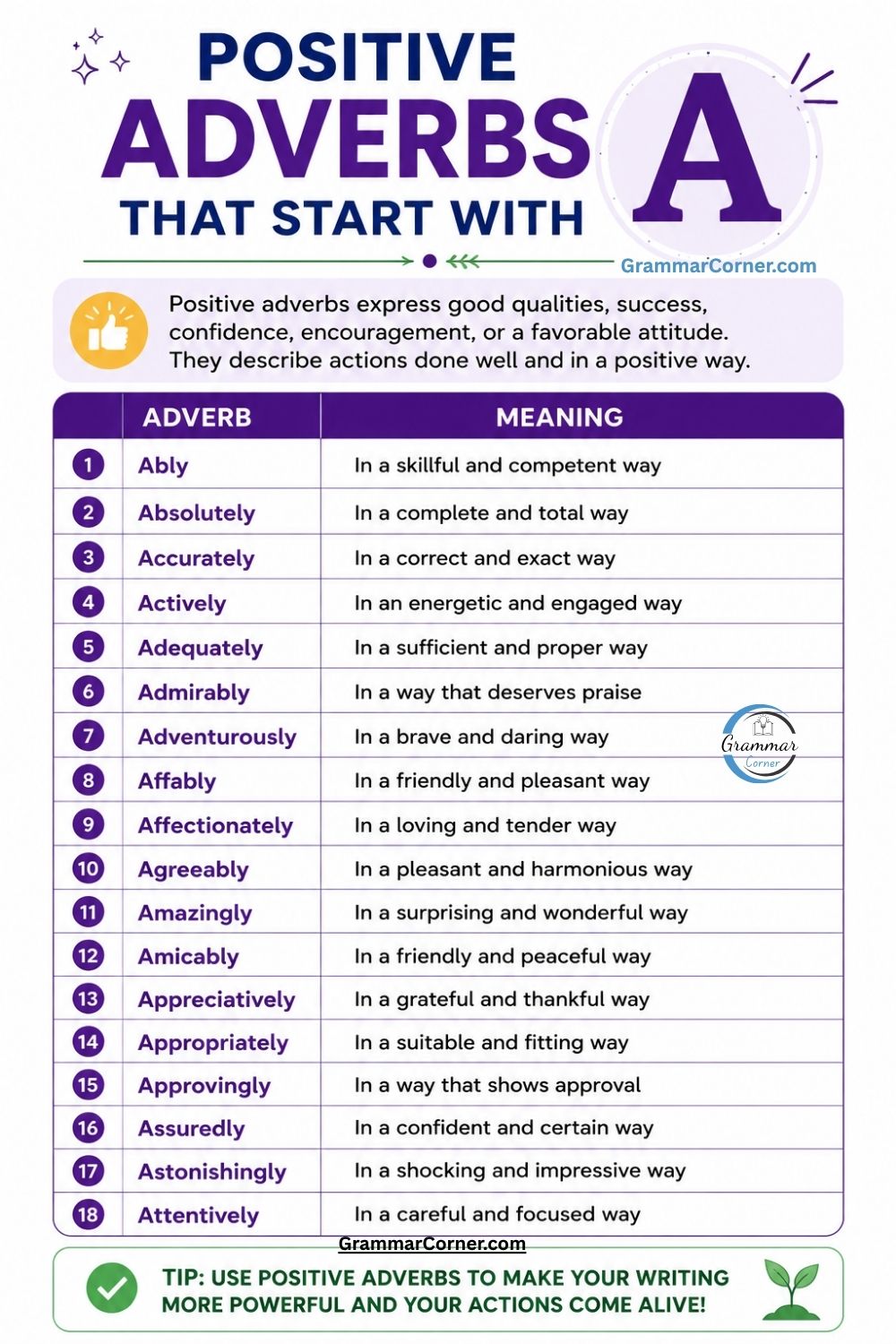
Positive Adverbs That Start with A
Positive adverbs express good qualities, success, confidence, encouragement, or a favorable attitude. A-adverbs are especially handy when you want to describe a positive action or show that something was done well.
| Adverb | Example Sentence |
|---|---|
| Ably | The captain ably guided the team through the difficult match. |
| Absolutely | She was absolutely delighted with her results. |
| Accurately | The student accurately answered all the questions. |
| Actively | The children actively participated in the activity. |
| Adequately | The volunteers adequately prepared the hall for the event. |
| Admirably | He admirably supported his classmates during the project. |
| Adventurously | The family adventurously explored the new hiking trail. |
| Affably | The host affably welcomed the visitors. |
| Affectionately | The grandmother affectionately hugged her grandchildren. |
| Agreeably | The students worked agreeably with their new classmates. |
| Amazingly | Amazingly, the students completed the project ahead of schedule. |
| Amicably | The two teams amicably resolved their disagreement. |
| Appreciatively | The audience appreciatively applauded the performers. |
| Appropriately | She appropriately thanked everyone who helped her. |
| Approvingly | The teacher nodded approvingly at the student’s effort. |
| Assuredly | The teacher spoke assuredly about the students’ abilities. |
| Astonishingly | The small team performed astonishingly well in the final. |
| Attentively | The students listened attentively to the lesson. |
| Authentically | The artist authentically represented the traditional style. |
Word Spotlight: Absolutely
Most words in the table above describe a verb — the captain guided ably, the students listened attentively. Absolutely works differently. In She was absolutely delighted, it strengthens the adjective delighted rather than an action.
That’s a useful reminder: an adverb can also make an adjective stronger or weaker, and absolutely is one of the strongest options English offers.
Quick Tip: The -le → -ly Spelling Shift
Adjectives ending in -le don’t simply add -ly. Drop the final e and add y:
- able → ably
- admirable → admirably
- agreeable → agreeably
- amicable → amicably
Writing ablely or amicablely is one of the most common spelling slips with these words.
Negative Adverbs That Start with A
Negative A-adverbs describe unpleasant behavior, poor attitudes, worry, anger, carelessness, or an undesirable way of doing something. They are useful when you’re writing about how a person behaves or how an action is carried out.
| Adverb | Meaning | Example Sentence |
|---|---|---|
| Abnormally | In an unusual or unhealthy way | The machine was functioning abnormally. |
| Abruptly | In a sudden or unfriendly way | He abruptly ended the conversation. |
| Accidentally | By mistake, without intending to | He accidentally damaged the equipment. |
| Accusingly | In a way that suggests blame | He looked at his colleague accusingly. |
| Adversely | In a harmful or unfavorable way | The decision adversely affected the small business. |
| Aggressively | In a forceful or hostile way | The player aggressively argued with the referee. |
| Agitatedly | In an upset or restless manner | She spoke agitatedly about the problem. |
| Agonizingly | In an extremely painful or difficult way | The injured player moved agonizingly slowly. |
| Aimlessly | Without a clear purpose or direction | He wandered aimlessly around the empty building. |
| Alarmingly | In a worrying or frightening way | The patient’s condition changed alarmingly quickly. |
| Angrily | In an angry manner | She angrily rejected the accusation. |
| Annoyingly | In an irritating manner | He annoyingly interrupted the speaker several times. |
| Antagonistically | In a hostile or unfriendly manner | The two groups behaved antagonistically toward each other. |
| Anxiously | In a worried or nervous manner | He anxiously waited for the results. |
| Apathetically | Without interest, care, or enthusiasm | The student responded apathetically to the discussion. |
| Apologetically | In a way that shows regret | He apologetically admitted his mistake. |
| Apprehensively | In a worried or fearful manner | She looked apprehensively at the difficult task. |
| Argumentatively | In a way that is likely to cause disagreement | He spoke argumentatively during the meeting. |
| Arrogantly | In an overly proud or superior manner | He arrogantly ignored the advice of others. |
| Artificially | In an unnatural or manufactured way | The flowers were artificially colored. |
| Audaciously | In an overly bold or reckless manner | He audaciously ignored the safety instructions. |
| Avariciously | In a greedy manner | The businessman pursued wealth avariciously. |
| Avoidably | In a way that could have been prevented | The conflict developed from an avoidably careless decision. |
| Awkwardly | In an uncomfortable or clumsy manner | She awkwardly answered the unexpected question. |
A Note on Tone
A few words in this table are only negative in certain situations, so read the whole sentence before judging the tone:
- Accidentally simply means “by mistake” — it carries no blame on its own.
- Apologetically shows regret, which is often polite rather than unpleasant.
- Audaciously can mean impressively bold as easily as recklessly bold.
Adverbs That Start with A to Describe a Person
A-adverbs can describe how a person speaks, behaves, works, reacts, or gets along with others. The words below are useful for describing someone’s manner, attitude, skills, or behavior.
| Adverb | What It Describes | Example Sentence |
|---|---|---|
| Ably | Skill or ability | She ably led the team through the project. |
| Abruptly | Sudden behavior | She abruptly left the room. |
| Absolutely | Strong agreement or certainty | She absolutely refused to give up. |
| Accidentally | Unintentional action | He accidentally sent the message to the wrong person. |
| Accurately | Correctness | He accurately answered the difficult question. |
| Actively | Participation | Sara actively participates in classroom activities. |
| Actually | Reality or truth | He actually knew the answer. |
| Admirably | Praiseworthy behavior | He admirably helped his classmates. |
| Affably | Friendly behavior | The teacher spoke affably to the new students. |
| Affectionately | Loving behavior | She affectionately greeted her grandmother. |
| Aggressively | Forceful behavior | He aggressively defended his position. |
| Alertly | Watchfulness | The guard observed the entrance alertly. |
| Altruistically | Selfless behavior | She altruistically volunteered to help others. |
| Amazingly | Impressive behavior or ability | He amazingly completed the task in one day. |
| Amicably | Friendly behavior | The two friends settled their disagreement amicably. |
| Amusingly | Humorous expression | He amusingly described his travel experience. |
| Angrily | Angry behavior | She angrily responded to the unfair criticism. |
| Anxiously | Worried behavior | He anxiously waited for the interview results. |
| Apologetically | Regretful behavior | She smiled apologetically after making the mistake. |
| Appreciatively | Gratitude | He nodded appreciatively after receiving help. |
| Appropriately | Suitable behavior | She appropriately responded to the teacher’s question. |
| Arrogantly | Overconfident behavior | He arrogantly dismissed the advice. |
| Artfully | Skillful behavior | She artfully presented her ideas. |
| Assertively | Confidence | He assertively expressed his opinion. |
| Assuredly | Confidence or certainty | She spoke assuredly during the presentation. |
| Attentively | Attention | The students listened attentively to their teacher. |
| Audaciously | Bold behavior | The athlete audaciously accepted the challenge. |
| Authoritatively | Confidence or authority | The principal spoke authoritatively to the students. |
| Automatically | Action without conscious control | She automatically checked her notes before speaking. |
| Awkwardly | Clumsy or uncomfortable behavior | He awkwardly introduced himself to the guests. |
Choose the Word to Fit the Person
Several words in this table sound similar but land very differently on the reader. Assertively and aggressively both describe someone standing their ground, yet only one of them is a compliment. The same goes for audaciously and arrogantly.
When you’re writing about a real person — in a report, a reference, or a school profile — read the sentence back and ask whether the adverb describes the behavior or quietly judges the person.
5-Letter Adverbs That Start with A
Five-letter adverbs beginning with A are useful for students who are learning to spot word patterns and build their vocabulary. The table below gives common examples with simple sentences.
| Adverb | Example Sentence |
|---|---|
| Aback | I was taken aback by the sudden news. |
| Again | Please try the question again. |
| Ahead | The teacher walked ahead of us. |
| Aloud | Read the sentence aloud. |
| Amiss | Something seems amiss today. |
| Apart | The two chairs stood apart. |
A Quick Note on These Words
Some A-words that work as adverbs have additional grammatical uses depending on the sentence. Ahead stands alone in Walk ahead, but pairs with of in ahead of us, and aback appears almost only in the fixed phrase taken aback.
Descriptive Adverbs That Start with A
Descriptive adverbs beginning with A add detail to an action or a situation. They can show the way something happens, how strongly it happens, or what the speaker thinks about it.
| Adverb | Meaning | Example Sentence |
|---|---|---|
| Abruptly | In a sudden or unexpected way | The meeting ended abruptly. |
| Absolutely | Completely or without doubt | I absolutely agree with you. |
| Accidentally | By mistake or without intention | She accidentally dropped the glass. |
| Accurately | In a correct or exact way | He answered the question accurately. |
| Actively | In an energetic or involved way | The students actively participated in class. |
| Actually | In fact or really | She actually knew the answer. |
| Admirably | In an excellent or praiseworthy way | He handled the situation admirably. |
| Affectionately | In a loving or caring way | The mother spoke affectionately to her child. |
| Aggressively | In a forceful or hostile way | The dog barked aggressively. |
| Aloud | In a voice that can be heard | Please read the paragraph aloud. |
| Amazingly | In a surprising or impressive way | The team performed amazingly well. |
| Angrily | In an angry manner | He spoke angrily to his brother. |
| Anxiously | In a worried or nervous way | She waited anxiously for the results. |
| Appropriately | In a suitable or proper way | The students behaved appropriately. |
| Attentively | With careful attention | The children listened attentively. |
| Awkwardly | In an uncomfortable or clumsy way | He awkwardly carried the large box. |
Three Different Jobs in One Table
The words above don’t all do the same work, and noticing the difference makes them much easier to place in a sentence:
- The way something happens: angrily, awkwardly, affectionately, aggressively — these sit close to the verb.
- How strongly: absolutely agree, performed amazingly well — these strengthen another word.
- The speaker’s attitude: actually — this one comments on the whole statement rather than on the action.
-ly Adverbs That Start with A
These A-adverbs all end in -ly, the most common adverb ending in English. They’re especially useful for describing how a person performs an action or behaves.
| Adverb | Example Sentence |
|---|---|
| Ably | She ably handled the difficult task. |
| Abnormally | The machine was operating abnormally. |
| Abruptly | He abruptly ended the conversation. |
| Absolutely | I absolutely agree with your decision. |
| Accidentally | He accidentally broke the glass. |
| Accurately | She accurately answered every question. |
| Actively | The students actively participated in the activity. |
| Actually | She actually remembered the answer. |
| Admirably | He admirably supported his teammates. |
| Adventurously | The family traveled adventurously through the mountains. |
| Affably | The host greeted the visitors affably. |
| Affectionately | She affectionately hugged her child. |
| Aggressively | The player aggressively challenged his opponent. |
| Agreeably | They worked agreeably with one another. |
| Alarmingly | The temperature rose alarmingly quickly. |
| Amazingly | She amazingly completed the difficult project. |
| Amicably | The two sides resolved the disagreement amicably. |
| Angrily | He angrily rejected the suggestion. |
| Anxiously | She anxiously waited for the results. |
| Apologetically | He smiled apologetically after the mistake. |
| Appreciatively | She nodded appreciatively after receiving the compliment. |
| Appropriately | She appropriately answered the teacher’s question. |
| Arrogantly | He arrogantly ignored everyone’s advice. |
| Artfully | She artfully presented her ideas. |
| Articulately | He explained his argument articulately. |
| Assuredly | He spoke assuredly during the presentation. |
| Astonishingly | The young student performed astonishingly well. |
| Attentively | The students listened attentively to the lesson. |
| Audaciously | The climber audaciously attempted the difficult route. |
| Automatically | The door automatically opened when they approached. |
| Awfully | The weather was awfully cold. |
| Awkwardly | He awkwardly introduced himself to the guests. |
Watch the Spelling: Accidentally
Accidently is a spelling to avoid. The correct form is accidentally — it comes from the adjective accidental, so the -al stays before the -ly ending.
The same pattern protects incidentally and occasionally.
Common Mistakes When Using A-Adverbs
Learning A-adverbs isn’t only about memorizing vocabulary. Students also need to see how these words behave inside a sentence. The examples below cover the mistakes that come up most often with word choice, spelling, placement, and similar-sounding adverbs.
-
Confusing Already and All Ready
✕Incorrect: I am already to leave.
✓Correct: I am all ready to leave.
Why? Already means something has happened before now. All ready means completely prepared.
-
Confusing Aloud and Allowed
✕Incorrect: Students are not aloud to use phones.
✓Correct: Students are not allowed to use phones.
Why? Allowed means permitted. Aloud means speaking so that other people can hear you.
-
Using Good Instead of Well
✕Incorrect: She sings good.
✓Correct: She sings well.
Why? Good is normally an adjective, while well is the adverb that describes how someone performs an action.
-
Confusing Almost and Most
✕Incorrect: Almost students completed the assignment.
✓Correct: Almost all students completed the assignment.
✓Correct: Most students completed the assignment.
Why? Almost means nearly. Because it’s an adverb, it can’t sit directly in front of a plural noun — it needs a word such as all, every, or none after it. Most can go straight in front of the noun on its own.
-
Incorrect Placement of Always
✕Incorrect: She goes always to school on time.
✓Correct: She always goes to school on time.
Why? Always usually comes before the main verb. With the verb be, however, it normally comes after it: She is always punctual.
-
Using Actually When You Mean Currently
✕Incorrect: I am actually working on my homework right now.
✓Correct: I am currently working on my homework.
Why? Actually means in fact or really. Currently means at the present time.
-
Confusing Accidentally and Intentionally
✕Incorrect: I accidentally broke the window because I planned to do it.
✓Correct: I intentionally broke the window because I planned to do it.
Why? Accidentally describes something done by mistake, while intentionally describes something done deliberately.
-
Confusing Apart and A Part
✕Incorrect: The two boxes were kept a part.
✓Correct: The two boxes were kept apart.
Why? Apart means separated or at a distance. A part refers to one piece or section of something.
-
Using Already Incorrectly with a Future Action
✕Incorrect: I already will finish the project tomorrow.
✓Correct: I will finish the project tomorrow.
✓Correct: I will have already finished the project by tomorrow.
Why? Already points to something that is complete before a particular moment, so it doesn’t fit a plain statement about the future.
-
Confusing Alone and Along
✕Incorrect: He walked alone the river.
✓Correct: He walked along the river.
Why? Alone means without another person. Along shows movement beside or through something, as in along the river.
Practice Exercises
Use the activities below to review A-adverbs and check your understanding. Try each exercise before opening the answer key.
1. Fill in the Blanks
Choose the most suitable adverb from the word bank and type it into each gap.
- Word bank
- always
- accidentally
- already
- aloud
- carefully
-
Please read the instructions .
-
I have completed my homework.
-
Sara helps her classmates.
-
He dropped his phone.
-
Check your answers before submitting your work.
2. Choose the Correct Adverb
Tap the adverb that best completes each sentence.
-
The students listened __________ to the teacher.
-
Please speak __________ so everyone can hear you.
-
She __________ forgot to bring her notebook.
-
We have __________ finished the exercise.
-
The children walked __________ toward the playground.
3. Match the Adverb with Its Meaning
Pick the meaning that belongs to each adverb.
-
Always
-
Accidentally
-
Abruptly
-
Attentively
-
Absolutely
4. Correct the Mistake
Rewrite each sentence using the correct A-adverb, then open the answer key to compare.
- She sings good in the school concert.
- The students are not aloud to leave early.
- He goes always to the library after class.
- I am already to start the lesson.
- The two children sat a part from each other.
Show the answer key
1. Fill in the Blanks
- aloud
- already
- always
- accidentally
- carefully
2. Choose the Correct Adverb
- A) attentively
- B) aloud
- A) accidentally
- A) already
- A) ahead
3. Match the Adverb with Its Meaning
- Always — B (Every time)
- Accidentally — A (By mistake)
- Abruptly — C (In a sudden way)
- Attentively — D (With careful attention)
- Absolutely — E (Completely)
4. Correct the Mistake
- She sings well in the school concert.
- The students are not allowed to leave early.
- He always goes to the library after class.
- I am all ready to start the lesson.
- The two children sat apart from each other.
Frequently Asked Questions
What is an A-adverb?
What adverbs start with A and describe how an action happens?
What is the difference between aloud and allowed?
What is the difference between already and all ready?
Where should A-adverbs be placed in a sentence?
Can an adverb starting with A modify an adjective?
See also: