Transitional Phrases (Types and Examples)
What Are Transitional Phrases?
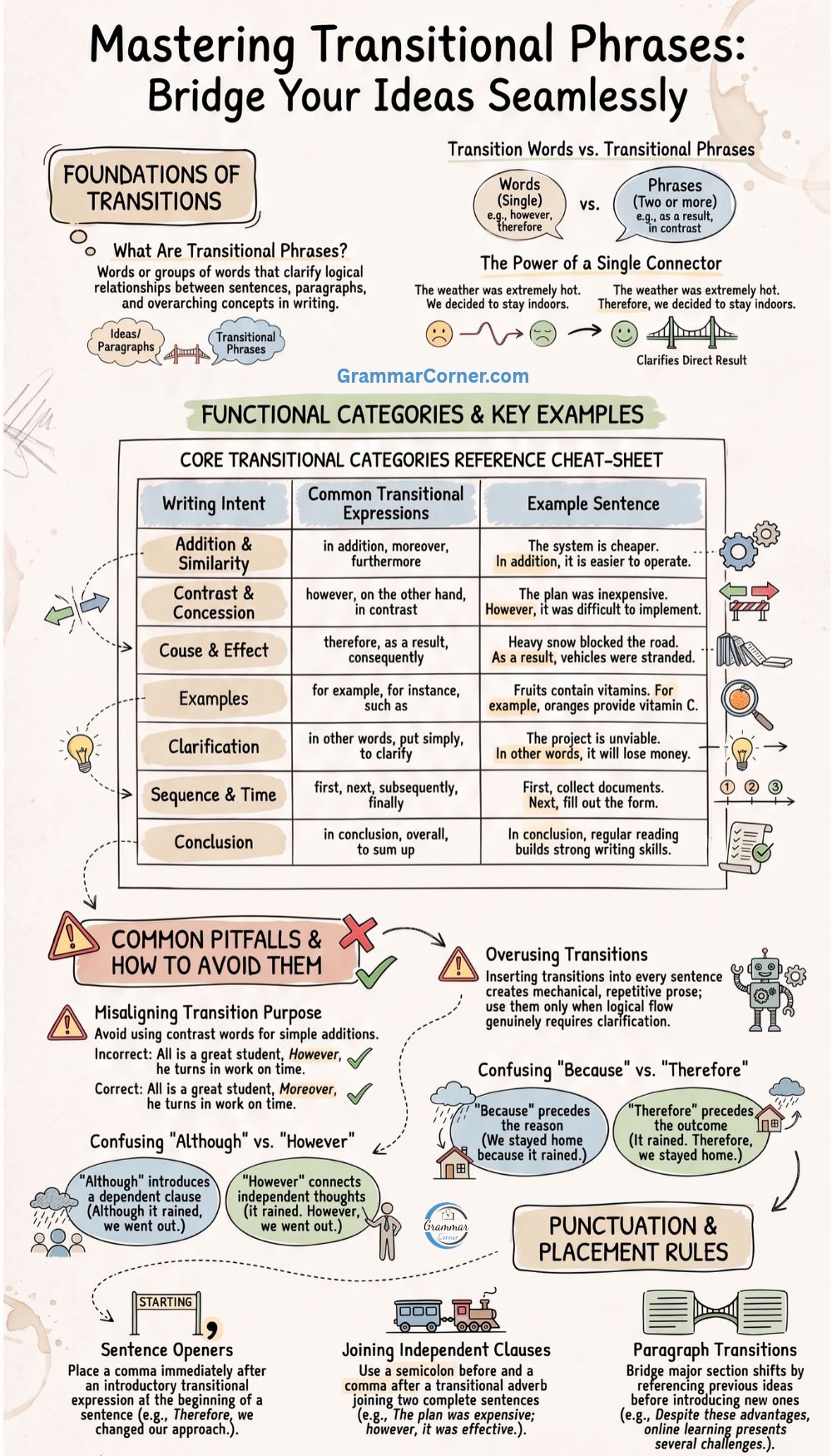
A paragraph can contain perfectly correct sentences and still feel difficult to read if the relationship between those sentences is unclear. Transitional phrases solve this problem by showing whether the writer is adding information, making a contrast, explaining a reason, showing a result, giving an example, or moving to the next point.
For example:
Without a transition:
The weather was extremely hot. We decided to stay indoors.
With a transition:
The weather was extremely hot. Therefore, we decided to stay indoors.
The word therefore makes the relationship between the two ideas clear: staying indoors was the result of the hot weather.
Transitional phrases are also called transition words, linking words, connecting words, or transitional expressions. Different sources group them in slightly different ways, but the basic purpose remains the same: they guide the reader from one thought to the next.
Why Are Transitional Phrases Important?
Good writing is not simply a collection of sentences. The ideas need to fit together logically.
Compare these two examples:
Example 1:
Julia studied hard for the examination. She was nervous. She passed the examination. She received the highest marks in the class.
The meaning can be understood, but the relationships between the ideas are not clearly expressed.
Example 2:
Julia studied hard for the examination. Although she was nervous, she remained confident. As a result, she passed the examination and, in fact, received the highest marks in the class.
The second version is easier to follow because the transitional expressions show how the ideas are connected.
Transitional phrases can help writers:
- connect related ideas;
- show contrast;
- explain cause and effect;
- introduce examples;
- add supporting information;
- show similarities;
- indicate time or sequence;
- emphasize an important point;
- clarify an idea;
- summarize information;
- introduce a conclusion;
- move from one paragraph to another.
What Is the Difference Between a Transition Word and a Transitional Phrase?
A transition word is usually a single word that connects ideas.
Examples:
- however
- therefore
- moreover
- similarly
- consequently
- meanwhile
- finally
A transitional phrase contains two or more words.
Examples:
- in addition
- for example
- as a result
- on the other hand
- in contrast
- in other words
- for this reason
- in conclusion
In everyday grammar discussions, however, the terms are often used broadly. That is why you will frequently see both single words and multi-word expressions described simply as transition words or transition phrases.
Types of Transitional Phrases
Transitional expressions can be grouped according to the relationship they establish between ideas. The most useful categories include addition, similarity, contrast, cause and effect, examples, clarification, sequence, emphasis, condition, purpose, conclusion, and summary.
Transitional Phrases for Addition
Use these when you want to add another point or piece of information.
Common examples:
- also
- in addition
- additionally
- furthermore
- moreover
- besides
- as well as
- along with
- together with
- not only … but also
- equally important
- what is more
- another point is
- apart from this
- in addition to this
- to add to this
- on top of that
- as a further point
- likewise
Example:
The new system is cheaper. In addition, it is easier to operate.
Transitional Phrases for Similarity
These expressions show that two ideas, situations, or facts are similar.
Common examples:
- similarly
- likewise
- in the same way
- in a similar way
- in the same manner
- by the same token
- equally
- correspondingly
- in like manner
- just as
- in much the same way
- along similar lines
- comparable to this
- in a similar fashion
Example:
Ali enjoys reading historical novels. Similarly, his brother prefers books about history.
Transitional Phrases for Contrast
Use these when the second idea differs from or conflicts with the first.
Common examples:
- however
- nevertheless
- nonetheless
- on the other hand
- in contrast
- by contrast
- in comparison
- conversely
- instead
- rather
- whereas
- while
- although
- even though
- though
- yet
- still
- despite this
- in spite of this
- unlike
- at the same time
- on the contrary
- alternatively
- even so
- all the same
Example:
The first plan was inexpensive. However, it was difficult to implement.
Transitional Phrases for Cause and Effect
These expressions explain why something happened or what happened because of something else.
Common examples:
- therefore
- thus
- hence
- consequently
- as a result
- as a consequence
- for this reason
- because of this
- due to this
- owing to this
- accordingly
- as a result of
- because
- since
- so
- for that reason
- resulting from this
- in consequence
- on account of this
- this is why
Example:
The road was blocked by heavy snow. As a result, several vehicles were unable to continue their journey.
Transitional Phrases for Giving Examples
These expressions introduce an example that supports or explains an idea.
Common examples:
- for example
- for instance
- such as
- to illustrate
- as an example
- as an illustration
- particularly
- especially
- including
- in particular
- one example is
- a good example of this is
- to give an example
- by way of example
- as demonstrated by
Example:
Many fruits contain important vitamins. For example, oranges are a good source of vitamin C.
Transitional Phrases for Clarification
Use these when you want to explain an idea more clearly or express it in another way.
Common examples:
- in other words
- that is
- that is to say
- to put it differently
- to put it another way
- more precisely
- more specifically
- specifically
- namely
- in simple terms
- put simply
- to clarify
- in simpler terms
- what this means is
- in practical terms
Example:
The project is financially unviable. In other words, it is unlikely to make enough money to cover its costs.
Transitional Phrases for Sequence and Order
These phrases tell the reader where an idea or event occurs in a sequence.
Common examples:
- first
- firstly
- first of all
- to begin with
- initially
- in the beginning
- at first
- second
- secondly
- next
- then
- after that
- afterward
- subsequently
- following this
- meanwhile
- before this
- previously
- earlier
- later
- eventually
- finally
- lastly
- in the meantime
- at the same time
- in the next step
- subsequently
Example:
First, collect all the required documents. Next, complete the application form. Finally, submit the application.
Transitional Phrases for Emphasis
These expressions draw attention to an important point.
Common examples:
- above all
- most importantly
- more importantly
- indeed
- in fact
- particularly
- especially
- notably
- without doubt
- undoubtedly
- clearly
- certainly
- importantly
- it is important to note
- it should be emphasized
- of particular importance
Example:
The new policy will reduce costs. More importantly, it will improve the quality of service.
Transitional Phrases for Condition
These expressions show that one event depends on another condition.
Common examples:
- if
- unless
- provided that
- providing that
- as long as
- on condition that
- in case
- in the event that
- assuming that
- given that
- otherwise
- if this happens
- under these circumstances
- in that case
Example:
You can borrow my car as long as you return it before midnight.
Transitional Phrases for Purpose
These expressions explain why an action is performed.
Common examples:
- for this purpose
- for that purpose
- in order to
- so that
- with this aim
- with this purpose in mind
- for the purpose of
- with the intention of
- with the aim of
- to ensure that
- so as to
- with a view to
Example:
The company introduced a new training program in order to improve employee performance.
Transitional Phrases for Reference
These expressions help the writer return to or focus on a particular subject.
Common examples:
- regarding
- concerning
- with regard to
- with respect to
- in relation to
- as for
- as regards
- in terms of
- when it comes to
- in connection with
- on the subject of
- with reference to
Example:
With regard to the proposed changes, the committee has requested further information.
Transitional Phrases for Alternative Ideas
These expressions introduce another possibility or option.
Common examples:
- alternatively
- otherwise
- instead
- on the other hand
- as another option
- another possibility is
- in another case
- as an alternative
- rather
- or else
- instead of this
Example:
We can travel by train. Alternatively, we can rent a car.
Transitional Phrases for Concession
Concession expressions acknowledge one point while introducing another that may seem surprising or different.
Common examples:
- although
- even though
- though
- despite this
- in spite of this
- nevertheless
- nonetheless
- even so
- granted
- admittedly
- regardless of this
- notwithstanding this
- despite the fact that
- in spite of the fact that
Example:
Although the task was difficult, the students completed it on time.
Transitional Phrases for Conclusion
These expressions signal that the writer is reaching the final point or conclusion.
Common examples:
- in conclusion
- to conclude
- in closing
- to sum up
- in summary
- in short
- in brief
- overall
- all things considered
- on the whole
- taking everything into account
- ultimately
- in the final analysis
- to summarize
- in the end
- as a final point
Example:
In conclusion, regular reading can improve vocabulary, comprehension, and writing skills.
Transitional Phrases for Summarizing
Use these to bring several points together in a shorter form.
Common examples:
- in summary
- to summarize
- in short
- in brief
- overall
- in a nutshell
- to put it briefly
- in essence
- all in all
- on the whole
- in sum
- taken together
- in general
- broadly speaking
- in simple terms
Example:
Overall, the results indicate that the new method is more effective than the old one.
Complete List of Common Transitional Phrases
The following list brings together a broad range of useful transitional expressions in one place.
| Purpose | Transitional phrases |
|---|---|
| Addition | also, in addition, additionally, furthermore, moreover, besides, as well as, along with, together with, what is more, not only…but also, equally important |
| Similarity | similarly, likewise, in the same way, in a similar way, in the same manner, by the same token, equally, correspondingly, in like manner |
| Contrast | however, nevertheless, nonetheless, in contrast, by contrast, on the other hand, conversely, instead, whereas, while, unlike, yet, still, even so |
| Cause | because, since, as, because of this, due to this, owing to this, on account of this, for this reason |
| Effect | therefore, thus, hence, consequently, as a result, as a consequence, accordingly, for that reason, in consequence |
| Examples | for example, for instance, such as, to illustrate, as an example, particularly, especially, including, in particular |
| Clarification | in other words, that is, that is to say, to clarify, more precisely, more specifically, namely, put simply, in simpler terms |
| Sequence | first, firstly, initially, to begin with, first of all, second, secondly, next, then, afterward, subsequently, finally, lastly |
| Time | meanwhile, at the same time, before this, previously, earlier, later, afterward, subsequently, eventually, in the meantime |
| Emphasis | above all, most importantly, more importantly, indeed, in fact, notably, especially, particularly, without doubt, clearly |
| Condition | if, unless, provided that, as long as, on condition that, in case, in the event that, assuming that, otherwise |
| Purpose | in order to, so that, for the purpose of, with the aim of, with the intention of, so as to, to ensure that |
| Reference | regarding, concerning, with regard to, with respect to, in relation to, as for, in terms of, when it comes to |
| Alternative | alternatively, instead, otherwise, rather, another possibility is, as an alternative, or else |
| Conclusion | in conclusion, to conclude, in closing, to sum up, in summary, overall, all things considered, ultimately |
| Summary | in short, in brief, in essence, all in all, on the whole, in a nutshell, taken together, broadly speaking |
How to Use Transitional Phrases in a Sentence
The position of a transitional phrase depends on the expression being used and the grammatical structure of the sentence.
At the Beginning of a Sentence
Many transitional adverbs and phrases can appear at the beginning of a sentence.
The company introduced a new policy. However, some employees opposed it.
The weather was poor. As a result, the match was cancelled.
A comma commonly follows an introductory transitional expression.
In the Middle of a Sentence
Some transitions can be placed within a sentence.
The proposal was, however, rejected by the committee.
The results were therefore considered unreliable.
The exact punctuation depends on the grammatical role and position of the expression.
Between Two Ideas
A transition can make the relationship between two clauses much clearer.
The first method was inexpensive, but it was unreliable.
The first method was inexpensive. However, it was unreliable.
These sentences express a similar contrast, but they use different grammatical structures.
Transitional Phrases Between Paragraphs
Transitions are not limited to individual sentences. They can also help readers move from one paragraph or section to another.
Suppose one paragraph discusses the advantages of online education and the next discusses its disadvantages.
A weak transition:
Online education has several disadvantages.
A smoother transition:
Despite these advantages, online education also presents several challenges.
The second sentence connects the new paragraph to the previous discussion instead of making the new point seem unrelated.
Transitional Phrases in Academic Writing
Transitional expressions are particularly useful in essays, research papers, reports, and other forms of academic writing because readers need to follow the writer’s reasoning.
First, the study examines the causes of the problem. Next, it considers the effects on local communities. Finally, it evaluates possible solutions.
Similarly, an argument can be developed through contrast:
The proposed approach appears inexpensive. However, its long-term costs may be considerably higher.
The important point is not to insert transitions into every sentence. Good academic writing uses them where the relationship between ideas actually needs to be made explicit. Overusing them can make writing repetitive or unnecessarily heavy.
Transitional Phrases in Everyday English
Transitions are not only for formal writing. They are common in everyday speech as well.
For example:
- Anyway, let’s talk about something else.
- By the way, did you call Ahmed?
- In other words, you want me to start again.
- After that, we went home.
- On the other hand, we could simply stay here.
Some expressions, such as moreover or consequently, sound more formal, while others, such as anyway, by the way, and then, are more natural in casual conversation.
Choosing the right expression for the situation is just as important as knowing its meaning.
Common Mistakes With Transitional Phrases
Using the Wrong Transition
A transition must express the relationship that actually exists between two ideas.
Incorrect:
The road was closed. Similarly, we took a different route.
There is no similarity here. The second idea is a result of the first.
Better:
The road was closed. Therefore, we took a different route.
Using a Contrast Transition for an Addition
Incorrect:
Ali is an excellent student. However, he regularly completes his assignments on time.
If completing assignments on time is additional evidence of being a good student, however is not appropriate.
Better:
Ali is an excellent student. Moreover, he regularly completes his assignments on time.
Using Too Many Transitions
Every sentence does not need a transition.
Weak:
Firstly, the plan is inexpensive. Secondly, it is easy to implement. Furthermore, it requires little training. Moreover, it can be introduced quickly.
Better:
The plan is inexpensive and easy to implement. Furthermore, it requires little training and can be introduced quickly.
Too many transitional expressions can make writing sound mechanical and repetitive. Effective writing uses transitions where they genuinely improve the connection between ideas.
Confusing “Although” and “However”
These two expressions both introduce contrast, but they do not work in exactly the same way.
Although normally introduces a dependent clause:
Although the weather was bad, we continued the journey.
However commonly connects two independent sentences:
The weather was bad. However, we continued the journey.
Incorrect:
Although the weather was bad. We continued the journey.
The first sentence is incomplete because although introduces a dependent clause.
Confusing “Because” and “Therefore”
Because introduces a reason.
We stayed home because it was raining.
Therefore introduces a result.
It was raining. Therefore, we stayed home.
The relationship is reversed, so replacing one with the other can change the meaning of the sentence.
Starting Every Sentence With a Transition
There is nothing inherently wrong with beginning a sentence with a transition, but doing it repeatedly can make the writing feel forced.
Instead of:
First, we collected the data. Next, we analyzed it. Then, we prepared the report. Finally, we presented the findings.
You could write:
We first collected the data and then analyzed it. After preparing the report, we presented the findings.
Use transitions to improve the flow, not simply to decorate every sentence.
Transitional Phrases and Punctuation
Punctuation depends on the type and position of the transition.
When a transitional adverb such as however, therefore, or consequently begins a sentence, it is commonly followed by a comma.
However, the plan was rejected.
Therefore, we changed our approach.
When such a word appears between two independent clauses, a semicolon may be appropriate:
The plan was expensive; however, it was effective.
A transition such as although works differently:
Although the plan was expensive, we approved it.
There is no semicolon after although because it introduces a dependent clause.
Practice Exercise 1: Choose the Correct Transitional Phrase
Choose the best answer.
Select the correct choice
1. The restaurant was expensive. ________, the food was excellent.
A. However
B. Therefore
C. For example
✅ A — However
2. The road was flooded. ________, we decided to take another route.
A. Similarly
B. As a result
C. In addition
✅ B — As a result
3. Many vegetables are rich in nutrients. ________, spinach contains several important vitamins.
A. For example
B. However
C. Nevertheless
✅ A — For example
4. The first method was successful. ________, the second method produced similar results.
A. Likewise
B. Therefore
C. Otherwise
✅ A — Likewise
5. The company reduced its expenses. ________, it was able to increase its profits.
A. In contrast
B. Consequently
C. For instance
✅ B — Consequently
Answers:
1. A — However
2. B — As a result
3. A — For example
4. A — Likewise
5. B — Consequently
Practice Exercise 2: Identify the Function
Identify the function of the bold transitional phrase.
1. In addition, the school has introduced a new library.
2. The first proposal was rejected. However, the second proposal was accepted.
3. The roads were blocked. Therefore, the delivery was delayed.
4. Several animals are endangered. For example, the tiger population has declined in many regions.
5. Finally, the researchers presented their findings.
Answers:
1. Addition
2. Contrast
3. Cause and effect / result
4. Giving an example
5. Sequence / conclusion of a sequence
Frequently Asked Questions About Transitional Phrases
-
What are transitional phrases?
Transitional phrases are words or groups of words used to connect ideas and show the relationship between them. They can express addition, contrast, cause and effect, sequence, examples, clarification, conclusion, and other relationships.
-
What are some common transitional phrases?
Common examples include in addition, for example, however, on the other hand, as a result, therefore, similarly, in contrast, in other words, for this reason, finally, and in conclusion.
-
What is the purpose of transitional phrases?
Their main purpose is to make the connection between ideas clear. They help readers understand whether the writer is adding information, comparing ideas, showing a contrast, explaining a result, giving an example, or moving toward a conclusion.
-
Are transition words and transitional phrases the same thing?
They are closely related terms. A transition word may consist of one word, such as however, while a transitional phrase may contain several words, such as as a result. In many grammar and writing resources, both are discussed under the broader term transition words.
-
Can a transitional phrase begin a sentence?
Yes. Many transitional expressions can appear at the beginning of a sentence. The appropriate punctuation depends on the grammatical structure of the expression.
-
Can transitional phrases be used in academic writing?
Yes. They are especially useful in essays, research papers, reports, and other formal writing because they help make the relationship between arguments and evidence easier to follow. However, they should not be inserted mechanically into every sentence.
-
How many transitional phrases should I use?
There is no fixed number. Use enough to make the relationship between ideas clear, but avoid using one in every sentence. If the relationship is already obvious, adding another transition may make the writing unnecessarily repetitive.
-
What is the difference between “however” and “therefore”?
However expresses contrast, while therefore expresses a result.
-
What is the difference between “for example” and “for instance”?
They have essentially the same function and are often interchangeable.
-
Can I use “and” as a transitional word?
Yes, and connects ideas by adding information. However, it is more accurately classified as a coordinating conjunction rather than a transitional adverb or transitional phrase. Its grammatical function is different from expressions such as however, therefore, and moreover.
-
Is “although” a transitional phrase?
Although can function as a linking expression that introduces a contrast, but grammatically it is a subordinating conjunction. It introduces a dependent clause and should not be treated exactly like however.
-
Can transitional phrases improve my writing?
Yes, when they are used accurately. They can make writing easier to follow by showing how one idea relates to another. But simply adding more transitions does not automatically make writing better. The transition must express the correct relationship.
-
Should every paragraph contain a transitional phrase?
No. Some paragraphs naturally connect to the preceding paragraph without needing an explicit transition. Use one when it helps the reader understand the relationship between the ideas.
-
What are the most useful transitional phrases to learn first?
For everyday and academic writing, start with a small core group:
in addition — additionfor example — examplehowever — contraston the other hand — alternative or contrastsimilarly — similarityas a result — resulttherefore — result or conclusionfor this reason — reasonin other words — clarificationfirst, next, finally — sequencein conclusion — conclusionoverall — summary