Modal Verbs Chart in English (Structure, Rules & Examples
What Are Modal Verbs?
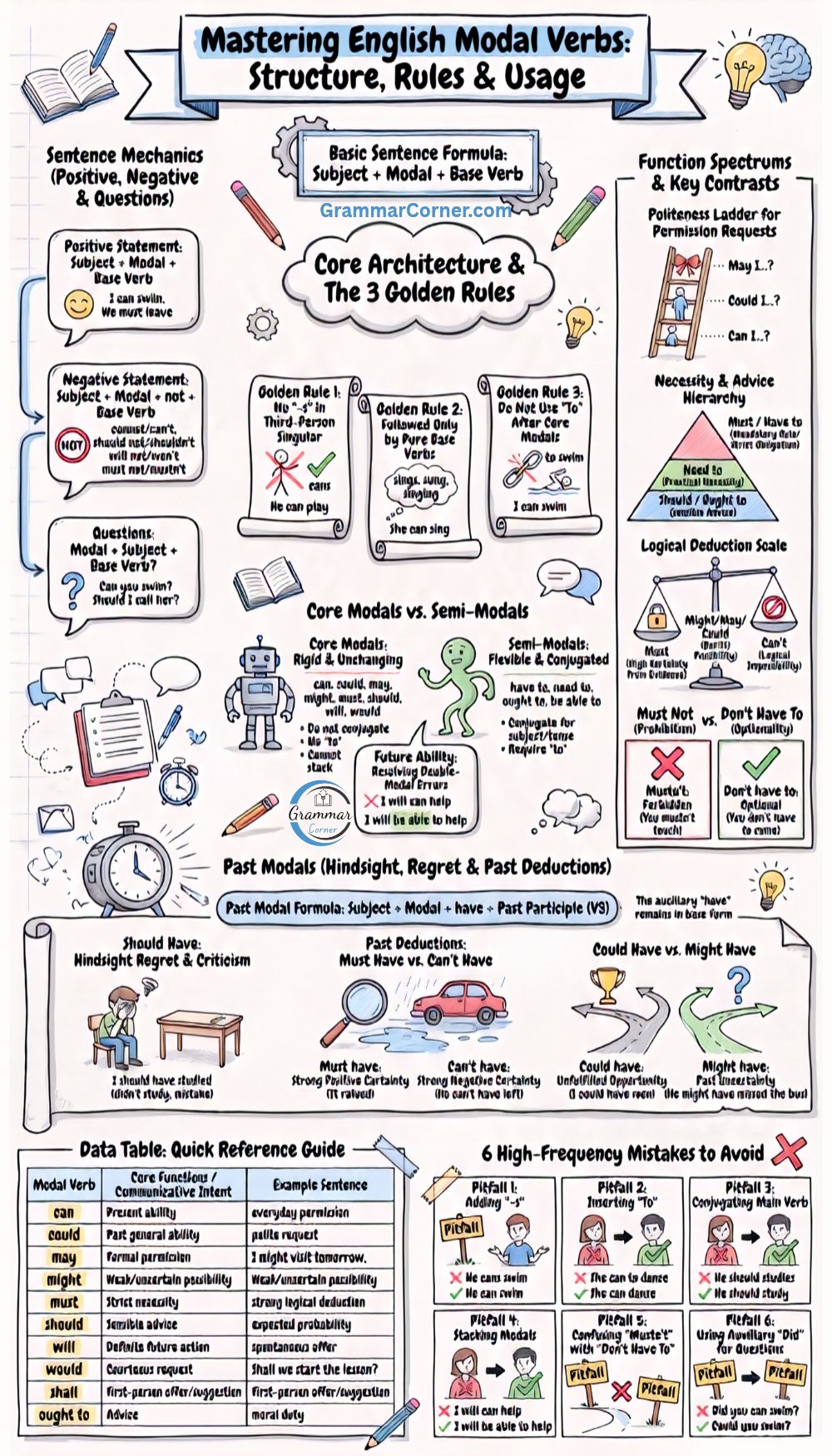
Modal verbs are auxiliary (helping) words that partner with main verbs to express nuances like ability, possibility, permission, necessity, advice, willingness, and certainty. They allow us to move beyond stating plain facts to communicate intention, likelihood, and obligation.
Essential modal auxiliaries in English:
• He should study tonight. (Advice)
• They might come later. (Possibility)
Phrases that express modal meanings but behave differently with grammar rules:
• You ought to see a doctor.
• She is able to speak three languages.
How Modal Verbs Shift Sentence Meaning
Notice how adding a modal verb transforms a factual statement into an expression of necessity or possibility:
• Modal (Necessity): “I must go to school.” ➔ Highlights an essential obligation.
• Modal (Possibility): “Julia might come tomorrow.” ➔ Expresses an uncertain possibility.
Basic Rules of Modal Verbs
Core modal verbs follow unique grammatical principles that distinguish them from ordinary verbs:
❌ Incorrect: He
❌ Incorrect: She can
❌ Incorrect: I can
Never conjugate the modal or add to after core modals: Subject + Modal + Base Verb (“She must leave,” not “She must to leaves”).
Quick Challenge
Which sentence applies the rules of modal verbs correctly? Tap an option.
See the full explanation
Answer: B. He can play football.
Grammar breakdown:
- Formula:
Subject (He) + Modal (can) + Base Verb (play) + Object (football). - Why A is incorrect: Modals are followed by base verbs, not inflected 3rd-person forms (plays).
- Why C is incorrect: Core modals take the bare infinitive, making to play ungrammatical.
How to Form Sentences with Modal Verbs
Modal verbs follow a streamlined three-part sentence architecture across positive statements, negative statements, and questions. Unlike ordinary verbs, modal verbs never require auxiliary do/does/did in questions or negatives—the modal itself handles the inversion and negation.
- I can swim.
- She should study.
- They might come.
- We must leave.
- I cannot swim.
- She should not worry.
- They might not come.
- We must not leave.
- Can you swim?
- Should I call her?
- May I come in?
- Could you help me?
- Will they arrive soon?
Can and Could: Present vs. Past Ability
Can and could are two of the most widely used modal auxiliaries in English. While both express ability, possibility, and requests, their core distinction lies in timeframe:
Describes what someone has the physical or mental capacity to do now:
- I can swim.
- Sara can speak English.
- My brother can ride a bicycle.
- Birds can fly.
Describes a general skill or power held in the past that may or may not exist today:
- When I was five, I could ride a bicycle.
- My grandfather could run very fast when he was young.
- She could read simple books at the age of six.
Never ask Do can you help me? or Can you to help me?. The modal verb is already an auxiliary, so question inversion is direct: Can you help me?
Quick Challenge
Which sentence correctly expresses an ability in the past? Tap an option.
See the full explanation
Answer: B. When I was six, I could swim.
Grammar breakdown:
- Timeframe Agreement: “When I was six” establishes a past timeframe, requiring the past modal auxiliary could rather than present can.
- Base Verb Rule: could must be followed directly by the bare infinitive swim (without to or inflections).
- Question Inversion: When forming questions with modals, place the modal first:
Modal (Can) + Subject (you) + Base Verb (help) + Object (me)?➔ “Can you help me?”
Can and Could for Permission
Beyond expressing physical and mental ability, can and could are widely used to request, grant, and discuss permission. While can is direct and common in casual contexts, could softens the tone to form more polite, deferential requests.
Used in casual conversation with friends, family, and peers:
- Can I use your pencil? (Asking)
- Can I sit here? (Asking)
- You can play outside. (Giving permission)
Used when speaking to strangers, teachers, or in professional settings:
- Could I borrow your book?
- Could I use your phone?
- Could you help me with this bag?
Can and Could for Possibility
Both modals can also describe what is possible or available under specific circumstances:
Describes what is generally possible in a given situation:
➔ It is physically possible to view them because the road offers a clear line of sight.
Describes suggestions, possible plans, or uncertain events:
• “It could rain this evening.” (Uncertain future event)
• Present/Future Possibility: “We could go to the park this afternoon.” ➔ Refers to an open option available right now.
When requesting something from someone you do not know well, prefer Could I / Could you over Can I / Can you to make your request sound courteous and considerate.
Quick Challenge
Which sentence uses could to express a present/future possibility rather than past ability? Tap an option.
See the full explanation
Answer: B. We could go to the park this afternoon.
Grammar breakdown:
- Context Clues: “This afternoon” frames the timeframe as upcoming, which shifts could into expressing a suggestion or possibility rather than past ability.
- Politeness Check: In requests (“Could I use your pen?” vs. “Can I use your pen?”), could is universally recognized as the more polite, formal phrasing.
May and Might: Possibility and Permission
May and might express situations that are possible but uncertain. While both convey likelihood in daily English (“It may rain today” / “It might rain today”), may carries a more formal tone—especially when asking for or granting permission—while might typically suggests a slightly lower degree of certainty.
Used in academic, professional, and formal contexts:
- May I come in? (Formal request)
- May I ask a question? (Polite inquiry)
- You may begin the test. (Granting permission)
Used when an outcome is possible, but you are not sure:
- I might visit my cousin tomorrow.
- She might be at home.
- We might go shopping later.
Must: Strong Obligation and Necessity
Must is one of the strongest modal verbs in English. It expresses essential requirements, official rules, and urgent personal obligations:
The speaker frames the action as mandatory or non-negotiable:
- You must wear your school uniform. (School regulation)
- We must finish our homework. (Essential task)
- You must follow the rules. (Direct instruction)
- Students must arrive on time. (Institutional rule)
• Possibility / Uncertainty: “She might come.” ➔ Open chance; unsure.
• Suggestion: “You might wear a coat.” ➔ Mild option.
• Strict Necessity: “You must wear a seat belt.” ➔ Crucial legal/safety requirement.
Use May I when you want maximum politeness in formal settings, might when discussing plans that are not yet certain, and must when communicating strict rules or urgent necessities.
Quick Challenge
Which sentence conveys a strict requirement or necessity? Tap an option.
See the full explanation
Answer: B. You must wear a seat belt.
Grammar breakdown:
- Function of Must: Must expresses mandatory obligations and binding rules (“You must wear a seat belt”).
- Function of Might: Might indicates uncertainty or a weak possibility (“She might come” vs. the definite “She will come”).
- Function of May: May handles formal permission requests (“May I leave now?” is more formal than “Can I leave now?”).
Must Not for Prohibition
Must not (or the contraction mustn’t) communicates strict prohibition—it means an action is forbidden or not allowed. In English, this is fundamentally different from expressing a lack of obligation.
- You must not run in the hallway.
- You mustn’t touch the machine.
- Students mustn’t use phones during the exam.
• Don’t Have To (Lack of Obligation): “You don’t have to bring a phone.” ➔ Bringing a phone is optional / not necessary (you may if you wish).
Must for Logical Deductions and Strong Guesses
We also use must when available evidence leads to a confident logical conclusion:
The speaker is not directly seeing the final truth, but the clues make the conclusion almost certain:
- “The lights are on. They must be at home.” (Evidence: lights on ➔ Deduction: home)
- “She has been studying all day. She must be tired.” (Evidence: all-day study ➔ Deduction: tired)
- “He has won the race. He must be very happy.” (Evidence: victory ➔ Deduction: happy)
Should for Advice and Recommendations
Should is used for advice, recommendations, expectations, and personal opinions about what is a good or sensible idea:
Frames an action as the best path without imposing a strict command:
- You should study every day. (Sensible study habit)
- You should drink more water. (Health recommendation)
- She should talk to her teacher. (Constructive guidance)
- We should leave early. (Practical suggestion)
“You must stop” is a non-negotiable rule or emergency order. In contrast, “You should take a rest” is a caring recommendation that leaves the decision up to the listener.
Quick Challenge
In the sentence “He has won the race. He must be very happy,” what does the modal verb must mean? Tap an option.
See the full explanation
Answer: B. I strongly think / conclude he is happy based on evidence.
Grammar breakdown:
- Logical Deduction: When must is paired with a state verb (like be) following clear evidence (“He has won the race”), it functions as a strong logical deduction rather than a command.
- Prohibition vs. Obligation: “You mustn’t go” means leaving is forbidden (not allowed), while “You don’t have to go” means leaving is merely optional.
- Giving Advice: Should provides friendly recommendations (“You should take a rest”), unlike mandatory directives (“You must stop”).
Should Not for Advice and Should for Expectations
While should provides positive recommendations, should not (or shouldn’t) serves as friendly counsel to avoid unwise actions. In addition to advice, should is frequently used to state what is reasonably expected to occur based on normal schedules and routines.
Used to recommend avoiding an unhelpful or harmful behavior:
- You shouldn’t stay up too late.
- You shouldn’t waste your money.
- He shouldn’t speak rudely to his teacher.
- We shouldn’t ignore the problem.
Expresses what is expected to happen under normal conditions (though not 100% guaranteed):
- The bus should arrive soon.
- The teacher should be here in a few minutes.
- The food should be ready by six o’clock.
- The train should arrive at 5:00.
Introducing Will and Would: Future Events
Will and would are versatile modals that cover future intentions, willingness, polite requests, hypothetical scenarios, and past habits.
Use will to state upcoming decisions, promises, and expected future events:
- I will call you tomorrow. (Future commitment)
- She will come after school. (Expected future action)
- We will visit Grandma next weekend. (Planned event)
• Expectation: “The package should arrive by noon.” ➔ Anticipated schedule.
“I will call you tonight” focuses on a future action, while “I called you yesterday” simply relates a past event with a standard past tense verb.
Quick Challenge
In the sentence “The train should arrive at 5:00,” what meaning does the modal verb should convey? Tap an option.
See the full explanation
Answer: A. The train is expected to arrive at 5:00.
Grammar breakdown:
- Expectation Function: When used with scheduled events (e.g., trains, buses, meals), should expresses probability and reasonable expectation rather than moral advice.
- Negative Advice: When counseling against unhealthy habits, shouldn’t fits naturally (“You shouldn’t eat too many sweets”).
- Future Reference: Will explicitly anchors actions in upcoming timeframes (“I will call you tonight”).
Will for Willingness, Offers, and Promises
In addition to marking future events, will indicates that someone is readily willing or offering to perform an action. In real-time interaction, this creates natural promises, offers of assistance, and spontaneous decisions to help.
Used to volunteer help on the spot:
- “I will help you with your homework.” (Offering assistance)
- “Don’t worry. I will carry the bag.” (Reassuring promise)
Would for Polite Requests and Imagined Scenarios
Would serves as a versatile modal for softening requests into courteous inquiries and projecting hypothetical results in second-conditional frames:
Turns direct imperatives into respectful inquiries:
- Would you help me?
- Would you open the window?
- Would you please wait here?
- Would you like some juice?
Expresses what would happen in an unreal or imagined situation:
- If I were rich, I would travel the world.
- If I had more time, I would read more books.
- If she knew the answer, she would tell us.
• Polite Request: “Would you open the door, please?” ➔ Courteous, respectful modal phrasing.
If + Past Simple, Subject + would + Base Verb ➔ “If I had wings, I would fly.” Use would to describe the unrealized result of an imagined condition.
Quick Challenge
Complete the hypothetical sentence: “If I had wings, I ______ fly.” Tap an option.
See the full explanation
Answer: A. would
Grammar breakdown:
- Hypothetical Framing: “If I had wings” describes an unreal, imagined scenario, requiring the modal would in the result clause (“I would fly”).
- Polite Requests: Would softens direct commands into courteous inquiries (“Would you open the door, please?”).
- Willingness Function: In statements like “I will help you,” will indicates a spontaneous offer or willingness to assist.
Past Habits, Suggestions, and Moral Advice: Would, Shall, and Ought To
English includes specialized modal verbs and semi-modals tailored for distinct communicative roles: would for nostalgic, repeated past routines, shall for polite first-person suggestions, and ought to for moral duty and expectations.
Describes repeated routines or customary actions in the past:
- When I was young, I would play outside every evening.
- During summer holidays, we would visit our grandparents.
Used with I or we to propose next steps or offer assistance:
- Shall we go to the park?
- Shall I carry your bag?
- Shall we start the lesson?
Carries the same meaning as should, expressing what is sensible or right:
- You ought to study harder.
- We ought to help our neighbours.
- You ought to apologise.
Grammar Comparison: Ought To vs. Standard Modals
While core modal verbs (like can, could, should, will) take the bare infinitive without to, ought is an exception that requires the to-infinitive:
• ❌ Incorrect: “You
- Shall is primarily used with I and we in questions to make polite offers or group suggestions (“Shall we watch a movie?”).
- Would describes repeated actions in the past (“When we were children, we would play together”).
Quick Challenge
Which sentence applies the semi-modal ought to correctly? Tap an option.
See the full explanation
Answer: B. You ought to study harder.
Grammar breakdown:
- Ought To Pattern:
Subject + ought to + Base Verb➔ “You ought to study harder.” - Past Habits Function: In “When we were children, we would play together every afternoon,” would expresses a habitual, repeated past action.
- Suggestions with Shall: “Shall we watch a movie?” uses shall to make a friendly group suggestion.
Semi-Modals: Have To, Need To, and Be Able To
Semi-modals (also known as modal expressions or periphrastic modals) express necessity, obligation, and ability just like primary modal verbs. However, unlike core modals, they conjugate for subject agreement (e.g., have/has, need/needs, am/is/are/was/were) and require to + base verb.
Used when an action is required by an external rule or schedule:
- I have to finish my homework.
- She has to wear a uniform.
- We have to leave early.
Expresses necessity while sounding less harsh or forceful than must:
- I need to finish my homework.
- You need to drink more water.
- He needs to practise.
Replaces can/could in tenses where modals cannot grammatically exist:
- I am able to swim. (Present)
- She was able to solve it. (Past)
- They will be able to join us. (Future)
Grammar Comparison: Core Modals vs. Semi-Modals
The crucial difference between core modals and semi-modals lies in subject inflection and future compatibility:
• Semi-Modal (Conjugates): “I have to go” / “She has to study” (Conjugates with 3rd-person singular has).
• ❌ Impossible: “I will can help you.” ➔ Two core modals cannot be stacked together.
• ✅ Correct: “I will be able to help you tomorrow.” ➔ Be able to integrates cleanly into future tenses.
Always include to with semi-modals: have to, has to, need to, needs to, be able to. Never attach to directly to core modals (e.g., avoid must to or can to).
Quick Challenge
Which sentence correctly expresses future ability in English? Tap an option.
See the full explanation
Answer: B. I will be able to help you tomorrow.
Grammar breakdown:
- Future Ability Rule: Modal verbs like can have no infinitive or future form. To express ability after will, English uses
will + be able to + Base Verb. - Subject-Verb Agreement: Semi-modals conjugate with the subject (“She has to study”, not She have to study; “We need to leave”, not We needs to leave).
Modal Verbs for Possibility and Deductions
Modal verbs give speakers the flexibility to discuss future chances, evaluate uncertain events, and make logical deductions based on available facts. The choice of modal verb reflects how confident or certain the speaker feels about the situation.
Used when something is possible but not guaranteed:
- It may rain today.
- It might rain today.
- It could rain today.
Used when clear evidence supports a strong logical conclusion:
- “She has been studying all day. She must be tired.” (Strong positive deduction)
- “He is at school. He can’t be at home.” (Strong negative deduction / impossibility)
Modals and Modal Expressions for Ability
To describe physical or mental capabilities across different timeframes, English alternates between core modals and the flexible semi-modal be able to:
- I can swim.
- She can speak English.
- I could swim when I was six.
- He could run very fast as a child.
- I will be able to drive when I am older.
- She will be able to join us tomorrow.
• ✅ Grammatical Future: “I will be able to swim.”
Modals for Permission: The Politeness Spectrum
When asking for or granting permission, modal choice signals social distance and level of formality:
• “You can use my computer.” (Informal)
• “You may leave now.” (Formal authorization)
Use might / may / could for open chances, must / can’t for logical deductions, will be able to for future abilities, and adjust can ➔ could ➔ may depending on how formal you want to be.
Quick Challenge
Which sentence correctly expresses an ability in the future? Tap an option.
See the full explanation
Answer: B. I will be able to swim when I take lessons.
Grammar breakdown:
- Future Ability: Because modal auxiliaries cannot be stacked, English uses
will + be able to + Base Verb. - Uncertain Possibility: Might highlights that an outcome is possible but uncertain (“It might rain”).
- Formality Hierarchy: Can (casual) ➔ Could (polite) ➔ May (formal).
Modal Verbs for Requests
Modal verbs allow speakers to adjust the tone of a request—moving from direct instructions to friendly inquiries and highly courteous, polite entreaties. The primary modal verbs used for making requests are can, could, will, and would.
Modals for Advice and Suggestions
When guiding others, modal verbs allow you to distinguish between sensible recommendations, gentle suggestions, and moral obligations:
Used to give practical guidance or counsel against unwise actions:
- You should practise English every day.
- You should ask your teacher.
- You shouldn’t stay up too late.
- You ought to study harder.
Used to propose gentle ideas or optional possibilities without pressure:
- You could read this book. (Gentle option)
- We could go to the library. (Friendly group suggestion)
- You could try this exercise. (Helpful alternative)
“You could try this exercise” is a friendly suggestion presenting an open choice. In contrast, “You must not try this exercise” is a strict prohibition (not allowed).
Quick Challenge
Which option transforms a direct demand into a polite request? Tap an option.
See the full explanation
Answer: B. Could you give me your book, please?
Grammar breakdown:
- Polite Requests: Modal verbs like could and would soften commands into courteous questions (“Could you give me your book, please?”).
- Suggestions with Could: Could offers low-pressure suggestions (“You could try this exercise”), whereas must not imposes a strict ban.
- Advice with Should / Ought To: Use should or ought to when recommending the best course of action (“You should practise every day”).
Modals for Obligation and Necessity
When an action is mandatory, required by a rule, or practically essential, English relies on must, have to, and need to. While their positive forms express varying shades of necessity, their negative forms carry entirely different grammatical meanings.
Used when there is an obligation or practical need:
- You must wear a helmet. (Official safety rule)
- We have to finish the project. (External deadline requirement)
- I need to buy some food. (Personal necessity)
• Don’t have to (Lack of Obligation): “You don’t have to bring your book tomorrow.” ➔ Bringing it is not necessary (you are free to do so if you wish).
Modals for Logical Deduction
When you observe physical clues or facts and make an informed inference, modal verbs indicate your level of certainty:
• might / may / could ➔ Open possibility (“It is possible, but I am not certain”)
• can’t ➔ Logical impossibility (“It is impossible based on the facts”)
Never use must not to express logical impossibility in standard British/international grammar. When evidence proves something cannot be true, always use can’t (“He can’t be at work—his car is in the driveway”).
Quick Challenge
You see Tom’s bicycle parked right outside his front door. Which sentence expresses a strong deduction based on this evidence? Tap an option.
See the full explanation
Answer: A. Tom must be home.
Grammar breakdown:
- Strong Deduction: Must indicates a confident logical inference drawn directly from concrete evidence (his bicycle parked outside).
- Prohibition vs. Absence of Obligation: “You don’t have to come” means attendance is not necessary / optional, whereas “You mustn’t come” means attendance is forbidden.
Modal Verbs in the Past
To evaluate past events, express past possibility, form deductions about completed actions, reflect on missed opportunities, or express hindsight regret, English uses the past modal construction.
Common past modal expressions:
- She may have forgotten. (Past possibility)
- He might have missed the bus. (Uncertain past chance)
- They could have won. (Missed opportunity)
- We must have taken the wrong road. (Strong past deduction)
❌ Incorrect: She might
Should Have: Regret, Criticism, and Hindsight
Should have + past participle is used to reflect on past actions and indicate that a different choice would have been better or more sensible:
Communicates that an action was desirable, but did not actually occur:
- “I should have studied for the test.” ➔ Studying was the better choice, but I did not study (Regret).
- “You should have called me.” ➔ Calling would have been the right thing to do (Criticism / Wish).
- “He should have listened to his teacher.” ➔ He failed to listen, leading to an unwanted outcome.
- “We should have left earlier.” ➔ Leaving earlier was advisable, but we delayed.
• Reality: I did not take an umbrella, it rained, and that choice turned out to be a mistake.
Every past modal follows the invariant structure: Modal + have + Past Participle (V3). Use should have for regret and hindsight, must have for strong past deductions, and could/might/may have for past possibilities.
Quick Challenge
What does the sentence “I should have taken an umbrella” imply about the past? Tap an option.
See the full explanation
Answer: B. I did not take an umbrella, and that was a mistake.
Grammar breakdown:
- Hindsight & Regret: Should have + past participle always signals that the optimal action was not completed in the past.
- Auxiliary Rule: In constructions like “She might have forgotten,” the verb following the modal must remain the bare infinitive have (never has or had).
Past Modals: Could Have, Might Have, and Must Have
When looking back at past situations, pairing modal verbs with have + past participle allows you to distinguish between missed opportunities, uncertain possibilities, and confident logical deductions based on evidence.
Describes an opportunity or ability that existed in the past, but did not actually happen:
- “I could have won the race.” ➔ Winning was possible, but I did not win.
- “We could have taken the train.” ➔ The train was an available option, but we chose otherwise.
- “She could have passed the test.” ➔ Success was within reach, but unfulfilled.
Expresses that an event possibly happened in the past, but the speaker is not sure:
- “He might have missed the bus.” (Possible, but unknown)
- “Sara might have forgotten the meeting.”
- “They might have gone home.”
- “He might have left his phone at school.”
Draws a confident, logical conclusion about a past event based on known facts:
- “She must have forgotten her keys.” (Evidence points to this conclusion)
- “They must have missed the train.” (Concluded from available information)
- “The ground is soaking wet. It must have rained.”
Comparing Degrees of Past Certainty
Notice how changing the modal shifts the speaker’s confidence when interpreting what happened in the past:
All past modal structures use: Subject + Modal (could / might / must) + have + Past Participle (V3). Remember that the auxiliary have never changes to has or had, regardless of the subject.
Quick Challenge
Which sentence expresses an uncertain possibility about what happened in the past? Tap an option.
See the full explanation
Answer: B. He might have gone home.
Grammar breakdown:
- Might Have: Expresses tentative, uncertain past possibility (“He might have missed the bus”).
- Must Have: Expresses a strong logical conclusion or deduction about the past based on facts (“She must have forgotten her keys”).
- Could Have: Indicates an unrealized opportunity or past potential that did not materialize (“She could have passed the test” ➔ passing was possible, but it did not happen).
Can’t Have: Expressing Past Impossibility and Negative Deduction
Can’t have + past participle is used when the speaker is confident that an event was impossible or simply did not happen in the past, based on known facts and logical evidence.
Used when facts make an alternative explanation unreasonable:
➔ Given the two reminders, the speaker finds it impossible or extremely unlikely that he forgot.
Used to reject claims that clash with known circumstances:
➔ The speaker considers it impossible or highly improbable that she consumed the entire cake alone.
Deduction Contrast: Must Have vs. Can’t Have
Must have and can’t have represent the two opposite poles of logical deduction in the past:
To express that something was impossible in the past, standard English uses can’t have + past participle (or couldn’t have + past participle). Avoid using must not have for logical impossibility.
Quick Challenge
What does the speaker mean by saying: “She can’t have eaten all the cake”? Tap an option.
See the full explanation
Answer: A. The speaker thinks it is impossible or very unlikely that she ate it all.
Grammar breakdown:
- Function of Can’t Have: Can’t have + past participle serves as the negative counterpart of must have, conveying that past circumstances render the action impossible or incredible.
- Formula:
Subject (She) + can't have + Past Participle (eaten) + Object (all the cake).
Common Mistakes with Modal Verbs
Because modal verbs do not conjugate or behave like typical main verbs, learners frequently encounter specific pitfalls with inflections, infinitives, auxiliary stacking, and past questions. Review these 6 high-frequency error patterns to write natural, accurate English sentences.
✅ Correct: He can swim.
Modals never take -s in 3rd-person singular (he, she, it).
✅ Correct: She can dance.
Main modals are followed by the bare infinitive (base verb without to).
✅ Correct: He should study.
The verb following a modal verb must stay in its pure base form.
✅ Correct: I will be able to help you.
Do not chain two core modals; use the semi-modal equivalent (be able to).
• You don’t have to go. ➔ Going is not necessary / optional.
Prohibition is fundamentally different from a lack of obligation.
✅ Correct: Could you swim? / Were you able to swim?
Modals form questions through direct subject-verb inversion without did.
Modal Verbs and Their Main Uses: Quick Reference Chart
Use this comprehensive summary table to review the primary communicative functions and examples for each modal and semi-modal verb in English:
| Modal Verb | Common Uses | Example Sentence |
|---|---|---|
| can | Ability, permission, possibility | I can swim. |
| could | Past ability, polite requests, possibility | Could you help me? |
| may | Formal permission, possibility | May I come in? |
| might | Possibility, uncertainty | It might rain. |
| must | Necessity, strong deduction, rules | You must study. |
| should | Advice, recommendations, expectation | You should rest. |
| will | Future events, willingness, predictions | I will help you. |
| would | Polite requests, imaginary situations, past habits | I would help you. |
| shall | Suggestions/offers (mainly with I/we) | Shall we start? |
| ought to | Advice, expectations, moral obligation | You ought to study. |
Subject + Modal + Base Verb (“She can sing”, “They must go”). Keep the modal unchanged and keep the main verb in its bare infinitive form.
Quick Challenge
Which sentence corrects all the grammatical errors in: She cans to sings very well? Tap an option.
See the full explanation
Answer: B. She can sing very well.
Grammar breakdown:
- Fix 1 (No “-s” on Modal): Remove -s from cans ➔ can.
- Fix 2 (No “to”): Core modals take the bare infinitive; remove to.
- Fix 3 (Base Verb): Change conjugated sings to the base form ➔ sing.
- Correct Result:
Subject (She) + Modal (can) + Base Verb (sing) + Adverbial (very well).
How to Choose the Right Modal
Choosing the correct modal verb starts with identifying your communicative intent. Ask yourself what core meaning you want to express—whether it is describing an ability, predicting a possibility, recommending advice, or making a polite request.
When in doubt, match the modal to the context: use should when offering friendly, sensible advice; use must / have to when failure to act results in a penalty or broken rule; and use might / could when outcomes remain uncertain.
Quick Challenge
Which modal verb best offers sensible advice in this situation? “You have an exam tomorrow. You ______ study tonight.” Tap an option.
See the full explanation
Answer: A. should
Grammar breakdown:
- Function Match: Advising a student to prepare for an upcoming exam is a recommendation, making should (or ought to) the ideal choice (“You should study tonight”).
- Alternative Functions: Might conveys mere possibility (“It might rain”), while can focuses on ability (“I can swim”).
Practice Exercises on Modal Verbs
Reinforce your understanding of English modal verbs and semi-modals with these 7 comprehensive practice modules. Test your knowledge across multiple-choice selections, sentence completions, error corrections, contextual meanings, past modal structures, and real-life communicative scenarios.
Check Exercise 1 Answers
- A. can (Expresses ability)
- B. May (Expresses formal permission)
- A. must (Expresses safety necessity / legal rule)
- A. might (Expresses weather possibility)
- A. should (Expresses practical advice)
Fill in the blanks using: can, could, may, might, must, should, or would.
Check Exercise 2 Answers
- could (Past general ability)
- must / should (Necessity or strong recommendation)
- May / Can (Asking for permission)
- might / may (Future possibility)
- Could / Would (Polite request)
- can (Present ability)
- would (Second conditional / hypothetical outcome)
Identify and correct the grammatical error in each sentence:
Check Exercise 3 Answers
- He can swim. (Modals never take -s)
- She should study harder. (Base verb required)
- I can help you. (No to after core modals)
- They might come tomorrow. (Bare infinitive without -s)
- You must wear a uniform. (No to after must)
- She will be able to drive next year. (Use semi-modal be able to for future ability)
Identify the primary communicative function of the bolded modal verb:
Check Exercise 4 Answers
- Ability (Skill)
- Advice (Recommendation)
- Possibility (Uncertain outcome)
- Necessity / Obligation (Mandatory requirement)
- Permission (Formal request)
- Polite request (Courteous inquiry)
- Imaginary situation (Hypothetical result)
Choose between mustn’t (prohibition) and don’t have to (lack of obligation):
Check Exercise 5 Answers
- don’t have to (Not necessary / optional)
- mustn’t (Forbidden / safety hazard)
- mustn’t (Strict examination prohibition)
- don’t have to (No obligation)
Complete with should have, could have, might have, or must have:
Check Exercise 6 Answers
- should have (Hindsight regret)
- might have / must have (Past possibility or deduction)
- could have (Unfulfilled past opportunity)
- must have (Strong deduction from evidence)
Check Exercise 7 Answers
- should (Advice)
- might / may / could (Weather possibility)
- mustn’t (Prohibition)
- May / Can / Could (Permission request)
- must (Strong logical deduction)
Review any incorrect answers above by verifying the three golden modal rules: never add -s, never use “to” after main modals, and always pair with a base verb.
Quick Challenge
Which sentence correctly resolves the double-modal error: She will can drive next year? Tap an option.
See the full explanation
Answer: B. She will be able to drive next year.
Grammar breakdown:
- Double Modal Prohibition: Core modals like will and can cannot be stacked consecutively.
- Semi-Modal Solution: English uses the semi-modal
will + be able to + Base Verb(drive) to indicate ability in future tenses.
Frequently Asked Questions About Modal Verbs
Get fast, clear answers to essential questions about modal verbs in English, covering core grammar mechanics, tense usage, negative forms, question inversion, and key differences between similar modals.
- Advice: should or ought to (“You should study regularly” / “You ought to study regularly”).
- Possibility: may, might, or could (“She might come tomorrow”).
- Strong Necessity: must, have to, or need to (“You must wear your uniform”).
Modal + have + Past Participle (V3):
Modal Verbs Quick Reference Chart
A quick-lookup guide summarizing the core functions and models for every major English modal verb:
| Modal Verb | Main Communicative Idea | Example Sentence |
|---|---|---|
| can | Ability, permission | I can swim. |
| could | Past ability, polite request, possibility | Could you help me? |
| may | Formal permission, possibility | May I come in? |
| might | Possibility, uncertainty | It might rain. |
| must | Necessity, strong deduction | You must study. |
| should | Advice, expectation | You should rest. |
| will | Future events, willingness | I will help you. |
| would | Polite request, hypothetical situation | I would travel. |
| shall | Suggestion, offer (with I/we) | Shall we go? |
| ought to | Advice, moral expectation | You ought to study. |
Modal verbs are versatile auxiliaries that never change form with subjects, never take to (except semi-modals), and invert directly with the subject to form questions.
Quick Challenge
Which modal verb is best suited to offer friendly advice and recommendations? Tap an option.
See the full explanation
Answer: B. should
Grammar breakdown:
- Function Breakdown:
- should / ought to = Advice & Recommendations (“You should rest”)
- must / have to = Strong Necessity & Rules (“You must study”)
- might / may / could = Possibility & Uncertainty (“It might rain”)