Infinitive Phrase (Types of Infinitives & Examples)
What Is an Infinitive Phrase?
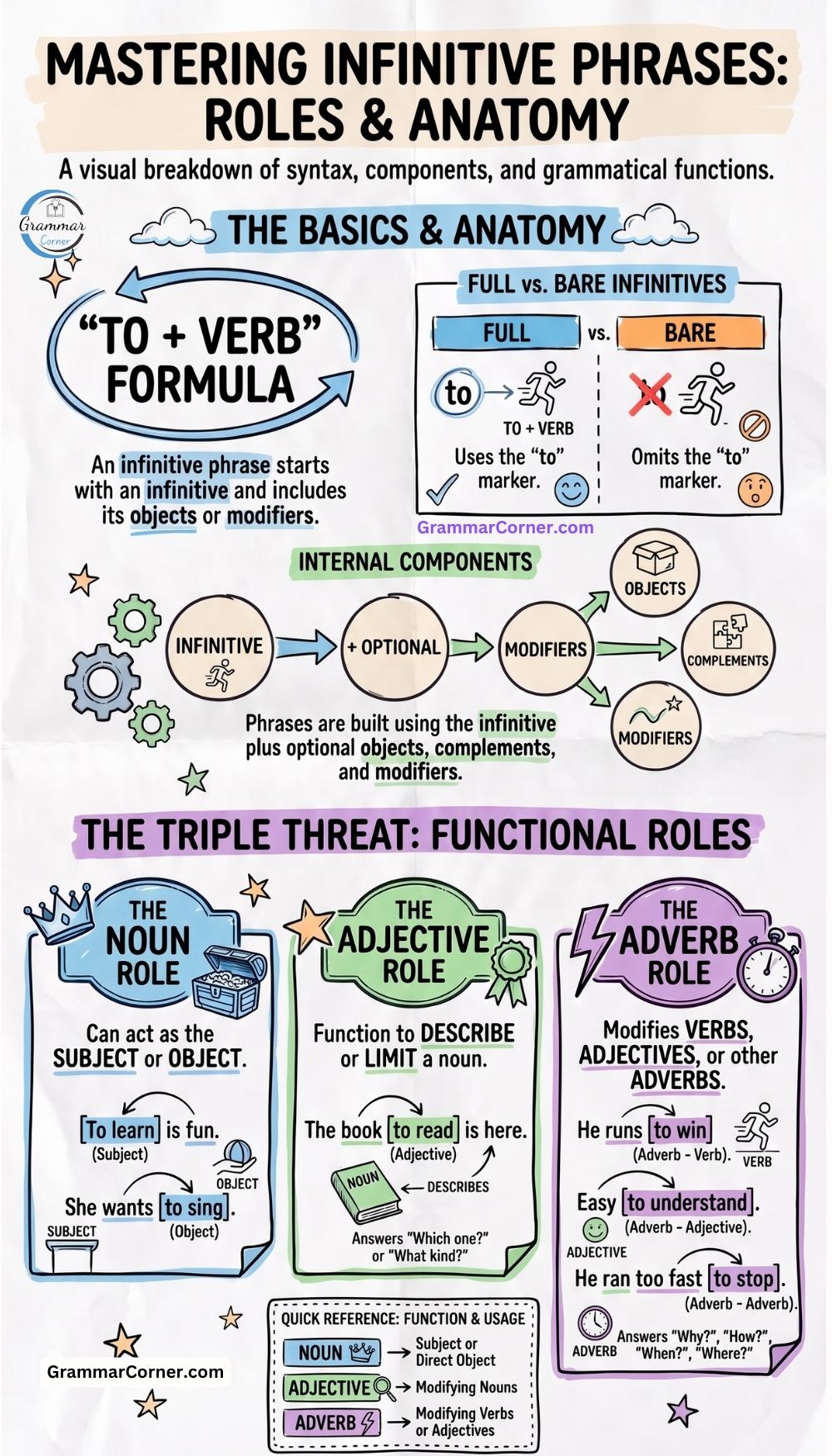
An infinitive phrase is a group of words structured around an infinitive (to + base verb) that contains any associated objects, complements, or modifiers connected with it.
These phrases make sentences more informative without requiring an additional full clause, expressing an action, purpose, intention, description, or result in a compact grammatical form.
Infinitive Phrases in Different Sentence Roles
Notice how infinitive phrases perform completely different grammatical jobs depending on context:
Understanding infinitive phrases involves more than just spotting to + verb; you must also analyze what follows the infinitive and determine the syntactic role of the complete unit.
Common Pattern of an Infinitive Phrase
to + base verb + objects / complements / modifiers
- Infinitive:
to read - Object of the Infinitive: a book
- Adverb Modifying the Infinitive: quietly
An infinitive phrase can function as a noun, an adjective, or an adverb.
Infinitive vs. Infinitive Phrase
A bare infinitive consists solely of two words (to + base verb). When additional objects, complements, or modifiers are attached, the entire group expands into an infinitive phrase.
to swim
to swim across the river
| Bare Infinitive | Expanded Infinitive Phrase |
|---|---|
to read |
to read the book |
to sing |
to sing beautifully |
to solve |
to solve the difficult problem |
to travel |
to travel around the world |
to help |
to help my younger brother |
Quick Challenge
Three of these four options contain an infinitive phrase. One contains a prepositional phrase instead. Tap the one that doesn’t belong.
See the full answer
Answer: “to the train station”
An infinitive phrase always requires the structure to + base verb (e.g., to solve, to travel, to read). In “to the train station,” the word to is a preposition followed by a noun phrase (the train station), creating a prepositional phrase rather than an infinitive phrase.
Types of Infinitives
English verbs form two main types of infinitives: full infinitives (with to) and bare infinitives (without to).
Formed with the particle to + base verb:
Full infinitives are widely used in sentences across nominal, adjectival, and adverbial roles:
- She hopes to win the competition.
- He went outside to get some fresh air.
- I need a chair to sit on.
The base form of the verb used without the marker to (e.g., go, eat, write, leave). Bare infinitives appear in three specific grammatical environments:
While broader grammatical analysis includes bare-infinitive structures as non-finite phrases, practical language analysis focuses primarily on full to-infinitive phrases.
What Can an Infinitive Phrase Contain?
Because infinitives are derived from verbs, they can take their own objects, complements, and modifiers while remaining a unified non-finite phrase:
| Internal Element | Example Infinitive Phrase |
|---|---|
| Infinitive core | to read |
| Direct object | to read the book |
| Indirect object + Direct object | to give her a gift |
| Adverb modifier | to speak quietly |
| Prepositional phrase modifier | to work in the office |
| Multiple combined elements | to finish the project before Friday |
What Are the Functions of Infinitive Phrases?
An infinitive phrase can perform three major syntactic functions: Noun, Adjective, or Adverb.
Infinitive Phrases as Nouns: Subject Position
When an infinitive phrase acts as a noun, it can occupy the subject position of a clause:
- “To travel alone can be exciting.” ➔ Subject of the predicate can be exciting.
- “To learn from mistakes is important.” ➔ Subject of the linking verb is.
Ask: What is the sentence asserting something about?
• In “To save money requires discipline,” ask: What requires discipline? ➔ To save money.
Whether an infinitive appears in its full form (to-infinitive) or bare form (after modals, perception verbs, or let/make), it can govern objects and modifiers to function as a noun, adjective, or adverb.
Infinitive Phrase as a Direct Object
An infinitive phrase can follow transitive verbs to receive the action as a direct object, answering the question “What?”:
-
“She wants to study medicine.”
➔ What does she want? To study medicine. -
“They decided to postpone the meeting.”
➔ What did they decide? To postpone the meeting.
Common Verbs Followed by Infinitives
Many English verbs pair specifically with full to-infinitives when taking non-finite objects:
- We plan to visit the museum.
- She refused to answer the question.
- He promised to help us.
Infinitive Phrase as a Subject Complement
Following a linking verb (such as is, was, became), an infinitive phrase can identify, rename, or define the subject:
| Subject | Infinitive Phrase | Syntactic Function |
|---|---|---|
| Her goal | to win | Subject complement |
| My plan | to study abroad | Subject complement |
| Their aim | to reduce costs | Subject complement |
Infinitive Phrases as Adjectives
An infinitive phrase functions adjectivally when it postmodifies a noun or pronoun, describing its purpose, nature, or intended use:
Which book? A book to read. The infinitive phrase describes and identifies the noun book.
- She needs someone to help her. (Modifies pronoun someone)
- We have several problems to solve. (Modifies noun problems)
- He brought some food to share. (Modifies noun food)
- There is no place to sit. (Modifies noun place)
Example: “I need a chair to sit on.”
➔ Which chair? The chair to sit on. The phrase modifies chair.
Adjectival Infinitive Phrase Examples
| Sentence | Infinitive Phrase | Word Modified |
|---|---|---|
| I have work to finish. | to finish | work |
| She needs a friend to talk to. | to talk to | friend |
| We found a place to stay. | to stay | place |
| He has several questions to ask. | to ask | questions |
| They need a machine to cut the wood. | to cut the wood | machine |
Infinitive Phrases as Adverbs
An infinitive phrase functions adverbially when it modifies a verb by explaining the purpose, reason, or result of the action.
1. Expressing Purpose (The “In Order To” Test)
Answering “Why did the action happen?” is the most common adverbial role:
- “He saved money to buy a car.”
- “She called me to ask a question.”
- “They arrived early to get good seats.”
- “I joined the course to improve my English.”
“She went outside to get some fresh air.” ≈ “She went outside in order to get some fresh air.”
2. Expressing Result or Consequence
In specific constructions, an infinitive phrase indicates an outcome rather than an intentional purpose:
- “He lived to see his grandchildren grow up.”
- “She worked hard to become one of the company’s best employees.”
3. Fronted Infinitive Phrases
When an adverbial infinitive of purpose opens a sentence, it is followed by a comma to separate the introductory modifier from the main clause:
- To save time, we took a taxi.
- To avoid confusion, label each file clearly.
Infinitive phrases adapt smoothly across clause environments: functioning as noun objects or complements after specific verbs, as adjectives describing nouns, or as adverbs explaining purpose and outcome.
Quick Challenge
Three of these sentences use an infinitive phrase functioning as an adverb of purpose. One functions as an adjective modifying a noun. Tap the one that doesn’t belong.
See the full answer
Answer: “I need a quiet book to read.”
In the sentences “He saved money to buy a car,” “They arrived early to get good seats,” and “To save time, we took a taxi,” the infinitive phrases function adverbially by explaining why the actions took place (purpose test: in order to).
In contrast, in “I need a quiet book to read,” the infinitive phrase to read functions adjectivally to describe and identify the noun book.
How to Identify an Infinitive Phrase
Follow this 4-step diagnostic method to locate and classify infinitive phrases accurately:
to followed directly by a base verb:
Caution: Verify that to is not functioning as a preposition governing a noun object.
to + verb if subsequent words attach to the action:• In “She wants to read the entire book before Friday,” the complete infinitive phrase is to read the entire book before Friday.
• Adjective: “I need a place to study.” ➔ Modifies the noun place.
• Adverb: “She went to the gym to exercise.” ➔ Explains why she went (Purpose).
• “The student found a quiet place to study.” ➔ Modifies noun place (Adjective).
• “To study harder requires discipline.” ➔ Functions independently as the clause Subject.
Infinitive Phrase Examples by Function
| Sentence | Infinitive Phrase | Function |
|---|---|---|
| To read widely improves vocabulary. | To read widely | Noun (Subject) |
| She wants to read widely. | to read widely | Noun (Direct object) |
| Her aim is to read more books. | to read more books | Subject complement |
| I need a book to read. | to read | Adjective |
| He went to the library to study. | to study | Adverb (Purpose) |
| She bought a notebook to record her ideas. | to record her ideas | Adjective |
| To finish on time was difficult. | To finish on time | Noun (Subject) |
| They worked late to finish the report. | to finish the report | Adverb (Purpose) |
Infinitive Phrase vs. Prepositional Phrase
The word to can function either as an infinitive particle or as a preposition:
| Example | Role of “to” | Construction Type |
|---|---|---|
| to the park | Preposition | Prepositional phrase |
| to school | Preposition | Prepositional phrase |
| to read | Infinitive marker | Infinitive |
| to study English | Infinitive marker | Infinitive phrase |
| to the teacher | Preposition | Prepositional phrase |
| to help my friend | Infinitive marker | Infinitive phrase |
to + noun / pronoun➔ Prepositional Phrase (e.g., “She walked to the office.”)to + base verb➔ Infinitive Phrase (e.g., “She went there to work.”)
Infinitive Phrase vs. Gerund Phrase
Both infinitives and gerunds (-ing forms) express actions and can function as subjects (“To swim is enjoyable” vs. “Swimming is enjoyable”). However, specific verbs and prepositions require one over the other:
| Infinitive Form | Gerund Form |
|---|---|
| to read | reading |
| to swim | swimming |
| to study | studying |
| to write | writing |
| to travel | traveling |
Infinitive Phrase vs. Verb Phrase
An infinitive originates from a verb, but an infinitive phrase does not serve as the main finite predicate of the clause:
“She is studying English.” ➔ Predicate
“She wants to study English.” ➔ Object of wants
The infinitive takes objects and modifiers like a verb, but it lacks tense markings and subject-verb agreement.
Infinitive Phrases with an Stated Actor / Performer
When the performer of the infinitive differs from the subject of the main clause, the actor is placed directly before the infinitive in the objective case:
“I want to finish the work.”
(Understood performer of finish is I)
• Main verb: want
• Stated actor: you
• Infinitive phrase: to finish the work
Verbs that commonly license this pattern include:
Infinitive Phrases After Adjectives
Infinitives frequently follow predicate adjectives as complements, providing essential context about an emotion, evaluation, judgment, or level of difficulty:
- “I am happy to help.” (Emotion / Willingness)
- “She was surprised to see him.” (Reaction)
- “This problem is difficult to solve.” (Evaluation / Challenge)
- “The instructions are easy to follow.” (Clarity / Accessibility)
Common Adjective + Infinitive Patterns
| Structural Pattern | Example Construction |
|---|---|
| adjective + infinitive | happy to help |
| adjective + infinitive phrase | difficult to understand the instructions |
| too + adjective + infinitive | too tired to work |
| adjective + enough + infinitive | strong enough to lift it |
Infinitive Phrases with “Too” and “Enough”
In degree constructions, the infinitive phrase completes the adjective by expressing sufficiency or limitation:
Infinitive Phrases for Purpose
An infinitive phrase answers the question “Why?”, functioning adverbially to state intention or purpose:
- “She went to the market to buy vegetables.”
- “He studied hard to pass the examination.” (Why did he study hard? ➔ To pass the examination)
- “We left early to avoid traffic.”
Split Infinitives: Modern Usage & Practical Rules
A split infinitive occurs when an intervening word (typically an adverb) is placed between the marker to and the base verb:
Modern English usage does not treat split infinitives as errors. While traditional prescriptivism discouraged them, placing the adverb inside the infinitive is often the most natural, unambiguous choice:
• “She decided to examine the evidence carefully.” (Unsplit – natural alternative)
Aspectual and Voice Forms of Infinitive Phrases
Focuses on the recipient or object of the non-finite action:
- She hopes to be selected for the team.
- The work needs to be completed by Friday.
- He expected to be invited to the meeting.
Emphasizes that the action is ongoing, in progress, or simultaneous:
- She seems to be waiting for someone.
- I would like to be traveling during the summer.
- He appears to be working on a new project.
Refers to an action completed prior to the time frame of the main verb:
- She seems to have forgotten the appointment. (Forgot prior to seeming)
- He claims to have completed the work.
- They were lucky to have found a solution.
How Infinitive Phrases Can Be Nested
An infinitive phrase can serve as the direct object or complement of another infinitive, creating layered, non-finite hierarchies:
• Nested Infinitive Phrase: to play the piano (Object of learn)
“He decided to try to solve the problem.”
Contains two cascading infinitives: to try governing to solve.
While nested infinitives are grammatically valid, stacking three or more in a single sentence can create processing fatigue for readers.
Infinitive Phrases and Punctuation
Punctuation with infinitive phrases depends entirely on whether the phrase appears in an introductory, medial, or final sentence position:
When an adverbial infinitive of purpose opens the sentence, separate it with a comma:
- To avoid delays, we left early.
- To understand the problem, read the instructions carefully.
Short adverbial or complement phrases at the end of a clause do not take punctuation:
Never place a comma between a main verb and the infinitive completing it:
✅ Correct: “She decided to leave early.”
Common Mistakes with Infinitive Phrases
to is the non-finite infinitive marker, not a preposition.• In “I went to school,”
to is a preposition governing the noun object school.
In “She wants to read the entire book tonight,” the phrase is not merely to read. The complete infinitive phrase encompasses its direct object (the entire book) and adverbial modifier (tonight).
• “She exercises to stay healthy.” ➔ Adverb (Purpose)
• ❌ Incorrect: “She promised helping.” ➔ ✅ Correct: “She promised to help.”
• ✅ Correct: “You should study.” / “They might arrive late.” / “We must leave now.”
In “She bought a book to read on the train,” the placement clearly modifies book or explains purpose. However, placing long infinitive modifiers far from their target nouns creates ambiguity. When modifier attachment is uncertain, rephrase the sentence directly.
Infinitive Phrases in Formal and Academic Writing
In academic, scientific, and professional prose, infinitive phrases are widely used to articulate research aims, project scopes, and experimental objectives concisely without inflating clause length:
“The researchers conducted the experiment because they wanted to test the theory.”
- “The study was designed to examine the effects of sleep.”
- “The researchers collected additional data to improve the accuracy of the results.”
- “The committee met to discuss the proposed changes.”
Infinitive Phrases vs. Other Major Phrase Types
Phrases are distinguished by their structural head—the central grammatical word that anchors the construction:
| Phrase Type | Example Phrase | Head / Main Element |
|---|---|---|
| Infinitive phrase | to read the book | infinitive (to read) |
| Gerund phrase | reading the book | gerund (reading) |
| Prepositional phrase | in the library | preposition (in) |
| Noun phrase | the old library | noun (library) |
| Adjective phrase | very difficult | adjective (difficult) |
| Adverbial phrase | very quickly | adverb (quickly) |
A Quick Comparison of Infinitive Functions
The same core grammatical structure can fulfill diverse syntactic roles:
| Function | Example Sentence | Syntactic Job |
|---|---|---|
| Noun | To learn English takes time. | Acts as the Subject |
| Noun | She wants to learn English. | Acts as the Direct Object |
| Complement | Her goal is to learn English. | Subject Complement (renames subject) |
| Adjective | She needs a book to learn English. | Modifies the noun book |
| Adverb | She studies to learn English. | Modifies verb (Expresses Purpose) |
Practice Exercises
- I want to learn Spanish.
- She went to the library to study.
- He needs a computer to complete the project.
- To understand grammar takes practice.
- They decided to postpone the meeting.
- We arrived early to get good seats.
- She has several books to read.
- He hopes to become a doctor.
- To finish the work on time was difficult.
- I need someone to help me.
| No. | Complete Infinitive Phrase |
|---|---|
| 1 | to learn Spanish |
| 2 | to study |
| 3 | to complete the project |
| 4 | To understand grammar |
| 5 | to postpone the meeting |
| 6 | to get good seats |
| 7 | to read |
| 8 | to become a doctor |
| 9 | To finish the work on time |
| 10 | to help me |
- To exercise regularly is beneficial.
- She wants to exercise regularly.
- He went outside to exercise.
- I need a place to study.
- Their goal is to win the competition.
- We arrived early to find a parking space.
- She has several questions to ask.
- To speak clearly requires practice.
| No. | Infinitive Phrase | Syntactic Function |
|---|---|---|
| 1 | To exercise regularly | Noun — Subject |
| 2 | to exercise regularly | Noun — Direct Object |
| 3 | to exercise | Adverb — Purpose |
| 4 | to study | Adjective — Modifies place |
| 5 | to win the competition | Noun — Subject Complement |
| 6 | to find a parking space | Adverb — Purpose |
| 7 | to ask | Adjective — Modifies questions |
| 8 | To speak clearly | Noun — Subject |
- She decided to leave early. (decide + infinitive)
- He can swim very well. (Modal can + bare infinitive)
- I enjoy reading novels. (enjoy + gerund)
- They hope to win the match. (hope + infinitive)
- We went to the store to buy some bread. (Infinitive of purpose)
- She is interested in learning French. (Preposition in + gerund)
- He made me apologize. (Causative make + bare infinitive)
- I need someone to help me. (Adjectival infinitive modifying someone)
Frequently Asked Questions About Infinitive Phrases
to + base verb) that includes its attached objects, complements, and modifying adverbs or prepositional phrases:
Contains infinitive
to finish + object the work + adverb quickly.
to + base verb + additional words (objects/modifiers), as seen in “to solve the difficult problem.”
to write), whereas an infinitive phrase includes that core plus all connected objects and modifiers (to write a detailed report carefully).
to + verb (to learn English), whereas a gerund phrase is centered on an -ing noun-verb form (learning English). Both can act as subjects, but specific governing verbs and prepositions strictly mandate one form over the other.
Infinitive phrases provide powerful syntactic flexibility across academic and everyday writing. By mastering their functional roles (noun, adjective, adverb) and structural boundaries, you ensure clear, concise, and grammatically precise sentences.