Adverbial Phrases (Rules, Functions and Examples)
What Is an Adverbial Phrase?
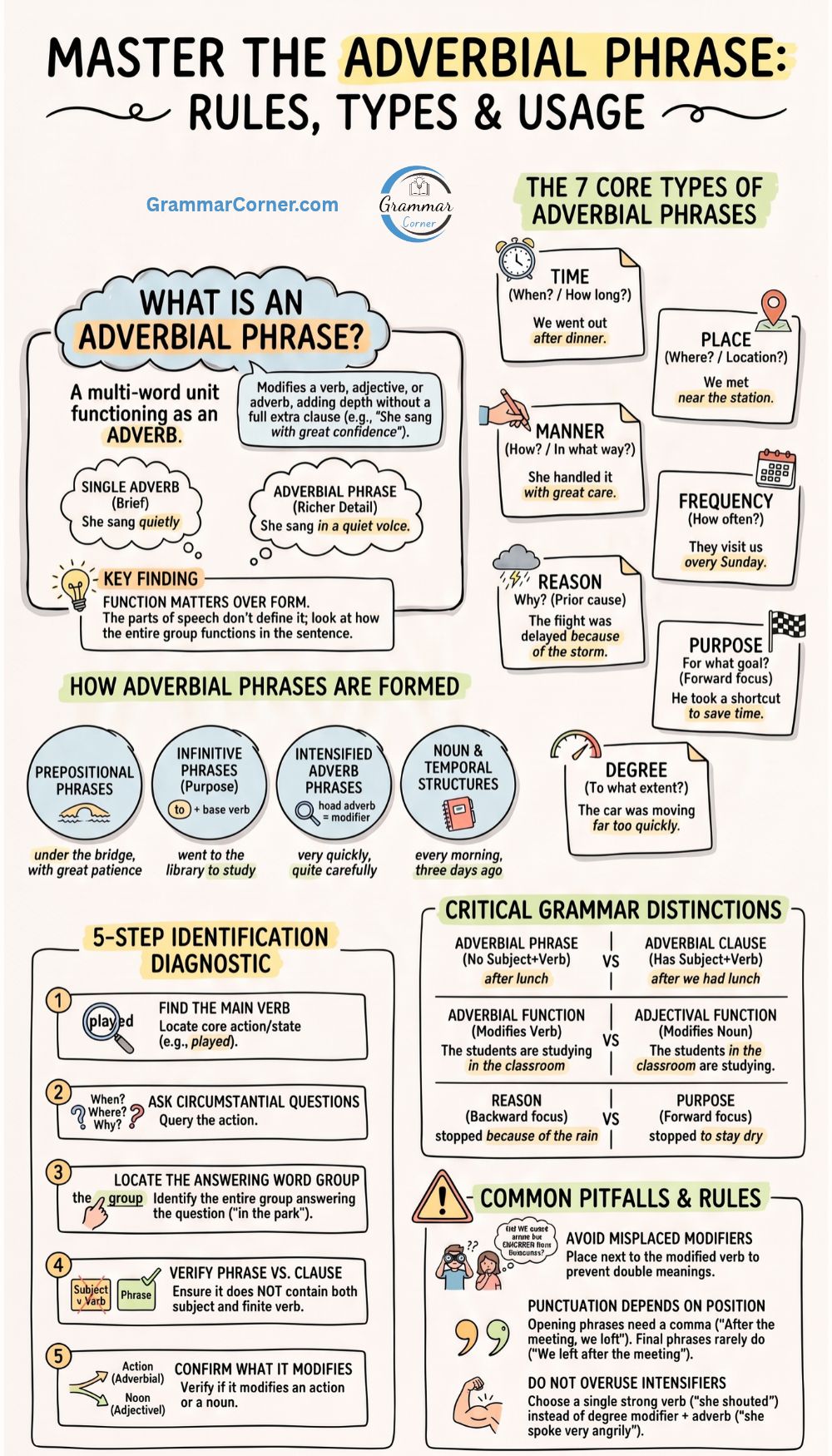
An adverbial phrase is a group of words that performs the functional job of an adverb. It can tell us when, where, how, why, how often, or to what degree an action or state happens.
Consider these varied examples:
These phrases vary in their grammatical forms—some are prepositional phrases, while others are adverb phrases—but all share a common function: they add adverbial information to the sentence.
Single Adverb vs. Adverbial Phrase
An adverbial phrase adds depth and detail without requiring an extra clause:
The entire phrase before the beginning of the ceremony works together to specify when the arrival took place.
What Does an Adverbial Phrase Modify?
While an adverbial phrase most commonly modifies a verb or verb phrase, it can also modify adjectives, other adverbs, or provide background for the broader sentence:
Quick Challenge
Three of these sentences contain an adverbial phrase modifying an action or state. One contains an adjectival phrase modifying a noun. Tap the one that doesn’t belong.
See the full answer
Answer: “The girl in the red jacket is my sister.”
In “The girl in the red jacket is my sister,” the phrase in the red jacket functions adjectivally because it postmodifies the noun girl to specify which person is meant.
In the other three options, the highlighted word groups function adverbially by modifying verbs:
- with great care modifies completed (Manner: How?)
- after lunch modifies will leave (Time: When?)
- in the garden modifies played (Place: Where?)
How Are Adverbial Phrases Formed?
An adverbial phrase does not have a single, fixed grammatical shape. Instead, several distinct types of structural phrases can perform an adverbial function within a sentence.
1. Prepositional Phrases
Prepositional phrases are among the most common constructions used as adverbials to show time, location, manner, or cause:
Specifies when the meeting took place (Time).
Specifies where they played (Location).
2. Infinitive Phrases (Expressing Purpose)
An infinitive phrase (to + base verb) functions adverbially when it explains the purpose or goal of an action:
The infinitive phrase to study answers why she went to the library.
- He saved money to buy a new laptop.
- They left early to avoid the traffic.
- I called her to ask about the meeting.
Ask: “Why did the subject perform the action?”
If the infinitive phrase directly answers that question, it is performing an adverbial function.
3. Adverb + Modifier (Intensified Adverb Phrases)
An adverbial phrase can consist of a head adverb accompanied by a premodifier (usually a degree adverb) that strengthens or nuances it:
“She finished the work very quickly.”
The central head word is the adverb quickly, and very intensifies its degree.
4. Other Noun & Temporal Structures
Noun phrases and temporal expressions can also serve as complete adverbials:
Components of an Adverbial Phrase
Because adverbial phrases can take various structural forms, they can be built from several distinct parts of speech:
Prepositions frequently introduce adverbials:
- after lunch
- under the table
- near the station
- with great enthusiasm
Nouns form temporal and frequency adverbials:
- every Sunday
- last year
- two hours later
Adverbs act as heads of adverb phrases:
- very slowly
- quite unexpectedly
- extremely carefully
Adjectives can appear inside larger adverbial structures:
- far too quickly
- much more carefully
The presence of a particular part of speech does not by itself determine whether the entire word group is adverbial. You must examine the phrase as a single functional unit within the sentence.
Types of Adverbial Phrases
Adverbial phrases are grouped according to the specific type of circumstantial information they supply about an action or state. The most important categories are time, place, manner, frequency, reason, purpose, and degree.
Tell us when an action occurs, how long it lasts, or its starting and ending points:
- We will discuss the matter after lunch.
- She moved to another city last year.
- The shop remains open until midnight.
- I saw him three days ago.
Tell us where an action occurs or where someone/something is situated:
- The children are playing in the garden.
- We parked the car near the entrance.
- A small shop stands across the street.
Explain how or in what way an action is carried out:
- She answered the question with confidence.
- The nurse handled the equipment with great care.
- He completed the task very carefully.
Indicate how often or at what intervals an action takes place:
- We visit our grandparents once a month.
- She goes swimming twice a week.
- They meet from time to time.
Explain the underlying cause or reason behind an action or situation:
- The match was canceled because of the rain.
- He stayed home due to illness.
- She opened the box out of curiosity.
Explain what outcome the subject intends to achieve (infinitive phrases are especially common here):
- She joined the course to improve her writing.
- We left early to avoid the rush-hour traffic.
- He checked the figures again in order to prevent mistakes.
Tell us how much, how intensely, or to what extent an action or quality occurs:
- The water level has risen to some extent.
- He was driving far too quickly.
- She completed the work much more carefully this time.
Adverbial Phrases at a Glance
| Type | Main Question | Example Phrase | Example Sentence |
|---|---|---|---|
| Time | When? | after dinner | We went out after dinner. |
| Place | Where? | near the station | We met near the station. |
| Manner | How? | with great care | She handled it with great care. |
| Frequency | How often? | every Sunday | They visit us every Sunday. |
| Reason | Why? | because of the storm | The flight was delayed because of the storm. |
| Purpose | For what purpose? | to save time | He took a shortcut to save time. |
| Degree | To what extent? | far too quickly | The car was moving far too quickly. |
✨ Quick Challenge
In the sentence “We left home early to catch the first train,” what type of adverbial phrase is highlighted? Tap your answer below.
See the full answer
Answer: Adverbial Phrase of Purpose
The infinitive phrase to catch the first train expresses an intended goal (answering the question “For what purpose did we leave early?”). Unlike an adverbial of reason (which looks back at a cause), a phrase of purpose looks forward toward a desired outcome.
Adverbial Phrase vs. Adverbial Clause
An adverbial phrase and an adverbial clause can perform the exact same communicative function, but their underlying grammatical structures are distinct:
Side-by-Side Comparison
| Feature | Adverbial Phrase | Adverbial Clause |
|---|---|---|
| Structure | Phrase | Clause |
| Complete subject + verb? | No | Yes |
| Example | after lunch | after we had lunch |
| Function | Gives adverbial information | Gives adverbial information |
| Can express time? | Yes | Yes |
| Can express reason? | Yes | Yes |
| Can express purpose? | Yes | Yes |
Comparing More Examples
• Clause (Reason): “She stayed home because it was raining.”
• Clause (Purpose/Reason): “He went outside because he wanted some fresh air.”
Adverbial Phrase vs. Adverb
An adverb is usually a single word, whereas an adverbial phrase is a multi-word unit performing the same functional role:
| Single Adverb | Adverbial Phrase Equivalent |
|---|---|
| quickly | with great speed |
| carefully | with great care |
| yesterday | the previous day |
| nearby | near the old station |
| quietly | in complete silence |
Adverbial Phrase vs. Adjectival Phrase
The same prepositional phrase form can serve an adjectival or adverbial function depending entirely on the word it modifies:
Side-by-Side Function Table
| Sentence | What It Modifies | Function |
|---|---|---|
| The students in the classroom | students (noun) | Adjectival |
| The students are studying in the classroom | studying (verb) | Adverbial |
| The book on the desk is mine. | book (noun) | Adjectival |
| Put the book on the desk. | put (verb) | Adverbial |
How to Identify an Adverbial Phrase
Use this 5-step diagnostic process to analyze sentences accurately:
• In “The children played in the park,” the main verb is played.
This group functions adverbially to show location.
• “after lunch” ➔ Phrase
• “after we ate lunch” ➔ Clause (contains subject we + verb ate)
• “The boy is standing near the window.” ➔ Modifies verb standing = Adverbial
Where Can an Adverbial Phrase Appear?
Adverbial phrases are syntactically flexible and can occupy the beginning, middle, or end of a sentence.
Often followed by a comma to mark a natural pause:
- After the meeting, we went for lunch.
- In the early morning, the streets were quiet.
Placed within the core clause with careful punctuation:
✅ Natural: She often reads novels in the evening.
The most common position; usually requires no comma:
- We met after school.
- She answered the question with confidence.
- They waited near the entrance.
The ideal position for an adverbial phrase is whichever spot creates the most natural sentence rhythm and leaves no doubt about which word or action it modifies.
Commas with Adverbial Phrases
Punctuation depends on sentence position, phrase length, emphasis, and whether the adverbial element serves as an essential or parenthetical addition.
A comma is standard after an introductory adverbial phrase to signal where the opening modifier ends and the main clause begins:
- After the rain stopped, the children went outside.
- In the middle of the night, the phone rang.
With very short introductory phrases, the comma can be omitted if readability is maintained: “Today we are studying phrases.”
Adverbial phrases in the natural end position normally do not require a comma:
- We went home after the movie.
- She answered with a smile.
If an adverbial phrase interrupts the subject and predicate as a parenthetical element, enclose it in a pair of commas:
Misplaced Adverbial Phrases
An adverbial phrase should be positioned next to the specific action or word it modifies. Poor placement causes unintended double meanings:
• ✅ Option A: “Using binoculars, we watched the children.”
• ✅ Option B: “We watched the children who were carrying binoculars.”
• ✅ Fronted Adverbial: “In the office, she told me about her trip.”
Adverbial Phrases and Sentence Variety
Fronting adverbial phrases breaks repetitive subject-first (S-V-O) patterns and connects events smoothly:
“We left the house. We went to the market. We returned before noon.”
Adverbial Phrases in Formal Writing
Adverbial phrases provide circumstantial precision in academic, professional, and descriptive prose, establishing:
- “During the first stage of the experiment, the researchers recorded the temperature.”
- “The participants completed the questionnaire without assistance.”
- “The results were examined in considerable detail.”
Adverbial phrases allow writers to pack precise methodological and situational context into sentences efficiently without cluttering paragraphs with repetitive dependent clauses.
Common Mistakes with Adverbial Phrases
Mistake 1: Calling Every Prepositional Phrase Adverbial
A prepositional phrase can be adjectival or adverbial.
The woman near the door is my teacher.
Here it describes woman.
The woman is standing near the door.
Here it tells us where she is standing.
Mistake 2: Confusing a Phrase with a Clause
after the meeting
is a phrase.
after the meeting ended
is a clause because it contains the subject the meeting and the verb ended.
Mistake 3: Using a Comma Automatically
Not every adverbial phrase requires a comma.
We met after school.
A comma would normally be unnecessary.
But an introductory phrase often benefits from a comma:
After school, we met at the library.
Mistake 4: Creating a Misplaced Modifier
Make sure the phrase clearly relates to the word or action you intend it to modify.
If a reader can attach the phrase to two different parts of the sentence, rewrite it.
Mistake 5: Overusing Intensifiers
Adverbial phrases can contain degree words such as very, extremely, really, and quite, but strong writing does not require an intensifier every time.
Compare:
She spoke very angrily.
with:
She shouted.
Sometimes choosing a stronger verb is more effective than adding another modifier.
Mistake 6: Confusing Reason and Purpose
Compare:
He stayed home because of the rain.
This gives the reason.
He stayed home to finish his work.
This gives the purpose.
Both answer a form of “why,” but they express different relationships.
Adverbial Phrase Examples in Sentences
| Sentence | Adverbial phrase | Type | Question answered |
|---|---|---|---|
| We arrived before sunset. | before sunset | Time | When? |
| The children played near the river. | near the river | Place | Where? |
| She answered with confidence. | with confidence | Manner | How? |
| They visit us every few months. | every few months | Frequency | How often? |
| The flight was canceled because of the storm. | because of the storm | Reason | Why? |
| He went to the store to buy bread. | to buy bread | Purpose | For what purpose? |
| She spoke far too quickly. | far too quickly | Degree/manner | To what extent/how? |
| We waited for nearly two hours. | for nearly two hours | Duration | How long? |
| The students worked in complete silence. | in complete silence | Manner | How? |
| I saw him three days ago. | three days ago | Time | When? |
Common Mistakes with Adverbial Phrases
Prepositional phrases can perform adjectival or adverbial functions depending on what they modify:
• “The woman is standing near the door.” ➔ Modifies verb is standing (Adverbial)
• “after the meeting ended” ➔ Adverbial Clause (contains subject the meeting + verb ended)
Punctuation depends on position and natural pause:
• ✅ Fronted Position (Comma recommended): “After school, we met at the library.”
Ensure the adverbial phrase sits adjacent to the intended action. If the placement allows attachment to two different sentence parts, rewrite the sentence to eliminate ambiguity.
While adverbs like very, extremely, really, and quite add degree, strong verbs often achieve greater impact:
• Purpose (Goal): “He stayed home to finish his work.” (Answers intended result)
Adverbial Phrase Examples in Sentences
| Sentence | Adverbial Phrase | Type | Question |
|---|---|---|---|
| We arrived before sunset. | before sunset | Time | When? |
| The children played near the river. | near the river | Place | Where? |
| She answered with confidence. | with confidence | Manner | How? |
| They visit us every few months. | every few months | Frequency | How often? |
| The flight was canceled because of the storm. | because of the storm | Reason | Why? |
| He went to the store to buy bread. | to buy bread | Purpose | For what purpose? |
| She spoke far too quickly. | far too quickly | Degree/Manner | To what extent? |
| We waited for nearly two hours. | for nearly two hours | Duration | How long? |
| The students worked in complete silence. | in complete silence | Manner | How? |
| I saw him three days ago. | three days ago | Time | When? |
Practice: Identify the Adverbial Phrase
Find the adverbial element in each sentence and determine its type:
- We reached the station before the train arrived.
- The children played in the backyard.
- She completed the project with great patience.
- They visit their grandparents once a month.
- The match was postponed because of the heavy rain.
- He went to the market to buy some vegetables.
- The car was moving far too quickly.
- We met after the final class.
- The teacher explained the lesson in a very simple way.
- The family stayed indoors during the storm.
| No. | Adverbial Group | Type / Classification |
|---|---|---|
| 1 | before the train arrived | Adverbial clause (not phrase) |
| 2 | in the backyard | Place |
| 3 | with great patience | Manner |
| 4 | once a month | Frequency |
| 5 | because of the heavy rain | Reason |
| 6 | to buy some vegetables | Purpose |
| 7 | far too quickly | Degree / Manner |
| 8 | after the final class | Time |
| 9 | in a very simple way | Manner |
| 10 | during the storm | Time |
Practice: Phrase or Clause?
Decide whether each bold group is an adverbial phrase or an adverbial clause:
- after dinner
- because she was tired
- in the afternoon
- when the bell rang
- to save money
- because of the high cost
- before we leave
- with great enthusiasm
| No. | Word Group | Classification |
|---|---|---|
| 1 | after dinner | Adverbial phrase |
| 2 | because she was tired | Adverbial clause |
| 3 | in the afternoon | Adverbial phrase |
| 4 | when the bell rang | Adverbial clause |
| 5 | to save money | Adverbial phrase |
| 6 | because of the high cost | Adverbial phrase |
| 7 | before we leave | Adverbial clause |
| 8 | with great enthusiasm | Adverbial phrase |
Frequently Asked Questions About Adverbial Phrases
The phrase after lunch is an adverbial phrase of time modifying arrived.
Combines time (After lunch), place (through the park), and manner (in complete silence).