Restrictive Clauses (Rules and Examples)
What Is a Restrictive Clause?
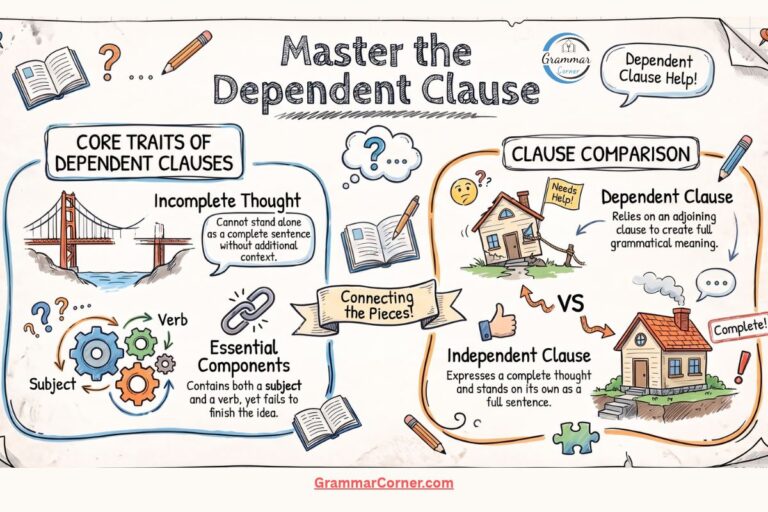
A restrictive clause is a dependent clause that provides information necessary to identify or narrow down the noun or pronoun it modifies. A small group of words can completely change the meaning of a sentence.
Consider these two sentences:
The difference is only the commas, but the meaning is not the same. The first type is called a restrictive clause.
Why Restrictive Clauses Matter
Restrictive clauses are important because they help readers identify exactly which person, thing, place, or group a sentence refers to.
The words that hangs above the fireplace form a restrictive clause identifying precisely which painting is being discussed.
✨ Quick Challenge
Which of the following sentences contains a restrictive clause (essential identifying information with no commas)? Tap your answer.
See the full answer
Answer: “Students who study regularly usually pass their exams.”
A restrictive clause provides essential information needed to identify or restrict the noun it modifies. Because the information is crucial to the core meaning of the sentence, it is not set off by commas:
- “Students who study regularly…” ➔ Restricts the claim specifically to those who study (Restrictive).
- Sentences using commas around the relative clause (e.g., “Mr. Ali, who is my neighbor, …”) supply extra, parenthetical information (Non-restrictive).
How a Restrictive Clause Works
Look at this sentence:
“The employee who handles customer complaints is on leave.”
The sentence has two important parts:
| Part | Function |
|---|---|
| The employee | Noun being identified |
| who handles customer complaints | Restrictive clause |
The clause answers an unstated question:
That is the heart of a restrictive clause.
Another Example
“Please bring the folder that contains the blue forms.”
• The clause narrows the meaning of folder.
Why Is It Called “Restrictive”?
The word restrictive refers to the way the clause limits the meaning of a noun. Suppose you say:
“The players are waiting outside.”
This could refer to all the players.
Now add a clause:
“The players who arrived early are waiting outside.”
The clause restricts the group. You are no longer necessarily talking about every player. You are talking about the particular players who arrived early.
Think of It as a Filter
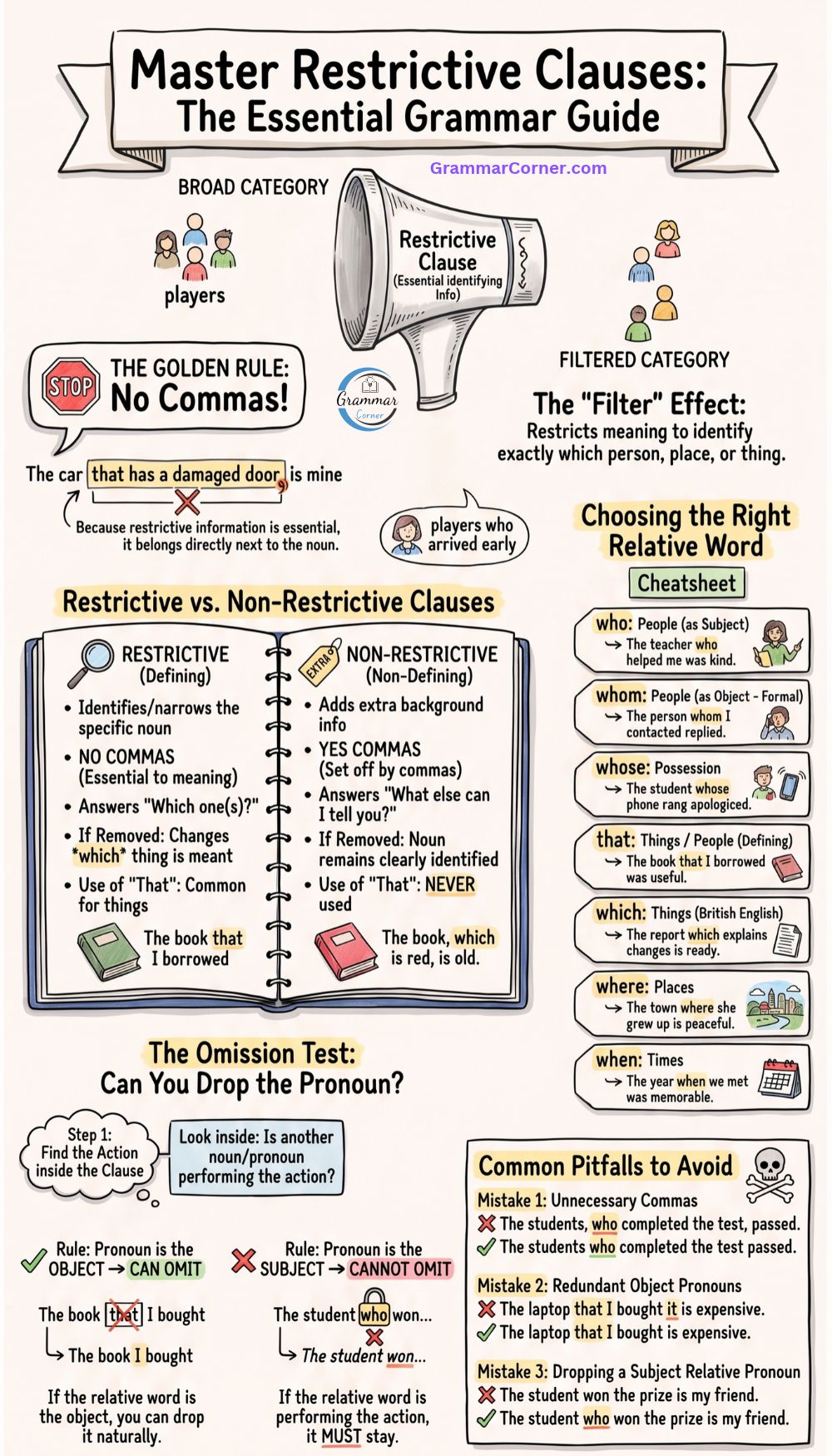
A restrictive clause works like a filter, narrowing down broad categories:
The clause reduces a broad category to the particular people or things the writer has in mind.
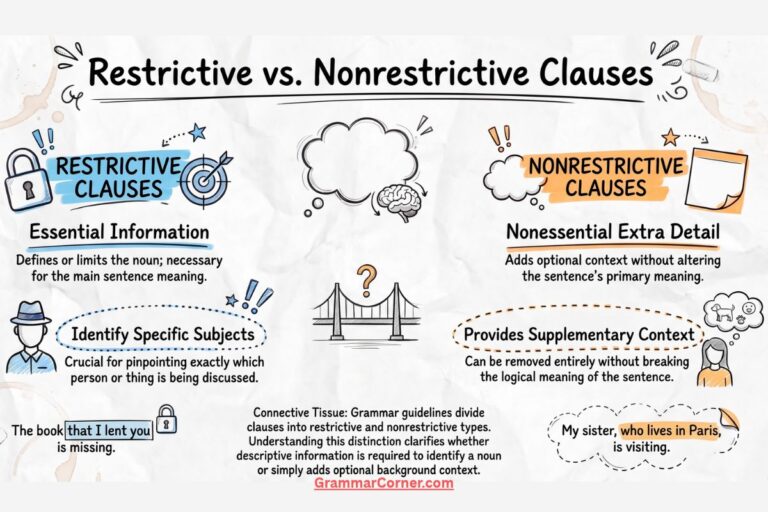
Restrictive Clause vs. Non-Restrictive Clause
This is the most important distinction to understand:
- A restrictive clause helps identify the noun.
- A non-restrictive clause simply adds information about a noun that is already identified.
Compare:
Side-by-Side Comparison
| Restrictive Clause | Non-Restrictive Clause |
|---|---|
| Identifies the noun | Adds information about the noun |
| Narrows the meaning | Does not narrow the meaning |
| Usually answers “Which one(s)?” | Often answers “What else can I tell you?” |
| No commas | Commas are required |
| Often uses that | Uses which, who, etc. |
| Relative pronoun can sometimes be omitted | Relative pronoun is normally retained |
The Comma Test: The Most Useful Rule
Restrictive clauses do not take commas.
✅ Correct: “The car that has a damaged door is mine.”
The clause identifies the car, so it belongs directly to the noun without separation.
Compare that with a non-restrictive clause:
“Am I using this clause to tell the reader which person or thing I mean?”
If yes, the clause is likely restrictive ➔ do not use commas.What Happens If You Remove the Clause?
Removing a restrictive clause does not necessarily make the remaining sentence grammatically incorrect. That can make testing by removal tricky. Consider:
“The students who arrived late missed the opening speech.”
“The students missed the opening speech.”
• However, its meaning has changed: Originally, the statement referred specifically to students who arrived late. After removing the clause, it appears to refer to the students as a whole.
Do not simply ask “Can I remove the clause?” Instead ask: “Does removing it change which person or thing the sentence refers to?” If it does, the clause is restrictive.
A Better Way to Identify a Restrictive Clause
Use these three steps on any sentence:
If the clause helps answer which one, it is restrictive.
Restrictive Clauses Are Not Only About People
A restrictive clause can modify many different types of nouns:
The same basic principle applies in each case: the clause helps identify the noun.
Relative Words Used in Restrictive Clauses
Restrictive clauses commonly begin with relative words. The choice depends on the noun and the grammatical role of the relative word inside the clause:
| Relative Word | Main Use | Example |
|---|---|---|
| who | People | The teacher who helped me was kind. |
| whom | People as objects | The person whom I contacted replied quickly. |
| whose | Possession | The student whose phone rang apologized. |
| that | People or things in many defining structures | The book that I borrowed was useful. |
| which | Things; especially common in British English | The report which explains the changes is available. |
| where | Places | The town where she grew up is peaceful. |
| when | Times | The year when we met was memorable. |
“Who” in Restrictive Clauses
Use who when referring to a person who performs the action in the relative clause:
“The student who answered the question received a mark.”
• Here, who is the subject of the restrictive clause.
- The woman who runs the bakery lives nearby.
- The engineer who designed the bridge received an award.
- The players who trained regularly improved quickly.
“Whom” in Restrictive Clauses
Whom is traditionally used when the person referred to is the object of the verb inside the clause:
“The candidate whom we interviewed had excellent qualifications.”
In everyday English, however, many speakers use who instead:
Both forms are widely encountered, but whom remains preferred in formal writing.
“Whose” Shows Possession
Whose is used when the restrictive clause expresses possession or association:
“The man whose car was stolen called the police.”
The clause identifies which man: the man whose car was stolen.
- I spoke to a teacher whose students had won several awards.
- We visited a company whose products are sold internationally.
- She hired a designer whose work impressed the entire team.
“That” in Restrictive Clauses
That is extremely common in restrictive clauses, particularly when referring to things:
- The computer that I bought is already having problems.
- The book that you recommended was excellent.
- The road that leads to the village is narrow.
It can also refer to people in some varieties and informal contexts:
“The person that called earlier left a message.”
However, who is often preferred for people, especially in careful or formal writing:
“The person who called earlier left a message.”
“Which” in Restrictive Clauses
The use of which in restrictive clauses varies somewhat between English varieties and style preferences:
This is a usage difference rather than a reason to treat every occurrence of restrictive which as universally incorrect.
Use that for restrictive clauses referring to things (especially in American English); use which according to the regional variety and style guide you are following.
Can You Omit the Relative Pronoun?
Yes, sometimes. This is one reason restrictive clauses often sound natural and flowing in everyday English. Consider:
“The movie that we watched was excellent.” ➔ “The movie we watched was excellent.”
Why? Because we is already the subject of the clause (we watched the movie). The relative word represents the object.
But You Cannot Always Omit It
Compare:
“The movie that won the award was excellent.”
Here, that is the subject of won.
When Can You Drop the Relative Pronoun?
Use this quick reference table to determine whether omission is possible:
| Example | Role of Relative Word | Can It Be Omitted? |
|---|---|---|
| The book that I bought | Object | Yes |
| The book that fell | Subject | No |
| The person whom I called | Object | Yes |
| The person who called | Subject | No |
| The car that we repaired | Object | Yes |
| The car that broke down | Subject | No |
The Quick Test
Look inside the restrictive clause. If another noun or pronoun is already doing the action, the relative word may be the object:
I called him (I am doing the calling) ➔ that can disappear:
Who called me? The man (he is doing the calling) ➔ who must remain:
Restrictive Clauses and “That” vs. “Which”
One of the most common questions is whether to use that or which. For practical writing, this pattern is useful:
Quick Comparison
| Sentence | Type |
|---|---|
| The phone that has the best camera is expensive. | Restrictive |
| The phone, which has the best camera, is expensive. | Non-restrictive |
| The students who studied hardest passed. | Restrictive |
| The students, who studied hardest, passed. | Non-restrictive |
The important difference is not simply that vs. which. It is the meaning and punctuation.
Restrictive Clauses and People: “Who” or “That”?
Both who and that can be found with people in restrictive clauses. Compare:
- “The student who won the competition is my cousin.”
- “The student that won the competition is my cousin.”
The first is generally the safer choice for formal and educational writing because who clearly identifies a person.
Restrictive Clauses With Places
Where can introduce a restrictive clause that identifies a place:
• You can often express the same idea using in which: “This is the restaurant in which we had dinner.”
The version with where is usually more natural.
Restrictive Clauses With Time
When can identify a particular time, period, day, or year:
- I remember the evening when we first met.
- That was the year when the company opened its first office.
In some sentences, when can be left out:
“I remember the evening we first met.”
The meaning remains clear because we is already the subject of the clause.
Restrictive Clauses With “Why”
Why can follow a noun such as reason:
“I understand the reason why he resigned.”
It identifies the particular reason being discussed.
However, English often allows a shorter structure:
The last example is a different clause structure because why he resigned functions as a noun-like unit (noun clause) rather than modifying an expressed noun.
Restrictive Clauses Can Modify Pronouns
A restrictive clause does not have to modify an ordinary noun. It can also modify an indefinite or demonstrative pronoun:
Here, who work hard identifies which people are meant by those.
The clause narrows the meaning of anyone.
The clause restricts the meaning of anything.
Restrictive Clauses Can Change the Meaning of a Sentence
The choice to use or omit commas directly shifts the meaning of the entire sentence. Consider:
Another Example
Only a particular group received certificates.
The sentence presents completion of the training as an added fact about all the employees.
Restrictive Clauses and Proper Names
A proper name usually identifies a person or place uniquely on its own:
“Ahmed is waiting outside.”
If we add information:
“Ahmed, who works at the bank, is waiting outside.”
The name Ahmed already tells us who the sentence refers to, so the added clause is normally non-restrictive (set off by commas).
This unusual restrictive construction is appropriate if there are several people named Ahmed and the speaker needs to distinguish one from another.
Restrictive Clause or Adjective Phrase?
Sometimes a restrictive clause can be shortened into a participial phrase for conciseness:
➔ Shortened: “The man standing near the door is my uncle.”
Uses a participial phrase instead of a full relative clause.
➔ Shortened: “The documents containing confidential information must be locked.”
The shorter version makes writing more compact, while the full relative clause remains fully grammatical and clear.
✨ Quick Challenge
Which sentence implies that only a specific subset of candidates passed the assessment (essential restriction), rather than all candidates collectively?
See the full answer
Answer: “The candidates who scored above 80% received offers.”
The presence or absence of commas changes the scope of reference:
- Without commas (Restrictive): “The candidates who scored above 80%…” restricts the noun candidates to narrow down and identify only those specific individuals who achieved the score.
- With commas (Non-restrictive): “The candidates, who scored above 80%, …” indicates that all the candidates being discussed scored above 80%, offering the clause simply as supplementary information.
How to Make a Restrictive Clause From Two Sentences
Start with two separate sentences:
• “The laptop has a touchscreen.”
More Sentence-Building Examples
• The designer specializes in logos.
• The keys were under the sofa.
• The museum displays ancient coins.
• The employee manages the department.
Common Restrictive-Clause Mistakes
The presence of who does not automatically require a comma.
• “The car that I bought is expensive.” (Writers following American formal conventions often prefer that).
Who was standing beside the student? Probably the teacher, but in complicated contexts, a reader may hesitate.
Restrictive Clause vs. Essential Clause vs. Defining Clause
You may encounter several different names for the same grammatical concept across grammar guides, style handbooks, and textbooks:
| Term | Meaning |
|---|---|
| Restrictive clause | Emphasizes that the clause limits the noun’s meaning |
| Defining clause | Emphasizes that the clause identifies the noun |
| Essential clause | Emphasizes that the information is necessary to the intended meaning |
| Restrictive relative clause | Makes its relationship to relative clauses explicit |
Restrictive Clause vs. Non-Restrictive Clause: A Full Comparison
| Feature | Restrictive | Non-Restrictive |
|---|---|---|
| Main purpose | Identifies the noun | Adds information |
| Changes intended reference if removed | Usually yes | Usually no |
| Commas | No | Yes |
| Often follows a general noun | Yes | Less often |
| Can follow a proper name | Possible when identification is needed | Very common |
| That | Common | Not used |
| Who | Yes | Yes |
| Whom | Yes | Yes |
| Which | Varies by English variety/style | Common |
| Relative pronoun omission | Sometimes possible | Normally not |
| Also called | Defining / Essential clause | Non-defining / Nonessential clause |
A Simple Decision Guide
When writing or analyzing a sentence containing a relative clause, follow this 4-step checklist:
➔ Noun: students
• “The students whom I invited…” ➔ Whom is the object, so it can be omitted: “The students I invited…”
This four-step approach handles most ordinary restrictive-clause questions easily.
Restrictive Clause Examples in Different Contexts
- Where’s the jacket that I left here?
- Call the person who sent the email.
- Take the bus that stops near the hospital.
- Researchers who study language variation often examine social factors.
- The data that were collected during the survey were analyzed separately.
- Employees who need additional training should contact HR.
- Please complete the form that accompanies this letter.
- Select the option that best describes your problem.
- Open the file that contains the original data.
Practice: Identify the Restrictive Clause
Find the restrictive clause in each sentence below:
- The student who sits near the window is absent today.
- Please open the document that I sent yesterday.
- We visited the village where my grandfather grew up.
- The employee whose computer was damaged reported the problem.
- I remember the afternoon when we received the news.
- People who exercise regularly often develop consistent routines.
| Sentence | Restrictive Clause |
|---|---|
| 1 | who sits near the window |
| 2 | that I sent yesterday |
| 3 | where my grandfather grew up |
| 4 | whose computer was damaged |
| 5 | when we received the news |
| 6 | who exercise regularly |
Practice: Add or Remove the Commas
Decide whether commas are needed based on the intended meaning:
Practice: Can You Omit the Relative Word?
Practice: Correct the Sentences
Frequently Asked Questions
• Which book? ➔ The book that is on the desk.
You normally cannot omit it when it functions as the subject:
❌ Incorrect: “The movie won the award was good.”