Dependent Clauses (3 Types and Examples)
What Is a Dependent Clause?
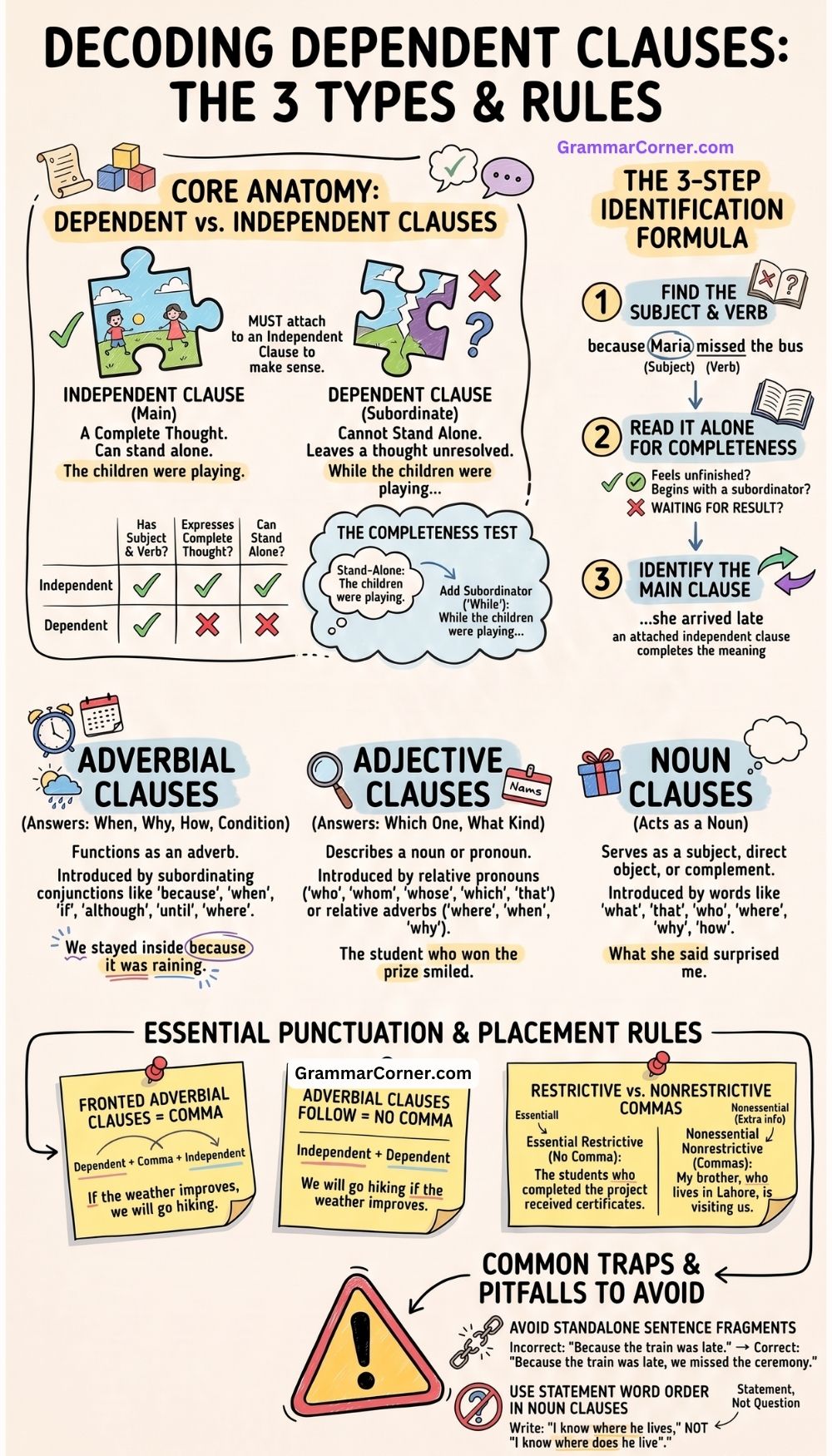
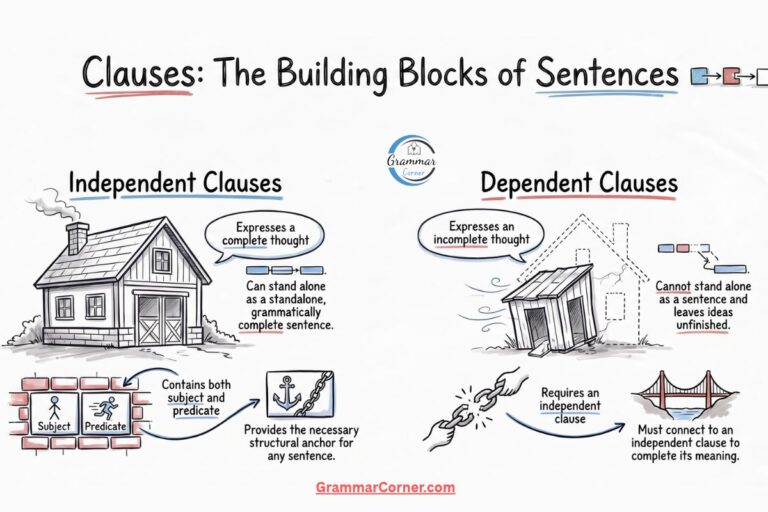
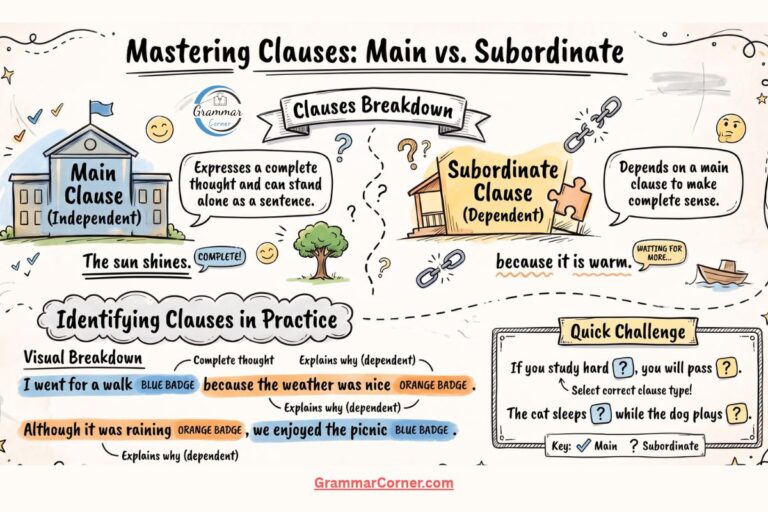
A dependent clause, also called a subordinate clause, is a clause that cannot stand alone as a complete sentence. It is a group of words that contains a subject and a verb but cannot express a complete thought by itself. It needs another clause to complete its meaning.
Example in Context
Consider the following sentence:
“Although the road was crowded” contains a subject (the road) and a verb (was), but it leaves the reader waiting for more information.
“we arrived on time” completes the thought and resolves the sentence.
Why Dependent Clauses Are Important
Dependent clauses are an important part of English sentence structure. They allow writers and speakers to show complex relationships without making every idea a separate sentence:
More Examples of Dependent Clauses
Notice how each clause below contains a subject and a verb, yet none can stand on its own as a full sentence:
Subject: the shop | Verb: was closed
Subject: the teacher | Verb: entered
Subject: who | Verb: lives
Subject: she | Verb: decided
Subject: he | Verb: was
Each group contains enough grammatical material to look like a clause, but none works as a complete sentence on its own.
✨ Quick Challenge
Three of these four word groups are dependent clauses that cannot stand alone. One is an independent clause. Tap the one that doesn’t belong.
See the full answer
Answer: “the teacher entered the room”
A dependent clause contains a subject and verb but starts with a subordinator (such as because, when, or although), making it an incomplete thought that depends on an independent clause.
In contrast, “the teacher entered the room” is an independent clause that forms a complete, freestanding sentence on its own.
Independent Clause vs. Dependent Clause
The easiest way to understand a dependent clause is to compare it with an independent clause. An independent clause can stand alone as a complete sentence. A dependent clause cannot.
| Point of Comparison | Independent Clause | Dependent Clause |
|---|---|---|
| Has a subject and verb | Yes | Yes |
| Expresses a complete thought | Yes | No |
| Can stand alone | Yes | No |
| Can form a sentence by itself | Yes | No |
| Can be joined to another clause | Yes | Yes |
| Other common name | Main clause | Subordinate clause |
Examples of the Difference
How to Identify a Dependent Clause in 3 Steps
Finding a dependent clause becomes much easier when you use a simple test:
First, find the basic subject-verb combination.
because Maria missed the bus
• Subject: Maria
• Verb: missed
So the group qualifies as a clause.
Ask whether it can function as a complete sentence.
“Because Maria missed the bus.”
The idea feels unfinished. We naturally expect to know what happened as a result.
Look for the independent clause that completes its meaning.
“Because Maria missed the bus, she arrived late.”
• Dependent clause: Because Maria missed the bus
• Independent clause: she arrived late
A Quick Identification Formula
• Subject: the weather
• Verb: improves
• Complete thought: No
Therefore, it is a dependent clause.
What Are the Three Main Types of Dependent Clauses?
Dependent clauses are commonly classified according to the grammatical job they perform. The three major types are:
- Adverbial clauses
- Adjective clauses
- Noun clauses
The same basic idea—an incomplete clause attached to another part of a sentence—can therefore perform three very different jobs.
| Type | Main Function | Usually Modifies or Replaces | Example |
|---|---|---|---|
| Adverbial clause | Gives information about an action or situation | Verb, adjective, or adverb | We left because it was late. |
| Adjective clause | Describes or identifies a noun/pronoun | Noun or pronoun | The student who won the prize smiled. |
| Noun clause | Acts like a noun | Subject, object, or complement | What she said surprised me. |
Adverbial Dependent Clauses
An adverbial clause is a dependent clause that performs an adverb-like function. It can tell us when, where, why, how, under what condition, for what purpose, or despite what circumstance something happens.
- We waited until the rain stopped.
- Because the road was blocked, we took another route.
- I will call you when I reach home.
- If you need help, ask the receptionist.
- She continued working although she was exhausted.
The dependent clause adds information about the action or situation expressed in the main clause.
Common Functions of Adverbial Clauses
| Relationship | Common Starters | Example |
|---|---|---|
| Time | when, while, before, after, until, once | Call me when you arrive. |
| Reason | because, since, as | We stayed inside because it was raining. |
| Condition | if, unless, provided that | If you hurry, you can catch the bus. |
| Contrast | although, though, even though, whereas | Although he was nervous, he spoke clearly. |
| Purpose | so that, in order that | She whispered so that nobody would hear. |
| Result | so…that, such…that | The box was so heavy that I needed help. |
| Place | where, wherever | Sit wherever you feel comfortable. |
| Comparison | than, as…as | She runs faster than I expected. |
Adjective Clauses
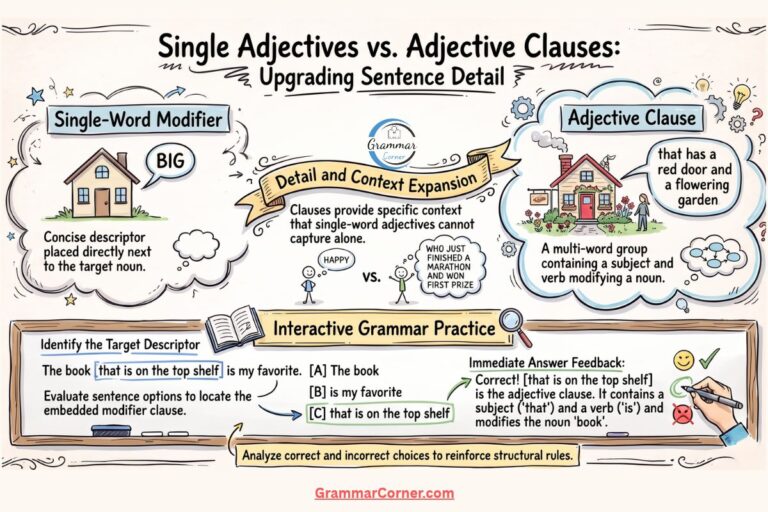
An adjective clause, also called a relative clause, is a dependent clause that describes or identifies a noun or pronoun.
This tells us which laptop only if the context is already clear.
“I bought the laptop that you recommended.”
The clause that you recommended describes the noun laptop.
- The woman who teaches mathematics is my neighbor.
- We visited a museum that opened last year.
- I found the keys which I had misplaced.
- The village where my grandfather grew up is very peaceful.
Common Words That Introduce Adjective Clauses
| Word | Typical Use | Example |
|---|---|---|
| who | People | The boy who won the race is my cousin. |
| whom | People as an object | The author whom I interviewed was friendly. |
| whose | Possession | The girl whose phone rang apologized. |
| which | Things/animals | The car which we rented was comfortable. |
| that | People or things in many restrictive clauses | The book that you gave me is excellent. |
| where | Places | This is the café where we met. |
| when | Times | I remember the year when we moved here. |
| why | Reasons | Nobody knew the reason why he left. |
Restrictive and Nonrestrictive Adjective Clauses
Not all adjective clauses carry the same importance.
-
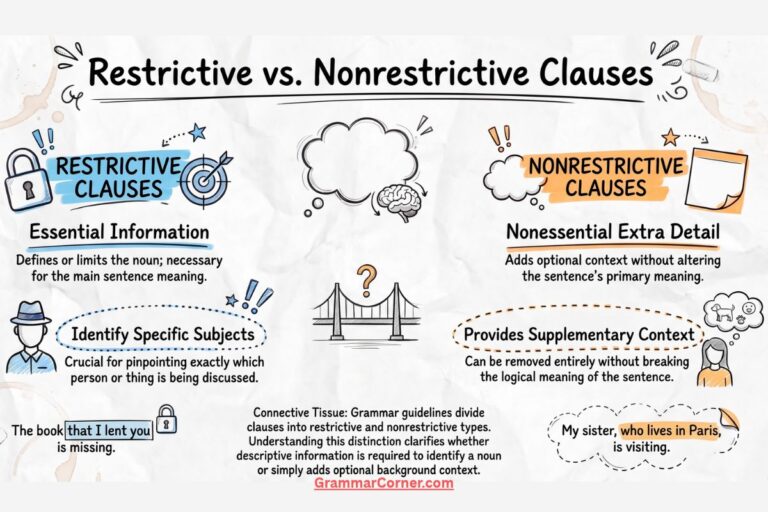
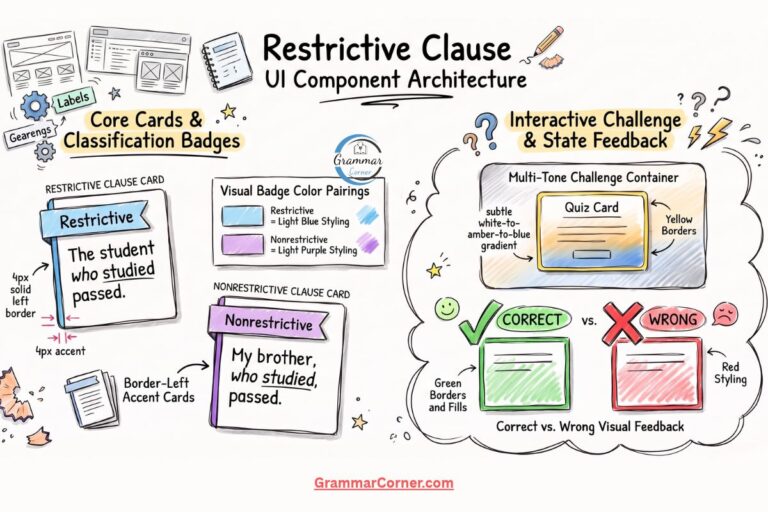
A restrictive clause identifies the noun. Without it, the reader may not know exactly which person or thing is meant:
“The students who completed the project received certificates.”
The clause identifies the particular students who received certificates. -
A nonrestrictive clause simply adds extra information about an already identified noun:
“My brother, who lives in Lahore, is visiting us.”
The reader already knows which brother is being discussed. The clause supplies additional information.
Comma Difference
| Type | Purpose | Commas? |
|---|---|---|
| Restrictive | Identifies or limits the noun | Usually no |
| Nonrestrictive | Adds nonessential information | Yes |
Compare:
In the first sentence, the clause helps identify the employees.
In the second, Sara is already identified.
Noun Clauses
A noun clause is a dependent clause that performs the job of a noun. It can function as:
Noun clauses can also function as an object of a preposition.
Common Noun-Clause Starters
| Starter | Example |
|---|---|
| that | I believe that she is honest. |
| what | Tell me what you need. |
| who | We know who opened the door. |
| whoever | Whoever arrives first can choose a seat. |
| whether | I don’t know whether he will come. |
| if | Ask her if she needs anything. |
| why | Nobody understands why he resigned. |
| how | She explained how the machine works. |
| where | We discovered where the documents were hidden. |
| when | I remember when we first met. |
Dependent Clause vs. Phrase
A dependent clause and a phrase are not the same thing. A dependent clause contains a subject and a verb. A phrase does not contain a complete subject-verb combination.
Compare:
| Expression | Type | Why? |
|---|---|---|
| after the meeting | Phrase | No subject + finite verb combination |
| after the meeting ended | Dependent clause | Subject = meeting; verb = ended |
| in the old building | Phrase | No finite verb |
| because the building was old | Dependent clause | Subject = building; verb = was |
• “We went home after the meeting ended.” ➔ The second contains a dependent clause.
Dependent Clause vs. Sentence Fragment
A dependent clause is not automatically a mistake. It becomes a sentence fragment when it is presented as though it were a complete sentence.
The dependent clause itself is grammatically useful; the problem is leaving it disconnected from the main clause.
How Dependent Clauses Form Complex Sentences
A complex sentence contains one independent clause and at least one dependent clause.
• Dependent clause 1: Although the road was narrow
• Dependent clause 2: because the village was nearby
Where Can a Dependent Clause Appear in a Sentence?
The position of a dependent clause depends largely on its type and function:
Adverbial clauses commonly appear before the independent clause.
A dependent clause can follow the main clause.
Relative clauses often appear inside a sentence because they describe a noun.
Comma Rules for Dependent Clauses
Punctuation depends on the type and position of the dependent clause. There is no single rule that says every dependent clause needs a comma.
• “Because the store was closed, we returned home.”
• “We returned home because the store was closed.”
• “She explained why she was upset.”
Common Words That Introduce Dependent Clauses
The words that introduce dependent clauses provide useful clues about their function.
Subordinating Conjunctions
Subordinating conjunctions commonly introduce adverbial clauses.
| Relationship | Examples |
|---|---|
| Time | after, before, when, whenever, while, until, once, as soon as |
| Cause | because, since, as |
| Condition | if, unless, provided that, as long as |
| Contrast | although, though, even though, whereas |
| Purpose | so that, in order that |
| Result | so that, so…that, such…that |
| Comparison | than, as…as |
| Place | where, wherever |
Relative Pronouns and Relative Adverbs
These commonly introduce adjective clauses:
- The scientist who discovered the formula became famous.
- This is the street where I grew up.
- I remember the day when we first met.
Words Used in Noun Clauses
Noun clauses can begin with:
- I wonder what she wants.
- Whatever you choose will be acceptable.
- We don’t know whether they have arrived.
How to Combine a Dependent Clause with an Independent Clause
There are two common arrangements:
This simple pattern is useful when writing essays, reports, stories, and everyday messages because it lets you connect related ideas instead of presenting them as short, disconnected sentences.
Common Mistakes with Dependent Clauses
This is not a direct question. It is a noun clause functioning as the object of know.
This is a direct question.
Dependent Clause and Direct Question: A Useful Difference
Learners often confuse indirect questions inside noun clauses with direct questions. Compare the structures:
| Direct Question | Noun Clause |
|---|---|
| Where does he live? | I know where he lives. |
| What did she buy? | Tell me what she bought. |
| Why did they leave? | I wonder why they left. |
| When will he arrive? | Do you know when he will arrive? |
✨ Quick Challenge
Three of these four sentences contain punctuation or word-order mistakes with dependent clauses. Tap the only correctly formed sentence.
See the full answer
Answer: “We stayed indoors because the storm was severe.”
Key combination and punctuation rules for dependent clauses:
- Independent + Dependent: Standard order does not take a comma (✅ “We stayed indoors because the storm was severe.”).
- Dependent + Comma + Independent: Fronted adverbial clauses require a comma (❌ “Although it was late we finished…” ➔ ✅ “Although it was late, we finished…”).
- Noun Clauses: Use statement word order, not question inversion (❌ “why did they leave” ➔ ✅ “why they left”).
- Sentence Fragments: Never terminate a standalone dependent clause with a period.
Why Are Dependent Clauses Important?
Dependent clauses give writers more control over how ideas are connected.
Dependent clauses can express relationships such as:
They are especially useful when you want to show how one idea relates to another.
Dependent Clauses in Everyday Writing
Dependent clauses are not limited to grammar exercises. They appear constantly in natural English across various contexts:
• “We can go if you are ready.”
Learning to use dependent clauses well can therefore make both spoken and written English more precise.
Dependent Clause Quick Reference Chart
| Question | Answer |
|---|---|
| What is a dependent clause? | A clause that cannot stand alone as a complete sentence. |
| What is another name for it? | Subordinate clause. |
| Does it contain a subject and verb? | Yes, in its typical finite-clause form. |
| Can it stand alone? | No. |
| What must it usually join? | An independent clause. |
| What are the three main types? | Adverbial, adjective, and noun clauses. |
| What introduces many adverbial clauses? | Subordinating conjunctions. |
| What introduces many adjective clauses? | Relative pronouns or relative adverbs. |
| What can noun clauses do? | Function as subjects, objects, and complements. |
| Does every dependent clause require a comma? | No. |
| What happens when one stands alone? | It generally becomes a sentence fragment. |
| What kind of sentence contains a dependent clause? | A complex sentence, when paired with an independent clause. |
Dependent Clause Examples
Here are examples of the three main types in context:
Adverbial Clause Examples
- When the bell rang, the students left the classroom.
- We postponed the picnic because dark clouds covered the sky.
- If you follow the instructions, the task will be easy.
- She smiled although she was nervous.
- We waited until the doctor called our name.
Adjective Clause Examples
- The man who repaired our roof was very professional.
- I returned the book that you lent me.
- The restaurant where we had dinner has closed.
- She wore the necklace which her grandmother gave her.
- The player whose ankle was injured left the field.
Noun Clause Examples
- What you said made everyone laugh.
- I understand why you are upset.
- She explained how the problem occurred.
- Nobody knows where the missing file went.
- Whoever finishes first can leave early.
Trick of Telling Dependent Clause
A useful trick is to ask what job the clause performs in the sentence:
• When did we leave? ➔ When the meeting ended.
• Which woman? ➔ The woman who owns the bakery.
• What do I know? ➔ What you want.
Practice Exercises
Practice Exercise 1: Identify the Dependent Clause
Identify the dependent clause in each sentence:
- When the movie ended, everyone left quietly.
- I stayed indoors because the temperature had dropped sharply.
- The teacher who helped me was very patient.
- We will start the meeting if everyone is ready.
- She explained what had happened.
- Although the task looked difficult, we completed it.
- I found the notebook that I had lost.
- Whoever answers correctly will receive a point.
- Call me when you reach the station.
- The house where they lived has been sold.
Practice Exercise 2: Identify the Type
Decide whether the bold clause is adverbial, adjective, or noun:
- Because the road was flooded, we turned around.
- The woman who lives upstairs is a doctor.
- I don’t understand why he left.
- If you need anything, send me a message.
- The painting that hangs above the fireplace is very old.
- What she discovered surprised the entire team.
| No. | Dependent Clause | Type |
|---|---|---|
| 1 | Because the road was flooded | Adverbial |
| 2 | who lives upstairs | Adjective |
| 3 | why he left | Noun |
| 4 | If you need anything | Adverbial |
| 5 | that hangs above the fireplace | Adjective |
| 6 | What she discovered | Noun |
Frequently Asked Questions About Dependent Clauses