Phrases (Structure, Types and Examples) | Sentence Vs Phrase
What Is a Phrase?
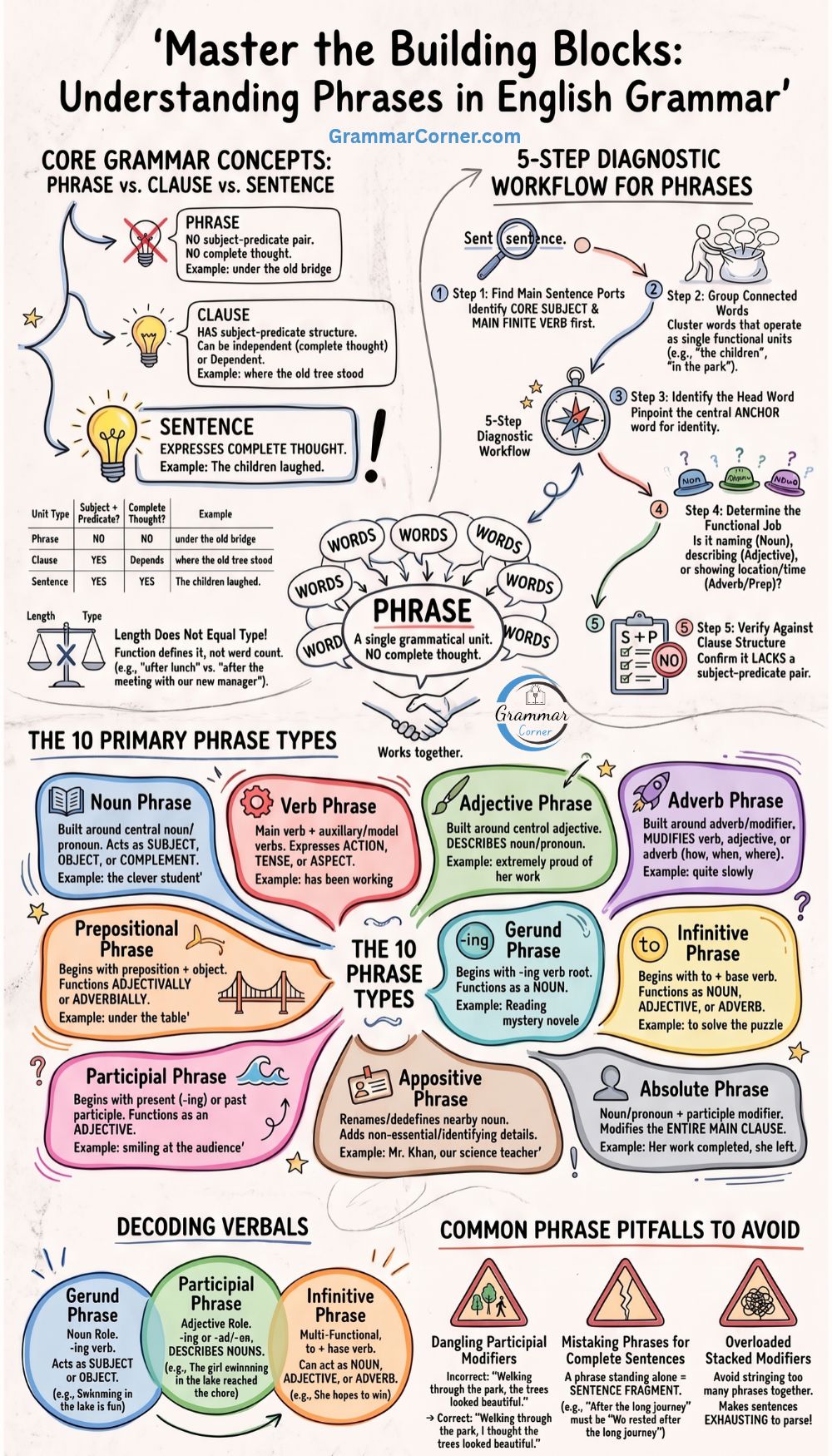
A phrase is a group of words that works together as one single unit in a sentence. It can name something, describe a person or thing, show an action, tell when or where something happens, or add other useful information.
Look at these examples of phrases:
Each group works as a unified piece, but none of them expresses a complete thought by itself.
Why Phrases Matter
Phrases are essential building blocks in English. They help us construct clear, precise, and detailed sentences. Once you learn how to recognize phrases and how they function, overall sentence structure becomes much easier to master.
The words with the red backpack form a prepositional phrase working together as a single unit to describe the boy.
The words has finished form a verb phrase. The phrase works together to specify the exact action completed by Maya.
Phrase Length vs. Function
A phrase is not defined by its word count. It can be very short or considerably expanded:
The number of words does not determine whether a word group is a phrase. What matters is how those words work together grammatically as a single functional element.
✨ Quick Challenge
Three of these four options are phrases (they function as single units without a complete subject-predicate thought). One is a complete sentence / clause. Tap the one that doesn’t belong.
See the full answer
Answer: “Maya finished her homework.”
A phrase is a group of words acting as a single unit that lacks a complete subject-plus-finite-verb combination (e.g., the old wooden bridge, with the red backpack, to win the competition).
In contrast, “Maya finished her homework.” contains both a subject (Maya) and a finite verb (finished), making it a complete clause and sentence rather than an isolated phrase.
What Makes a Group of Words a Phrase?
A phrase usually has a central head word or grammatical structure that gives the entire group its identity:
| Group of Words | Type | Why? |
|---|---|---|
| the clever student | Noun phrase | The noun student is the main word. |
| has been sleeping | Verb phrase | The main verb is sleeping. |
| extremely useful | Adjective phrase | The adjective useful is central. |
| quite slowly | Adverb phrase | The adverb slowly is central. |
| behind the door | Prepositional phrase | It begins with the preposition behind. |
| to solve the problem | Infinitive phrase | It begins with the infinitive to solve. |
Can a Phrase Be a Complete Sentence?
A grammatical phrase normally cannot stand alone as a complete sentence. For example:
“under the old bridge”
This tells us where something is located, but it does not express a complete idea. We can integrate it into a full sentence:
“The children were playing under the old bridge.”
The phrase now functions as a meaningful part of a complete sentence structure.
A phrase is a sentence part, not a complete sentence on its own.
A Sentence Can Contain More Than One Phrase
Phrases do not have to appear in isolation. They frequently combine and can even be nested inside one another:
• Noun Phrases: the girl, the blue umbrella, the school gate
How a Phrase Adds Detail and Meaning
Compare how phrases expand a basic sentence without making it clunky:
The second sentence uses phrases to provide rich, layered details all in one smooth sentence:
That is the primary purpose of phrases: they allow writers to add specific, vital information without creating separate, repetitive sentences for every detail.
Phrase vs. Clause: What Is the Difference?
Phrases and clauses are both groups of words, but they represent fundamentally different grammatical units.
The clearest distinction is that a clause contains its own subject-and-predicate structure (a subject performing a finite verb), while a phrase does not form that complete clause unit.
Side-by-Side Comparison
| Phrase | Clause |
|---|---|
| after the game | after the game ended |
| the smiling child | the child was smiling |
| to finish the project | because we finished the project |
| under the old tree | where the old tree stood |
A phrase may contain a noun or a verb form (such as a participle or infinitive), but that does not automatically give it the subject-verb predicate structure of a clause.
Phrase vs. Sentence
A sentence expresses a complete, standalone thought:
“The children laughed.”
A phrase does not normally express a complete thought on its own:
“after the children”
The phrase relies on a larger sentence structure to give it a complete grammatical role.
An Easy Test for Identifying a Phrase
When analyzing any group of words in a sentence, run through these four diagnostic questions:
This structural method is far more accurate and reliable than simply counting the number of words.
What Are the Types of Phrases?
English grammar classifies phrases based on their central head word or structural form. The primary types used in sentence building include noun, verb, adjective, adverb, prepositional, gerund, infinitive, participial, appositive, and absolute phrases.
Some phrase categories describe structure while others describe function. For instance, a gerund phrase functions as a noun, while a prepositional phrase can function adjectivally or adverbially.
Types of Phrases at a Glance
| Phrase Type | Main Feature | Usual Function | Example |
|---|---|---|---|
| Noun phrase | Built around a noun or pronoun | Acts as a noun | the clever student |
| Verb phrase | Contains a main verb with auxiliaries | Expresses an action or state | has been working |
| Adjective phrase | Built around an adjective | Describes a noun or pronoun | very proud of her work |
| Adverb phrase | Functions like an adverb | Modifies a verb, adjective, or adverb | quite slowly |
| Prepositional phrase | Begins with a preposition | Acts adjectivally or adverbially | under the table |
| Gerund phrase | Begins with a gerund (-ing) | Acts as a noun | Reading mystery novels |
| Infinitive phrase | Begins with an infinitive (to + verb) | Acts as a noun, adjective, or adverb | to solve the puzzle |
| Participial phrase | Begins with a present/past participle | Usually acts as an adjective | smiling at the audience |
| Appositive phrase | Renames or identifies a noun | Adds information about a noun | Mr. Khan, our science teacher |
| Absolute phrase | Contains a noun/pronoun plus a participle | Modifies the whole sentence | Her work completed, she went home. |
Noun Phrases
A noun phrase is a group of words built around a noun or pronoun. The noun serves as the central head element, while surrounding words identify, describe, or quantify it:
- the noisy classroom
- my younger brother
- three large boxes
- the woman near the window
In a full sentence:
“The young athlete won the race.”
The complete unit The young athlete functions together as the subject.
How to Identify a Noun Phrase
Find the noun first, then gather all the modifiers and determiners attached directly to it:
“The old wooden chair near the window needs repair.”
The head noun is chair. The determiners, adjectives, and prepositional phrase provide vital identifying details about that specific chair.
Functions of Noun Phrases
| Function | Example |
|---|---|
| Subject | The new student answered the question. |
| Object | We bought a large table. |
| Subject complement | Sara is a talented artist. |
| Object of a preposition | He spoke to the new manager. |
Verb Phrases
A verb phrase contains the main lexical verb and may include one or more auxiliary or modal verbs:
- is running
- has completed
- will arrive
- might have forgotten
- has been working
In a sentence:
“The workers have been repairing the road.”
What Makes a Verb Phrase?
The main verb carries the core lexical meaning of the action or state, while auxiliary verbs indicate tense, aspect, mood, possibility, or obligation.
Adjective Phrases
An adjective phrase is a group of words that functions like an adjective, providing descriptive information about a noun or pronoun:
- very expensive
- extremely proud of his son
- afraid of the dark
- full of useful information
The phrase describes the noun hotel.
The phrase describes the subject students.
What Does an Adjective Phrase Modify?
An adjective phrase normally describes a noun or pronoun directly:
“The woman proud of her achievement smiled.”
The phrase proud of her achievement immediately modifies the woman.
Adverb Phrases
An adverb phrase performs the functional job of an adverb. It tells us how, when, where, or to what extent an action occurs:
- very carefully
- quite unexpectedly
- in the morning
- with great enthusiasm
- more quickly than before
In a sentence:
“The students completed the task very carefully.”
The phrase explains how the students completed the task.
What Does an Adverb Phrase Modify?
An adverb phrase can modify a verb, an adjective, or another adverb:
- “She spoke very quietly.” ➔ Modifies the verb spoke.
- “The test was quite difficult.” ➔ Quite difficult functions adjectivally, while quite modifies the adjective difficult.
Prepositional Phrases
A prepositional phrase begins with a preposition and concludes with its object (typically a noun phrase). Common prepositions include:
Structure of a Prepositional Phrase
• under + the large wooden table ➔ under the large wooden table (with an expanded noun phrase object)
Adjective vs. Adverb Prepositional Phrases
• “The children played in the garden.” (Tells where)
Gerund, Infinitive, and Participial Phrases
These three phrase types are formed from verb roots (verbals), but perform different grammatical roles in sentences.
1. Gerund Phrases
A gerund is an -ing verb form that acts as a noun. A gerund phrase includes the gerund plus any objects or modifiers:
- “Reading mystery novels is my favorite hobby.” ➔ Subject
- “I enjoy playing cricket with my friends.” ➔ Object
2. Infinitive Phrases
An infinitive consists of to + base verb. An infinitive phrase contains the infinitive and its complements or modifiers:
- “She hopes to win the scholarship.” ➔ Completes hopes (object).
- “To travel alone can be challenging.” ➔ Functions as a noun-like subject.
- “He went to the library to study for his exam.” ➔ Adverbial (explains purpose).
3. Participial Phrases
A participial phrase begins with a present participle (-ing) or past participle (-ed/-en) and functions as an adjective:
- “Smiling proudly, the winner accepted the trophy.” ➔ Modifies the winner.
- “The books damaged by the flood were removed.” ➔ Modifies the books.
How to Tell Them Apart
| Phrase | Type | Function |
|---|---|---|
| Swimming in the river | Gerund phrase | Acts as a noun |
| to swim in the river | Infinitive phrase | May act as a noun, adjective, or adverb |
| swimming in the river | Participial phrase | Describes a noun (adjective) |
The surface verb form alone is not always enough to categorize a verbal phrase—always determine the functional job the phrase performs within the matrix sentence.
✨ Quick Challenge
In the sentence “Swimming in the lake is her favorite summer activity,” what type of verbal phrase is highlighted? Tap your answer.
See the full answer
Answer: Gerund Phrase (Noun Subject)
Both gerund and participial phrases can begin with an -ing verbal, but their functional roles differ:
- Gerund Phrase: Functions as a noun (here, “Swimming in the lake” is the grammatical subject of the linking verb is).
- Participial Phrase: Functions adjectivally to describe a noun (e.g., “The girl swimming in the lake reached the shore”).
Appositive and Absolute Phrases
These two phrase types add advanced layers of detail, descriptive precision, and background context to sentences.
Appositive Phrases
An appositive phrase gives another name or description for a nearby noun, renaming or redefining it:
“My brother, a professional photographer, lives in Lahore.”
The phrase a professional photographer renames and identifies my brother.
- Ali, my oldest friend, called me yesterday.
- The Nile, one of the world’s longest rivers, flows through several countries.
- Mrs. Ahmed, our English teacher, organized the competition.
Absolute Phrases
An absolute phrase usually contains a noun or pronoun combined with a participle or related modifier. Rather than modifying a single specific word, it modifies and adds background to the entire main clause:
- “The sun having set, the travelers continued their journey.”
- “Her homework finished, Maya went outside.”
The absolute phrase provides overarching situational context for the entire sentence.
How Appositive and Absolute Phrases Differ
| Phrase | Main Purpose | Example |
|---|---|---|
| Appositive phrase | Renames or identifies a specific noun | Ahmed, my neighbor, helped us. |
| Absolute phrase | Adds background information to the whole clause | The work completed, the team left. |
How to Identify a Phrase in a Sentence
Use this step-by-step diagnostic workflow on any sentence:
➔ Basic structure: The children (subject) + played (verb).
• the children ➔ noun phrase
• in the park ➔ prepositional phrase
• In “the three talented musicians”, the central head word is musicians (noun phrase).
• Does it describe a noun? ➔ Adjective or participial phrase
• Does it tell how, when, or where? ➔ Adverbial phrase
Examples of Phrases in Sentences
| Sentence | Phrase | Type | Function |
|---|---|---|---|
| The little boy opened the door. | The little boy | Noun phrase | Subject |
| She has been studying all morning. | has been studying | Verb phrase | Action |
| The box is extremely heavy. | extremely heavy | Adjective phrase | Describes noun |
| He answered very politely. | very politely | Adverb phrase | Modifies verb |
| The keys are under the sofa. | under the sofa | Prepositional phrase | Location |
| Reading good books improves vocabulary. | Reading good books | Gerund phrase | Subject |
| We decided to leave early. | to leave early | Infinitive phrase | Object / Complement |
| Tired after the journey, they went to bed. | Tired after the journey | Participial phrase | Describes pronoun |
| Sara, my next-door neighbor, helped me. | my next-door neighbor | Appositive phrase | Renames noun |
| The weather being pleasant, we ate outside. | The weather being pleasant | Absolute phrase | Background |
How Phrases Improve Writing
Phrases are not merely grammar labels to memorize—they are practical structural tools for craft and clarity.
Adding Specific Details
Compare:
“The woman entered the room.”
The phrases provide vivid details in a single flow without requiring several choppy sentences.
Combining Ideas Smoothly
“We arrived at the station. We arrived early. The station was crowded.”
Making Sentences More Precise
“He answered.”
Avoiding Unnecessary Wordiness
Adding phrases does not mean making every sentence longer. Before keeping a phrase, ask:
If the answer is no, cut it. Good writing is about selecting the right phrases for your intended meaning rather than packing in decorative word count.
Common Mistakes with Phrases
Phrase Examples for Students
- the red bicycle
- my best friend
- several interesting books
- the tall man near the gate
- is sleeping
- has completed
- will be arriving
- might have forgotten
- very beautiful
- full of energy
- afraid of spiders
- extremely difficult to understand
- very slowly
- quite unexpectedly
- with great care
- at the right time
- on the desk
- behind the curtain
- during the summer
- with my classmates
- Learning new words
- Playing football after school
- Reading historical novels
- Walking along the beach
- to learn English
- to complete the assignment
- to help her brother
- to become a doctor
- running across the field
- covered in mud
- smiling at everyone
- frightened by the loud noise
Practice: Identify the Phrase and Its Type
Identify the primary phrase in each sentence below and determine its type:
- The small wooden boat crossed the river.
- Ahmed has been working since morning.
- The children waited outside the school.
- Reading before bed helps me relax.
- She bought a dress to wear at the ceremony.
- Excited about the result, the students celebrated.
- My uncle, a retired engineer, lives nearby.
- The players practiced very carefully.
- The dog slept under the old wooden table.
- The work completed, the workers went home.
| No. | Phrase | Type |
|---|---|---|
| 1 | the small wooden boat | Noun phrase |
| 2 | has been working | Verb phrase |
| 3 | outside the school | Prepositional phrase |
| 4 | Reading before bed | Gerund phrase |
| 5 | to wear at the ceremony | Infinitive phrase |
| 6 | Excited about the result | Participial phrase |
| 7 | a retired engineer | Appositive phrase |
| 8 | very carefully | Adverb phrase |
| 9 | under the old wooden table | Prepositional phrase |
| 10 | The work completed | Absolute phrase |
Frequently Asked Questions About Phrases
• very carefully ➔ Adverb phrase (Manner)
• in the library ➔ Prepositional phrase (Location)
Contains a noun (boy) and a participle (running), but the whole word group acts as a single phrase rather than a clause.
• A clause contains both a subject and a finite predicate (and can be independent or dependent).