What is a Clause? (Types and Examples) | Clause Vs. Phrase
What Is a Clause?
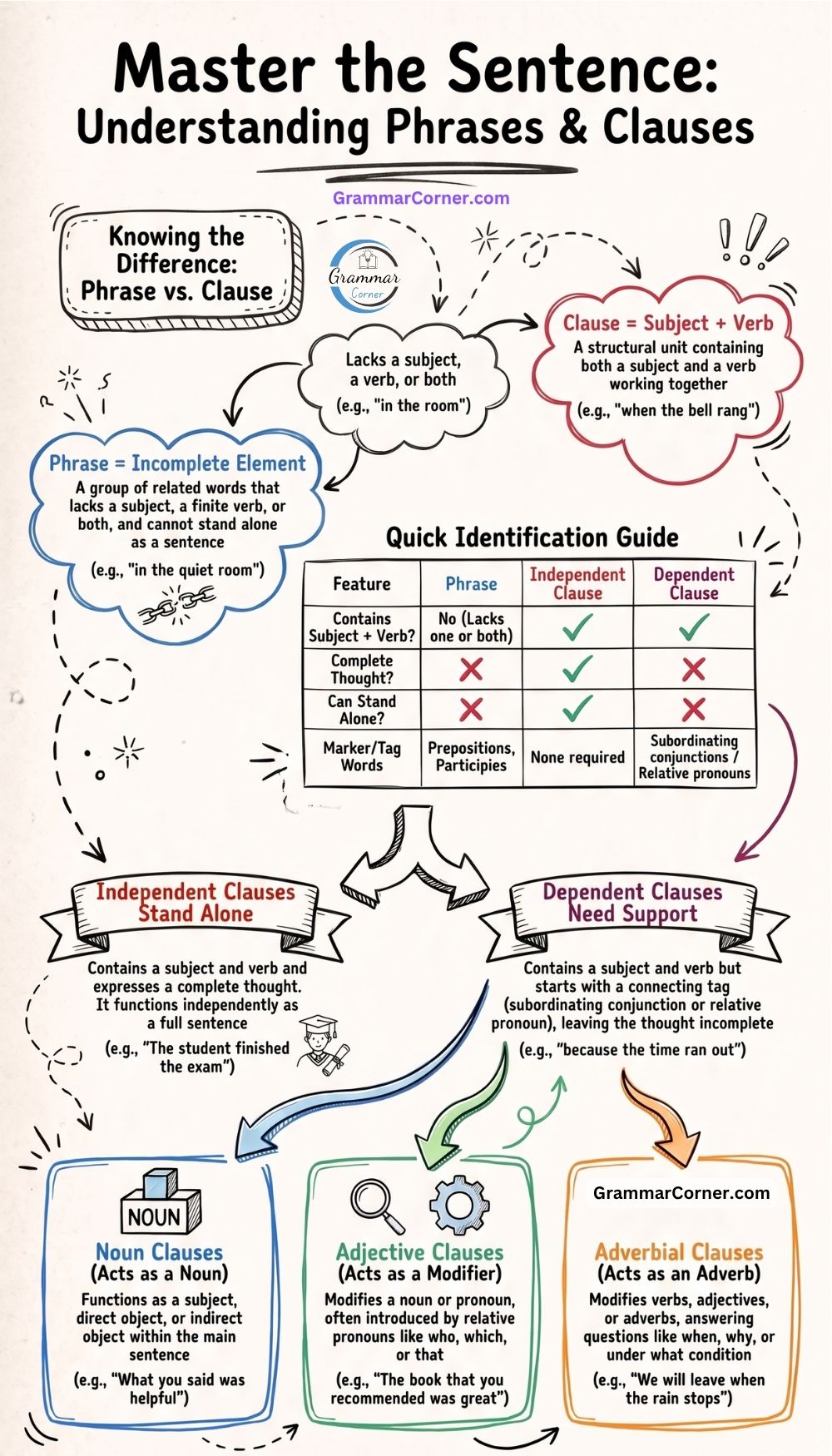
A clause is one of the fundamental building blocks of English sentences. It is a group of related words containing a subject and a verb working together as a single grammatical unit.
Why Understanding Clauses Matters
Once you recognize how clauses function, it becomes simple to:
Exploring Clause Structures: Same Core, Different Roles
Consider these three related word groups:
Independent Clause Contains a subject (children) and verb (laughed). Expresses a finished thought and stands alone as a complete sentence.
Dependent Clause Contains the same subject and verb, but the word because makes the thought incomplete. It requires connection to another clause.
Dependent Clause Includes an adverb (loudly) and a subordinating conjunction (when). It leaves the reader waiting for the main action.
Anatomy of a Clause in Action
Let’s look at another simple pairing:
Together, this subject-verb combination forms a complete, standalone clause.
Combining Clauses in Complex Sentences
Now observe what happens when we expand the sentence:
This sentence contains two distinct clauses working together:
Expresses a complete thought and can stand alone as its own full sentence.
Contains its own subject (she) and verb (was), but cannot stand alone because because makes it dependent on the first clause for complete meaning.
✨ Quick Challenge
Which of the following word groups forms a clause (possesses both a subject and a verb)? Tap your answer.
See the full answer
Answer: “because the lights went out”
A clause requires both a subject and a finite verb:
- “because the lights went out” ➔ Subject: the lights | Verb: went (Dependent Clause).
- “under the bright morning sun” = Prepositional Phrase (no verb).
- “to run five miles every day” = Infinitive Phrase (no subject performing a finite action).
- “smiling at the friendly audience” = Participial Phrase (no grammatical subject).
Clause vs. Phrase: What Is the Difference?
Clauses and phrases are often confused because both are groups of related words. The single easiest way to tell them apart is to look for a subject–verb pairing:
- A phrase lacks a complete subject-and-verb combination.
- A clause contains both a subject and a verb working together.
Examples Breakdown: Phrase vs. Clause
| Group of Words | Classification | Grammatical Reason |
|---|---|---|
| in the garden | Phrase | No subject + verb combination |
| after lunch | Phrase | No subject + verb combination |
| the children played | Clause | Contains subject (children) + verb (played) |
| because the children played | Clause | Contains subject (children) + verb (played) |
| under the old bridge | Phrase | No subject + verb combination |
| where the children played | Clause | Contains subject (children) + verb (played) |
Comparing Phrases and Clauses in Context
Notice how similar ideas take different grammatical forms in full sentences:
at the station = Phrase (Prepositional phrase; no subject or finite verb).
until the train arrived = Clause (Contains subject the train and verb arrived).
When you are unsure whether a group of words is a clause, ask:
- If yes ➔ It is a clause.
- If no ➔ It is a phrase.
What Are the Two Main Types of Clauses?
Clauses are broadly divided into two foundational categories based on whether they can stand alone as a complete thought:
| Clause Type | Other Name | Can Stand Alone? | Example |
|---|---|---|---|
| Independent clause | Main clause | Yes | The rain stopped. |
| Dependent clause | Subordinate clause | No | because the rain stopped |
Express a complete thought and contain everything required to function as an independent, standalone sentence.
Contain a subject and verb, but begin with a connecting word (subordinating conjunction or relative pronoun) that leaves the thought unfinished.
What Is an Independent Clause?
An independent clause contains both a subject and a verb and expresses a complete, finished thought. Because it makes sense entirely on its own, it can stand as an independent sentence.
Examples of Independent Clauses
Each of the following functions as a complete, standalone sentence:
- The students finished their work.
- My brother lives in Lahore.
- The sun has disappeared.
- We enjoyed the concert.
An independent clause does not have to be short. Complex sentences can contain multiple dependent modifiers while still rotating around a central independent clause:
Even with relative and adverbial clauses attached, the core independent clause (“The students finished their assignments”) carries the main predicate and thought.
Independent Clause Anatomy
Often called a main clause, an independent clause carries the central message of the sentence:
| Independent Clause | Subject | Verb (Predicate) |
|---|---|---|
| Sara smiled. | Sara | smiled |
| The boys were playing. | The boys | were playing |
| My father drives carefully. | My father | drives |
| The old house looks beautiful. | The old house | looks |
What Is a Dependent Clause?
A dependent clause (also known as a subordinate clause) contains a subject and a verb, but it cannot stand alone as a complete sentence because it leaves the thought unfinished.
Deconstructing a Dependent Clause
Consider this incomplete thought:
To make sense, it must be paired with an independent clause:
The subordinate clause adds vital supporting detail to the main idea.
Common Signs of a Dependent Clause
Dependent clauses are frequently signaled by subordinating conjunctions or relative pronouns:
Independent vs. Dependent Clauses
To master sentence structure, it is essential to distinguish between a clause that carries a complete statement and one that functions as a grammatical modifier:
| Independent Clause | Dependent Clause |
|---|---|
| Can stand alone as a sentence | Cannot normally stand alone |
| Expresses a complete thought | Leaves the thought unfinished |
| Forms a full sentence by itself | Needs an independent clause to complete its meaning |
| May be joined to another independent clause | Depends entirely on a main clause |
| Example: “She opened the door.” | Example: “because she heard a noise” |
Combined, they form a complete, grammatically sound sentence.
What Are the Main Types of Dependent Clauses?
Dependent clauses are categorized based on the functional grammatical role they fulfill within a sentence. The three core types are:
| Clause Type | Main Function | Questions Answered | Example |
|---|---|---|---|
| Noun Clause | Acts as a noun (subject, object, complement) | What? Who? | What she said surprised me. |
| Adjective Clause | Modifies or describes a noun/pronoun | Which one? What kind? | The book that you gave me is useful. |
| Adverb Clause | Modifies a verb, adjective, or clause | When? Why? How? Under what condition? | We stayed inside because it rained. |
Note: Specialized types (like conditional or comparative clauses) typically function as sub-varieties of adverbial or relative constructions.
What Is a Noun Clause?
A noun clause is a dependent clause that performs the exact structural role of a noun. Because nouns can serve as subjects, direct objects, or subject complements, noun clauses can slot into any of those positions:
Key Grammatical Roles of Noun Clauses
Common Words That Introduce Noun Clauses
Noun clauses typically begin with relative pronouns, interrogatives, or subordinators:
- I know where she lives.
- Tell me what you need.
- Nobody knows why he left.
- We wondered whether they would agree.
- She explained how the machine works.
“I know [what she wants]” ➔ “I know [the answer].”
If the sentence remains grammatically sound, you are working with a noun clause!
What Is an Adjective Clause (Relative Clause)?
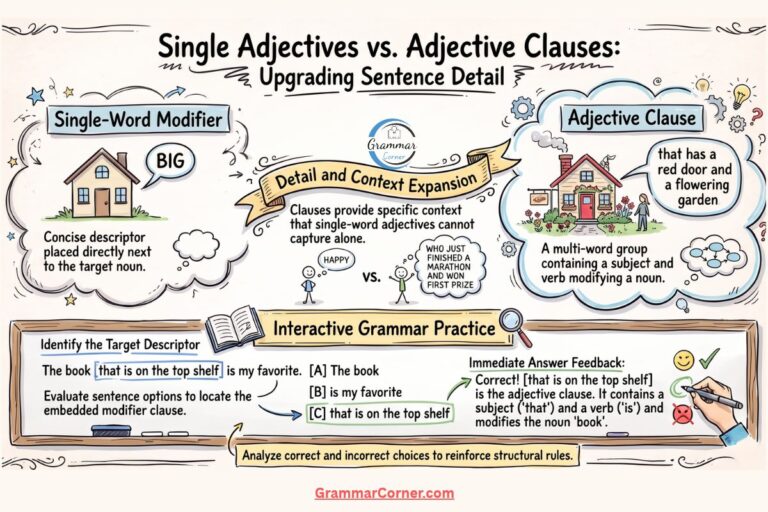
An adjective clause (often called a relative clause) is a dependent clause that modifies, identifies, or adds descriptive detail to a noun or pronoun. It typically follows immediately after the word it describes:
Examples of Adjective Clauses
- The woman who lives next door is a doctor. (describes woman)
- I read the book that you recommended. (describes book)
- This is the house where my grandfather was born. (describes house)
- I remember the day when we first met. (describes day)
- He is the person whom I contacted yesterday. (describes person)
Common Relative Pronouns and Adverbs
| Word | Typical Use | Example in a Sentence |
|---|---|---|
| who | People (as subjects) | The student who won received a prize. |
| whom | People (as objects in formal writing) | The person whom I called answered. |
| whose | Possession | The girl whose bag was lost went home. |
| which | Things, ideas, and animals | The car which broke down was old. |
| that | People or things (essential defining clauses) | The movie that we watched was funny. |
| where | Places | This is the park where we played. |
| when | Times and occasions | I remember the year when we moved. |
| why | Reasons | I know the reason why she left. |
✨ Quick Challenge
In the sentence “What the committee decided will affect the entire organization,” what is the functional role of the highlighted clause? Tap your answer.
See the full answer
Answer: A noun clause acting as the subject of the sentence
Apply the Noun Clause Replacement Test:
- “[What the committee decided] will affect the entire organization.”
- ➔ Substitute with a noun/pronoun: “[The decision / It] will affect the entire organization.”
- Because it performs the core role of a subject noun phrase for the verb will affect, it is a noun clause.
Defining and Non-Defining Adjective Clauses
Adjective clauses (relative clauses) provide descriptive information about nouns. Based on whether the detail is strictly necessary to identify the noun or simply supplementary, they are split into two categories:
Essential to the sentence. It tells the reader exactly which person, place, or item is being discussed.
• No commas are used.
Provides bonus information about a noun that has already been clearly identified or named.
• Commas are required to enclose the clause.
Defining vs. Non-Defining at a Glance
| Clause Type | Core Purpose | Commas Required? |
|---|---|---|
| Defining (Restrictive) | Identifies and limits the specific noun | Usually No |
| Non-Defining (Non-Restrictive) | Adds parenthetical, extra background information | Yes (enclosed in commas) |
• If Yes ➔ It is defining (No commas).
• If No (the noun is already fully identified on its own) ➔ It is non-defining (Set it off with commas).
What Is an Adverb Clause?
An adverb clause is a dependent clause that modifies a verb, an adjective, another adverb, or even an entire independent clause. It provides essential context surrounding an action or state.
What Adverb Clauses Tell Us
Common Types of Adverb Clauses
| Clause Type | Common Conjunctions / Signals | Example Sentence |
|---|---|---|
| Time | when, before, after, while, until, as soon as | Call me when you arrive. |
| Place | where, wherever | Sit wherever you like. |
| Reason | because, since, as | We left because it was late. |
| Condition | if, unless, provided that, as long as | I will help if you ask. |
| Contrast (Concession) | although, though, even though, while | Although he was tired, he continued. |
| Purpose | so that, in order that | She whispered so that nobody would hear. |
| Result | so… that, such… that | It was so cold that the lake froze. |
| Comparison | than, as… as | He runs faster than I do. |
Where Can an Adverb Clause Appear?
An adverb clause offers flexibility in placement—it can appear either at the beginning or at the end of a sentence. The placement dictates whether a comma is required:
The Standard Punctuation Rule to Remember
“Although it was late, we continued working.”
“We continued working although it was late.”
What Is a Conditional Clause?
A conditional clause is a specialized type of adverbial clause that outlines a condition (the circumstance) alongside its potential result.
Common Conditional Words
Examples in everyday usage:
- If you study regularly, you will improve.
- You will miss the bus unless you leave now.
- You can borrow my book as long as you return it tomorrow.
The Four Core Conditional Patterns
| Conditional Type | Basic Verb Pattern | Example Sentence |
|---|---|---|
| Zero Conditional General truths & facts |
If + present, present |
If water reaches 100°C, it boils. |
| First Conditional Realistic future possibilities |
If + present, will + verb |
If you hurry, you will catch the bus. |
| Second Conditional Hypothetical present/future |
If + past, would + verb |
If I had more time, I would travel. |
| Third Conditional Unreal past situations |
If + past perfect, would have + past participle |
If she had studied, she would have passed. |
How Do Clauses Combine to Form Sentences?
Clauses are the fundamental building blocks writers combine to create the four basic sentence types in English:
• because the weather was pleasant — Dependent
• their parents sat nearby — Independent
Sentence Structure Summary at a Glance
| Sentence Type | Clause Pattern | Example Sentence |
|---|---|---|
| Simple | 1 independent clause | She smiled. |
| Compound | 2+ independent clauses | She smiled, and I waved. |
| Complex | 1 independent + 1+ dependent clause | She smiled because she was happy. |
| Compound-Complex | 2+ independent + 1+ dependent clause | She smiled because she was happy, and I waved. |
Coordinating Conjunctions and Clauses
When two independent clauses are connected into a compound sentence using a coordinating conjunction, standard punctuation places a comma directly before the conjunction.
The standard coordinating conjunctions (often remembered by the acronym FANBOYS) are:
Do Not Confuse a Conjunction With a Clause
It is essential to distinguish between the single connecting word and the complete grammatical clause:
- “because” is solely the subordinating conjunction.
- “because I was tired” is the complete dependent clause (containing conjunction + subject + verb).
Keeping this distinction clear prevents confusion when analyzing complex sentences with multiple clauses.
Subordinating Conjunctions and Dependent Clauses
Subordinating conjunctions establish the logical relationship between a dependent clause and the main independent clause it modifies.
| Logical Relationship | Common Subordinating Conjunctions |
|---|---|
| Time | when, while, before, after, until, once, as soon as |
| Reason / Cause | because, since, as |
| Condition | if, unless, provided that, as long as |
| Contrast / Concession | although, though, even though, while, whereas |
| Purpose | so that, in order that |
| Place | where, wherever |
| Comparison | than, as… as |
The subordinating conjunction although establishes a concession and signals that the opening clause relies on the main clause (“the students completed it”) for complete meaning.
Relative Pronouns and Relative Adverbs
Relative words introduce adjective (relative) clauses, linking the clause directly to a specific noun or pronoun in the sentence.
Connect clauses describing people, things, or possession.
Connect clauses describing places, times, or reasons.
• “I remember the day when we graduated.”
• “I understand the reason why she left.”
✨ Quick Challenge
Which of the following sentences correctly joins two independent clauses using a coordinating conjunction (FANBOYS) and standard punctuation? Tap your answer.
See the full answer
Answer: “The report was due at noon, so we submitted it early.”
Understanding conjunctions and clause connections:
- Coordinating Conjunction (FANBOYS): When connecting two independent clauses (each with its own subject and verb), place a comma before the conjunction (“…, so we submitted it early”).
- Subordinating Conjunctions: Words like although, because, while create dependent adverbial clauses rather than compound sentences.
- Compound Predicate: If the second verb shares the subject with no new subject introduced, do not use a comma before and.
How to Identify Clauses in a Sentence
Accurately identifying clauses is much easier when following a structured, 4-step process rather than relying on punctuation or guesswork.
Verbs: stopped | went | wanted (infinitive: to play)
• the rain ➔ stopped | • the children ➔ went | • they ➔ wanted
Unit 1: “When the rain stopped” | Unit 2: “the children went outside” | Unit 3: “because they wanted to play”
| Clause Identified | Clause Type |
|---|---|
| When the rain stopped | Dependent Clause |
| the children went outside | Independent Clause (Main) |
| because they wanted to play | Dependent Clause |
Can a Sentence Have More Than Two Clauses?
Yes. Sentences frequently contain three, four, or more clauses woven together. Long, sophisticated sentences are typically built by connecting several compact clause units:
Deconstructing the Clause Hierarchy:
Clause Punctuation: When Do You Need a Comma?
Punctuation marks around clauses are determined by their position and grammatical role:
Always place a comma after an introductory subordinate clause.
• “After the meeting ended, everyone went home.”
No comma is normally required when the essential clause follows.
• “Everyone went home after the meeting ended.”
Place a comma before a coordinating conjunction (FANBOYS).
Enclose extra, non-essential descriptive clauses in commas.
Common Clause Mistakes to Avoid
Clause vs. Phrase vs. Sentence: Side-by-Side Comparison
Understanding the exact boundaries between a phrase, a clause, and a sentence clarifies how syntactic structures work together:
| Feature | Phrase | Clause | Sentence |
|---|---|---|---|
| Group of words? | Yes | Yes | Usually yes (except 1-word commands) |
| Subject + Verb pairing? | No | Yes | Yes (at least one clause) |
| Can stand alone? | No | Sometimes (only if independent) | Yes |
| Example | in the morning | when she arrived | She arrived early. |
Quick Clause Identification Decision Chart
Use this reference table to classify any clause unit in a sentence:
| Question to Ask | If the Answer Is Yes… |
|---|---|
| Does the group contain a subject and a verb? | It is a clause. |
| Can it stand alone as a complete thought? | It is an independent clause. |
| Does it leave the thought unfinished and rely on a main clause? | It is a dependent clause. |
| Does it function as a subject, object, or complement? | It is a noun clause. |
| Does it describe or modify a noun/pronoun? | It is an adjective (relative) clause. |
| Does it modify an action with time, reason, manner, or place? | It is an adverb clause. |
| Does it express a condition and consequence (e.g., with if, unless)? | It is a conditional clause. |
| Does it provide essential information to identify the noun? | It is a defining relative clause (no commas). |
| Does it add non-essential, extra information to a named noun? | It is a non-defining relative clause (use commas). |
Practice: Identify the Clauses
Read each sentence and identify its clause units. Then classify each clause as independent or dependent:
- When the lights went out, everyone became silent.
- I called my friend because I needed some advice.
- The book that you lent me is excellent.
- She stayed home although she wanted to attend the party.
- If you finish early, you can leave.
- The teacher smiled, and the students relaxed.
- I know what you are trying to explain.
- The restaurant where we had dinner was crowded.
- After the rain stopped, the children returned outside.
- He worked hard, but he did not complain.
A Mini Challenge: Multi-Layered Clause Hierarchy
Try identifying all the embedded clause units in this complex sentence:
Notice how complex sentences embed clauses inside other dependent clauses like nested puzzle pieces!
Why Clauses Are Fundamental to Strong Writing
Clauses are the architectural framework that determines how thoughts connect. Mastering them allows you to:
How Clauses Transform and Elevate Your Writing
Observe how replacing isolated short sentences with purposeful clause structures enhances fluidity and cohesion:
✨ Quick Challenge
Three of these options represent phrases (lacking a subject-verb pair). One is a clause (possessing both a subject and a verb). Tap the one that is a clause.
See the full answer
Answer: “because the power failed”
Distinguishing phrases from clauses:
- Clause: “because the power failed” contains both a subject (the power) and a verb (failed).
- Phrases: “across the wide river” (prepositional), “walking down the quiet street” (participial), and “to finish the project before Friday” (infinitive) are groups of words that lack an active subject-plus-finite-verb combination.
Frequently Asked Questions About Clauses
- Independent Clauses (Main Clauses): Express a complete thought and can stand alone as sentences.
- Dependent Clauses (Subordinate Clauses): Contain a subject and verb but leave the thought unfinished, requiring an independent clause to complete their meaning.
- Noun Clause: Acts as a noun (functioning as a subject, direct object, or complement).
- Adjective (Relative) Clause: Modifies, identifies, or describes a noun or pronoun.
- Adverb Clause: Modifies verbs, adjectives, or entire clauses to express time, place, reason, condition, contrast, or purpose.
- “under the table” ➔ Phrase (Prepositional phrase; no subject or finite verb).
- “where the cat sleeps” ➔ Clause (Contains subject the cat and verb sleeps).
• When the class ended (Dependent clause)
• the students packed their books (Independent clause)
• [and they] left the room (Coordinated independent clause)
• “because the room was hot” ➔ Incomplete Fragment on its own