Nouns That Start With K (Abstract, Concrete, Proper & Positive Nouns)
Think about the everyday words you use without even noticing. A surprising number of them begin with the letter K.
- kettle
- knife
- keys
- kid
These are familiar words that turn up in ordinary conversation all day long, which makes K more useful than most people realize.
The letter K may not begin as many English words as S or C, but it still gives us plenty of useful nouns. They cover everyday objects, people, foods, places, and important ideas such as kindness, knowledge, and kinship. Learning them builds a stronger vocabulary for speaking, writing, and reading.
Quick Challenge
Three of these four words are nouns. One is not. Tap the word that doesn’t belong.
See the full answer
Answer: knew. It’s the past tense of the verb know, so it names an action rather than a thing.
Try putting the in front of each word and you’ll hear the problem straight away: the kangaroo, the knowledge, and the kiosk all sound normal, but the knew is not English at all.
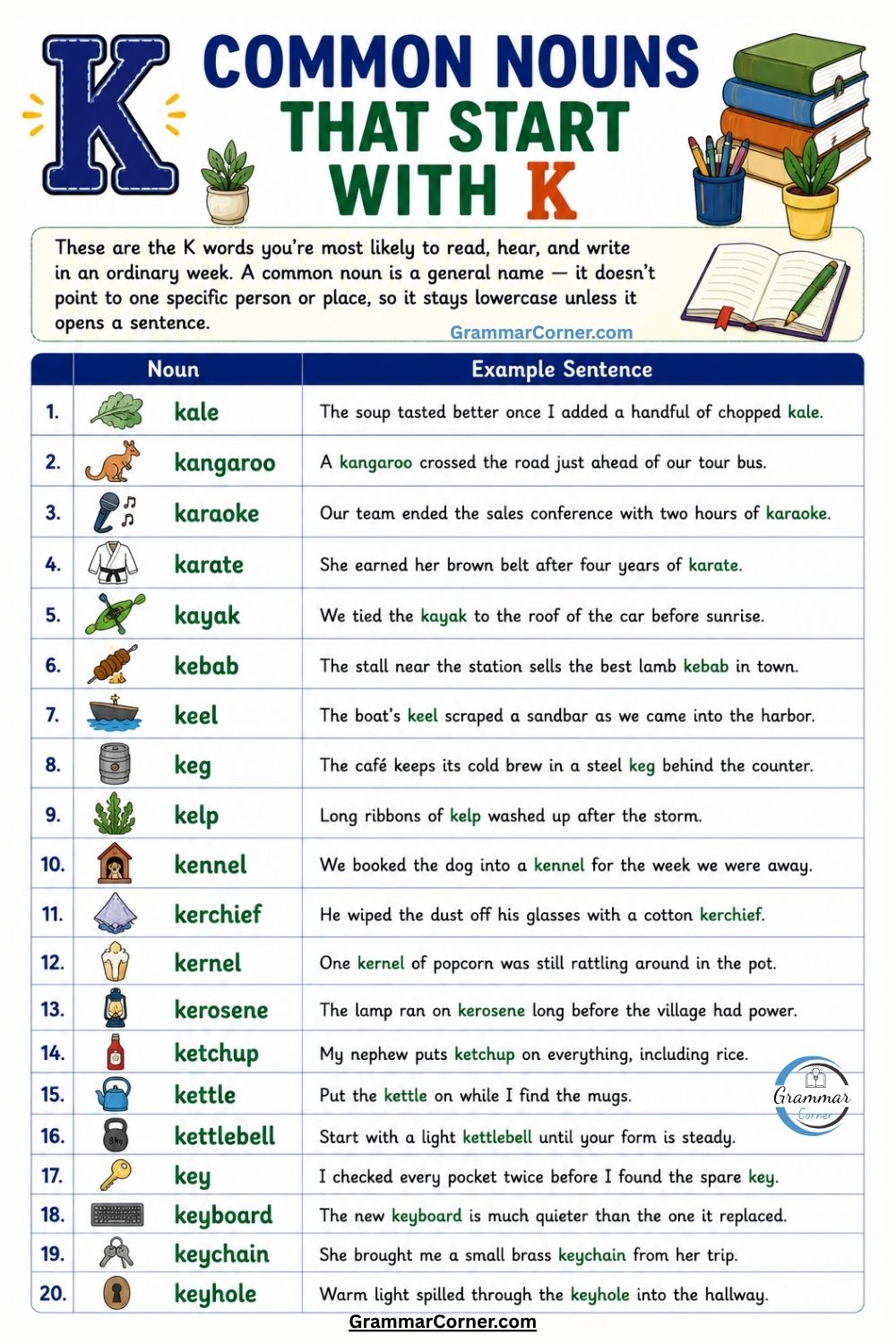
Common Nouns That Start with K
These are the K words you’re most likely to read, hear, and write in an ordinary week. A common noun is a general name — it doesn’t point to one specific person or place, so it stays lowercase unless it opens a sentence.
| Noun | Example Sentence |
|---|---|
| kale | The soup tasted better once I added a handful of chopped kale. |
| kangaroo | A kangaroo crossed the road just ahead of our tour bus. |
| karaoke | Our team ended the sales conference with two hours of karaoke. |
| karate | She earned her brown belt after four years of karate. |
| kayak | We tied the kayak to the roof of the car before sunrise. |
| kebab | The stall near the station sells the best lamb kebab in town. |
| keel | The boat’s keel scraped a sandbar as we came into the harbor. |
| keg | The café keeps its cold brew in a steel keg behind the counter. |
| kelp | Long ribbons of kelp washed up after the storm. |
| kennel | We booked the dog into a kennel for the week we were away. |
| kerchief | He wiped the dust off his glasses with a cotton kerchief. |
| kernel | One kernel of popcorn was still rattling around in the pot. |
| kerosene | The lamp ran on kerosene long before the village had power. |
| ketchup | My nephew puts ketchup on everything, including rice. |
| kettle | Put the kettle on while I find the mugs. |
| kettlebell | Start with a light kettlebell until your form is steady. |
| key | I checked every pocket twice before I found the spare key. |
| keyboard | The new keyboard is much quieter than the one it replaced. |
| keychain | She brought me a small brass keychain from her trip. |
| keyhole | Warm light spilled through the keyhole into the hallway. |
| keypad | Type the four-digit code into the keypad by the gate. |
| keyword | Choosing the right keyword changed how many people found the article. |
| khaki | Khaki hides dust better than any other color in the store. |
| kick | The goalkeeper’s kick sent the ball past the halfway line. |
| kickoff | Kickoff was delayed twenty minutes because of the rain. |
| kickstand | Lower the kickstand before you let go of the bike. |
| kid | Every kid in the class wanted a turn feeding the rabbit. |
| kidney | The doctor explained how each kidney filters waste from the blood. |
| kilobyte | The whole document was under one kilobyte of plain text. |
| kilogram | A kilogram of mangoes costs less at the weekend market. |
| kilometer | The last kilometer of the race felt longer than the first ten. |
| kilowatt | Our meter shows exactly what one kilowatt costs after midnight. |
| kilt | He wore his grandfather’s kilt to the wedding. |
| kimono | A silk kimono hung in the window of the vintage shop. |
| kindergarten | My daughter starts kindergarten in September. |
| kindling | We split some dry kindling before lighting the stove. |
| king | In the story, the king refuses to leave his burning city. |
| kingdom | The kingdom traded salt and cloth with its neighbors for centuries. |
| kingfisher | A kingfisher dropped off the branch and came up with a fish. |
| kiosk | Buy your ticket at the kiosk near platform three. |
| kiss | She blew a kiss from the departure gate. |
| kit | The first-aid kit lives under the passenger seat. |
| kitchen | Our kitchen is too small for two people to cook in at once. |
| kite | The kite climbed until it was just a dot above the field. |
| kitten | The kitten fell asleep inside an empty shoebox. |
| kiwi | Slice the kiwi thinly so it fits neatly on the tart. |
| knapsack | He carried a canvas knapsack with one change of clothes in it. |
| knee | My knee aches whenever the weather turns cold. |
| knife | Use a serrated knife for tomatoes. |
| knight | In the film, a knight rides for three days to deliver one letter. |
| knitting | She keeps her knitting in a basket beside the sofa. |
| knitwear | The shop moves its knitwear to the front window in October. |
| knob | The knob on the oven door has come loose again. |
| knock | A soft knock at the door interrupted the meeting. |
| knockout | The fight ended in a knockout in round three. |
| knot | Loosen the knot before you pull on the rope. |
| knuckle | He tapped one knuckle twice on the counter to get her attention. |
| koala | A koala sleeps for most of the day. |
| koi | Two orange koi circled the pond in the hotel courtyard. |
| kumquat | You can eat a kumquat whole, skin and all. |
A Note on Spelling
This article uses American spelling. Three K words change slightly in British English.
- kilometer / kilometre — the same pattern applies to kilogram, which is occasionally written kilogramme in older British texts.
- curb / kerb — the raised edge of a pavement is a curb in American English and a kerb in British English, though both varieties use curb for the verb meaning “to restrain.”
- kebab is standard in both, but American menus also print kabob and kebob.
Pick one system and stay with it across a whole piece of writing. Mixing kilometre and color in the same paragraph is the kind of small slip that makes editors reach for a red pen.
Quick Quiz: Countable or Uncountable?
Countable nouns can be counted one by one and take a plural form (one key, two keys). Uncountable nouns are treated as a mass and have no normal plural (ketchup, not ketchups). Decide which each of these is.
-
kettle
-
ketchup
-
knuckle
-
kale
-
kite
-
karma
The pattern holds across the whole letter: separate objects you can point at are countable, while substances and ideas are not.
Did You Know? The Kangaroo Myth
There’s a story that gets repeated in classrooms everywhere: when European sailors asked what the strange hopping animal was called, the local people answered kangaroo, meaning “I don’t understand” — and the visitors wrote the phrase down as the animal’s name.
It’s a good story and it isn’t true. Linguists who studied the languages of northern Queensland found gangurru recorded in Guugu Yimithirr, where it names a large dark kangaroo. The sailors heard the word correctly; they just borrowed it for the whole family of animals rather than the one species it referred to.
Why mention it in a vocabulary article? Because word-origin stories spread faster than word origins do, and a confident-sounding one is easy to repeat in an essay. If an etymology sounds like a joke with a punchline, check it before you pass it on.
Positive NounsPositive Nouns That Start with K
English is honestly a little short of positive K words — there is no K equivalent of the long, generous lists you can build from G or H. But the ones that exist are strong, and several of them are words hiring managers, teachers, and editors genuinely notice.
| Noun | Example Sentence |
|---|---|
| kaleidoscope | The night market was a kaleidoscope of spices, fabric, and noise. |
| keenness | Her keenness for the role showed in every question she asked. |
| keeper | That soup recipe is a keeper. |
| keepsake | I kept the ticket stub as a keepsake from our first trip together. |
| keystone | Trust is the keystone of any long working partnership. |
| kickstart | The small grant gave the whole project the kickstart it needed. |
| kindliness | There was a real kindliness in the way she corrected my mistakes. |
| kindness | One small kindness from a stranger turned my whole morning around. |
| kinfolk | Every December my kinfolk gather at the oldest house on the street. |
| kinship | I felt an instant kinship with the other new hires. |
| kismet | Meeting my business partner on a delayed train felt like kismet. |
| knack | He has a knack for explaining difficult ideas simply. |
| knighthood | The engineer received a knighthood for forty years of public service. |
| know-how | The team had the funding but not the technical know-how. |
| kudos | Kudos goes to the volunteers who stayed until midnight. |
Register Check
Three of these need a light touch:
- kinfolk is informal and regional, common in American Southern speech. In a business email, write relatives or family.
- kudos is uncountable and comes from Greek. Treat it as singular: “Kudos is due to the whole team.” There is no such word as “a kudo” in careful writing.
- kismet carries a romantic, fated feeling. It fits a personal story beautifully and sits oddly in a project report.
Choose the Better Noun
Fill the gap in this sentence:
“They had years of experience with the software, but nobody had the ___ to rebuild it from scratch.”
a) knack b) know-how c) kindness
Reveal the answer
Answer: b) know-how. Know-how means practical expertise that someone learned and can apply — exactly what rebuilding software takes. Knack would suggest a natural gift they were born with, which clashes with “years of experience.” Kindness names a quality of character and has nothing to do with technical skill.
Abstract NounsAbstract Nouns That Start with K
An abstract noun names something you cannot see, touch, or weigh: an idea, a quality, a condition, a field of study. You can’t hand someone a bowl of knowledge.
| Noun | Example Sentence |
|---|---|
| karma | She joked that the flat tire was karma for skipping her turn in the carpool. |
| keeping | Leave the passports in my keeping until the tour ends. |
| kilter | The whole schedule went out of kilter after the power cut. |
| kinesiology | She studied kinesiology before training as a physiotherapist. |
| kinesthesia | Dancers rely on kinesthesia to know where their limbs are without looking. |
| kinetics | Tuesday’s lecture covered the kinetics of a simple chemical reaction. |
| kingship | The play asks whether kingship is a duty or a burden. |
| kink | We ironed out the last kink in the delivery schedule on Friday. |
| kitsch | The gift shop sells cheerful kitsch: plastic flamingos and glitter globes. |
| kleptomania | Kleptomania is a recognized medical condition, not simple dishonesty. |
| knavery | The villain in the novel is finally undone by his own knavery. |
| knowledge | Her knowledge of local history turned a short walk into the best hour of the trip. |
Concrete NounsConcrete Nouns That Start with K
The common noun table earlier is already full of concrete nouns (kettle, knife, kite), so this list adds a different set: objects, animals, plants, and foods that widen your vocabulary rather than repeat it.
| Noun | Example Sentence |
|---|---|
| kaftan | She wore a light cotton kaftan over her swimsuit. |
| kaolin | Fine kaolin clay is what gives the porcelain its white finish. |
| kestrel | A kestrel hovered above the field beside the highway. |
| kettledrum | The kettledrum announced the start of the final movement. |
| kibble | Measure the kibble instead of guessing, or the puppy will gain weight. |
| kickboard | Beginners hold a kickboard while they practice their leg movement. |
| kidney bean | Rinse every kidney bean before adding it to the pot. |
| kiln | The pots stay in the kiln overnight and come out the next morning. |
| kimchi | A spoonful of kimchi lifts a plain bowl of rice. |
| king crab | One king crab leg was more than enough for the two of us. |
| kipper | Breakfast was toast, strong tea, and a kipper. |
| klaxon | A klaxon sounded as the ferry pulled away from the dock. |
| knave | He turned over the knave of hearts and won the round. |
| kneecap | The X-ray showed a small crack in his kneecap. |
| knickknack | She dusted every knickknack on the shelf before the guests arrived. |
| knoll | We ate lunch on a grassy knoll above the parking lot. |
| knothole | Light came through a knothole in the fence. |
| kohl | She lined her eyes with kohl before the ceremony. |
| kohlrabi | Grate the kohlrabi into the salad for extra crunch. |
| kookaburra | A kookaburra laughed from the top of the fence post. |
| krill | Whales strain krill from the water by the ton. |
| kudu | A kudu stepped out of the trees near the waterhole. |
| kudzu | Kudzu covered the abandoned barn in a single summer. |
| kurta | He ironed his best kurta the night before the wedding. |
Quick Note
A kipper is a herring that has been split, salted, and smoked, and a knave is the playing card Americans call a jack. Both words are far more common in British English than American English, so meeting one in a novel usually tells you something about where the story is set.
Proper NounsProper Nouns That Start with K
A proper noun names one specific person, place, brand, language, or event — and it always takes a capital letter, wherever it sits in the sentence.
| Proper Noun | Example Sentence |
|---|---|
| Kafka | Kafka worked in an insurance office by day and wrote at night. |
| Kannada | Kannada is spoken by tens of millions of people in southern India. |
| Keats | Keats was only twenty-five years old when he died. |
| Kellogg’s | Kellogg’s started out as a cereal company in Michigan. |
| Kelvin | The Kelvin scale begins at absolute zero. |
| Kennedy | Kennedy took office in January 1961. |
| Kepler | Kepler worked out that planets travel in ellipses, not perfect circles. |
| Kevlar | Kevlar is light enough to wear and strong enough to stop a blade. |
| Kickstarter | The board game hit its funding target on Kickstarter in nine hours. |
| Kindle | She reads on a Kindle so she can travel with one book-shaped device. |
| Kiswahili | Kiswahili is the name Swahili speakers use for their own language. |
| Kleenex | People say Kleenex when they mean any paper tissue at all. |
| Klondike Gold Rush | The Klondike Gold Rush drew thousands of people north in the 1890s. |
| Kodak | Kodak once dominated the market for camera film. |
| Korean | He takes Korean classes on Saturday mornings. |
| Krebs cycle | The Krebs cycle explains how cells release energy from food. |
| Kremlin | The Kremlin sits at the center of Moscow. |
| Kuiper Belt | Pluto orbits inside the Kuiper Belt. |
| Kurdish | Kurdish is written in more than one alphabet, depending on the country. |
| Kwanzaa | Kwanzaa runs from December 26 to January 1. |
Full List of Nouns That Start with K
54 words
- kabuki
- kaiser roll
- kappa
- karat
- kayaker
- kayaking
- keratin
- ketch
- ketone
- kettle corn
- keynote
- keystroke
- khan
- kibbutz
- kickback
- kickboxing
- kickflip
- kiddo
- kidnapper
- kidnapping
- killer
- killjoy
- kilo
- kilobit
- kilohertz
- kilojoule
- kindergartner
- kindred
- kingfish
- kingmaker
- kingpin
- kinsman
- kinswoman
- kitbag
- kitchenette
- kitty
- kneepad
- knell
- knitter
- knockdown
- knocker
- knockoff
- knuckleball
- koan
- kola nut
- kombucha
- korma
- kowtow
- kraken
- krona
- krypton
- kryptonite
- kung fu
- kvetch
A few of those deserve a sentence of explanation.
Word Notes
- kappa — the tenth letter of the Greek alphabet, and a symbol used constantly in statistics and physics.
- kibbutz — a collective farming community in Israel. The plural is kibbutzim.
- kickback — money paid secretly in return for a favor. The space matters: a kickback is a noun, but kick back as two words is a verb meaning to relax.
- knell — the slow ringing of a bell, especially for a death. You’ll almost always meet it as the death knell of something.
- koan — a short, puzzling question used in Zen practice, like the famous one about the sound of one hand clapping.
- kowtow — a deep, forehead-to-the-ground bow, and now more often a criticism: he kowtows to management.
- krona — a unit of currency in Sweden and Iceland. Norway and Denmark use the krone.
- kvetch — an informal American word, borrowed from Yiddish, for a person who complains constantly.
Country Names Starting With K
Eight countries have English names that begin with K, counting North and South Korea separately.
| Country Name | Capital |
|---|---|
| Kazakhstan | Astana |
| Kenya | Nairobi |
| Kiribati | Tarawa |
| North Korea | Pyongyang |
| South Korea | Seoul |
| Kosovo | Pristina |
| Kuwait | Kuwait City |
| Kyrgyzstan | Bishkek |
Notes Worth Having
- Kazakhstan’s capital changed names twice in recent memory. It was Astana until 2019, then Nur-Sultan, then Astana again from September 2022. Older textbooks and quiz answers may still say Nur-Sultan.
- Kiribati’s capital is officially Tarawa; the government offices sit on South Tarawa, which is where the population is concentrated.
- The two Koreas have longer official names: the Democratic People’s Republic of Korea in the north and the Republic of Korea in the south.
- Kosovo declared independence in 2008 and is recognized by many countries but not all, so it appears on some lists and not others.
- Kuwait City shares its name with the country, the same way Guatemala City, Panama City, and Luxembourg City do.
Quick Tip
No “the” before country names. Write “I flew to Kenya,” not “I flew to the Kenya.” English keeps “the” for a small group of country names built from plural or descriptive words — the Netherlands, the Philippines, the United Arab Emirates — and none of the K countries belongs to that group.
Place Names That Start with K
Cities, states, mountains, rivers, and parks — all proper nouns, all capitalized.
| Place | What It Is |
|---|---|
| Kabul | The capital and largest city of Afghanistan |
| Kalahari Desert | A vast dry region across Botswana, Namibia, and South Africa |
| Kansas | A state in the central United States, capital Topeka |
| Karachi | Pakistan’s largest city and its main seaport |
| Karakoram | A mountain range that includes K2, the world’s second-highest peak |
| Kathmandu | The capital of Nepal, set in a valley in the Himalayas |
| Kentucky | A southeastern US state, capital Frankfort |
| Kerala | A coastal state in southern India |
| Key West | An island city at the southern tip of Florida |
| Khartoum | The capital of Sudan, where the Blue Nile meets the White Nile |
| Kilauea | An active volcano on the island of Hawaii |
| Kilimanjaro | The highest mountain in Africa, in northern Tanzania |
| Kingston | The capital of Jamaica |
| Kinshasa | The capital of the Democratic Republic of the Congo |
| Kolkata | A major city in eastern India, formerly written Calcutta |
| Kraków | A historic city in southern Poland and its former royal capital |
| Kruger National Park | A large wildlife reserve in northeastern South Africa |
| Kuala Lumpur | The capital of Malaysia |
| Kyiv | The capital of Ukraine |
| Kyoto | A Japanese city that served as the imperial capital for centuries |
Real-Life Example
Your grandmother’s brass thimble sits in a drawer. You didn’t buy it, you didn’t pick it up on a trip, and it isn’t valuable — you keep it because it was hers.
Which noun would you choose: souvenir, memento, or keepsake?
Best answer: keepsake. A souvenir is something you buy while traveling, so it doesn’t fit an inherited object. A memento works — it reminds you of a person or an event — but keepsake is the most precise of the three, because the word literally means something kept for the sake of the person it came from. If the thimble had come from a museum gift shop in another city, souvenir would suddenly be the right word instead.
Common Mistakes When Using K-Nouns
These eight slips show up constantly in student work, emails, and first drafts. Each one is worth thirty seconds of your attention.
1. The plural of knife
❌ I bought two knifes for the kitchen.
✅ I bought two knives for the kitchen.
Most nouns ending in -f or -fe swap that ending for -ves: knife/knives, leaf/leaves, wife/wives. The form “knifes” does exist, but only as a verb (“he knifes through the crowd”), which is why spell-check lets it through.
2. Treating knowledge as countable
❌ She has many knowledges about design.
✅ She has a lot of knowledge about design.
✅ She has a good knowledge of design.
Knowledge is uncountable, so it has no plural. The second correction is the exception worth memorizing: when a describing word comes in front and “of” follows, “a knowledge of” is standard English.
3. “These kind of” instead of “these kinds of”
❌ These kind of mistakes are common in first drafts.
✅ These kinds of mistakes are common in first drafts.
✅ This kind of mistake is common in first drafts.
Kind is a noun, so it has to agree with the word in front of it. “This kind,” “these kinds” — never a plural pointer with a singular noun.
4. Inventing a singular for kudos
❌ He got a kudo for finishing the report early.
✅ He got kudos for finishing the report early.
Kudos is an uncountable Greek borrowing, not a plural. It takes a singular verb: “Kudos is due to the whole team.”
5. Losing the capital on proper nouns
❌ My cousin studies in korea and speaks korean.
✅ My cousin studies in Korea and speaks Korean.
Countries, languages, and the adjectives made from them are all proper nouns. If your keyboard autocorrects one but not the other, that’s a habit worth checking manually.
6. Karat and carat
❌ The ring is 18 carat gold. (in American English)
✅ The ring is 18 karat gold.
In American English, karat measures how pure gold is and carat measures how heavy a gemstone is. British English uses carat for both, so this is one to decide by audience. And caret — a third spelling — is the little proofreading mark that shows where to insert something.
7. Kernel and colonel
❌ He was promoted to kernel last year.
✅ He was promoted to colonel last year.
They sound identical, which is the whole problem. A kernel is a seed or the central part of something; a colonel is a senior military officer.
8. Spelling kindergarten
❌ My son starts kindergarden next year.
✅ My son starts kindergarten next year.
The word came into English from German, where “Kinder” means children and “Garten” means garden — a children’s garden. The English spelling kept the German -ten ending even though “garden” looks more natural to an English eye.
Practice Exercises
Exercise 1: Fill in the Blanks
- kettle
- kiosk
- knack
- kayak
- knuckles
- kilometer
- keepsake
- kindness
- Please put the ______ on; I could do with some tea.
- Buy your ticket from the ______ near the entrance.
- She has a real ______ for calming down anxious customers.
- We paddled the ______ across the lake before breakfast.
- He rapped his ______ against the window to get my attention.
- The last ______ of the trail runs steeply uphill.
- I kept her letter as a ______ of that summer.
- Small acts of ______ make a workplace much easier to be in.
Exercise 2: Choose the Correct Noun
- The ticket inspector waited at the (kiosk / kilt) on platform two.
- A (kitten / kettledrum) had climbed into the empty box.
- Her (knowledge / knuckle) of employment law saved the company a fine.
- The potter left the bowls in the (kiln / kelp) overnight.
- He received (kudos / kickback) from the whole department for the redesign.
Exercise 3: Match the Noun with Its Meaning
- kismet
- kiln
- knoll
- kudos
- kohlrabi
- a small rounded hill
- fate or destiny
- praise or recognition
- a vegetable that looks like a pale green turnip
- an oven used for hardening pottery
Exercise 4: Countable or Uncountable?
- kite
- karma
- kettle
- kimchi
- kangaroo
- kitsch
Exercise 5: Common or Proper?
- kangaroo
- Kenya
- kitchen
- Kwanzaa
- kilometer
- Kolkata
Exercise 6: Correct the Mistake
- We packed three knifes for the camping trip.
- These kind of errors slow the whole team down.
- My neighbor is learning kannada this year.
- He deserves a kudo for spotting the problem.
- My daughter finishes kindergarden in June.
Exercise 7: Rewrite the Sentence
Replace the vague underlined word with a more precise K noun.
- She has a thing for remembering people’s names. (natural ability)
- The shelf was covered in cheap decorative stuff. (showy, tacky items)
- I kept the boarding pass as a thing to remember the trip by. (kept for its personal meaning)
Show Answer Key
Exercise 1
1. kettle 2. kiosk 3. knack 4. kayak 5. knuckles 6. kilometer 7. keepsake 8. kindness
Exercise 2
1. kiosk 2. kitten 3. knowledge 4. kiln 5. kudos
Exercise 3
1–b, 2–e, 3–a, 4–c, 5–d
Exercise 4
1. countable 2. uncountable 3. countable 4. uncountable 5. countable 6. uncountable
Reminder: if you can put a number straight in front of it, it’s countable. “Two kimchis” doesn’t work, so you’d say “two jars of kimchi.”
Exercise 5
1. common 2. proper 3. common 4. proper 5. common 6. proper
Exercise 6
- We packed three knives for the camping trip.
- These kinds of errors slow the whole team down. (or “This kind of error slows…”)
- My neighbor is learning Kannada this year.
- He deserves kudos for spotting the problem.
- My daughter finishes kindergarten in June.
Exercise 7
- She has a knack for remembering people’s names.
- The shelf was covered in cheap kitsch.
- I kept the boarding pass as a keepsake.
Frequently Asked Questions
How many nouns start with the letter K?
A large dictionary lists a few thousand entries under K, but only a small share of those are nouns you’d use in normal writing — realistically a few hundred. K is one of the smaller letters in English because most of its words were borrowed rather than inherited: from Old Norse, German, Dutch, Japanese, Korean, Hindi, Urdu, Arabic, and Yiddish.
Why do knee, knife, and know start with a silent K?
Because English used to pronounce it. Speakers of Old and Middle English sounded both letters, so “knight” opened with something like k-nicht. The K dropped out of speech in the 1600s and the spelling never followed. That silent K only ever appears before the letter N.
What are some positive nouns that start with K?
Kindness, kinship, knack, knowledge, know-how, kudos, keenness, keepsake, kindliness, keystone, and kickstart are the most usable. The pool is genuinely small, so don’t waste time hunting for twenty more — learn these well instead.
Is knowledge countable or uncountable?
Uncountable. There’s no plural “knowledges,” and you can’t say “a knowledge” on its own. The one standard exception is when a describing word comes first: “a good knowledge of Spanish,” “a working knowledge of the software.”
Which countries start with K?
Kazakhstan, Kenya, Kiribati, North Korea, South Korea, Kuwait, and Kyrgyzstan — plus Kosovo, which is recognized by many countries but not all, so it appears on some lists and not others.
What’s the difference between karat, carat, and caret?
In American English, karat measures gold purity (“18 karat gold”), carat measures gemstone weight (“a two carat diamond”), and a caret is the proofreading mark that shows where to insert text. British English uses carat for both gold and gems.
What are the plurals of knife, kilo, and koala?
Knives, kilos, and koalas. Knife follows the -f to -ves rule; the other two just take -s. Two more worth knowing: kibbutz becomes kibbutzim, and kilo is simply the short form of kilogram, so it pluralizes like any ordinary noun.
Is kid acceptable in formal writing?
Not usually. Kid is fine in speech, in blog posts, and in friendly emails, but school reports, academic essays, and official documents want “child” or “children.” The same caution applies to “kiddo” and “kinfolk.”
What abstract nouns start with K?
Knowledge, kindness, kinship, karma, keenness, kitsch, kingship, kismet, kleptomania, kinetics, and know-how cover most of what you’ll need. Remember the test: if you can’t see it, touch it, or photograph it, it’s abstract.
What are good K nouns for young children?
Kite, kitten, king, key, kangaroo, koala, kitchen, kiwi, knee, and kick. They work well early because a child can point at nearly all of them, which makes the word stick without any explanation.
Does kudos take a singular or a plural verb?
Singular. Write “Kudos is due to the design team,” not “Kudos are due.” The final s belongs to the original Greek word — it isn’t an English plural ending, which is why “a kudo” isn’t standard.
See also: