Adjective Phrases (Definition, Structure & Examples)
What Is an Adjective Phrase?
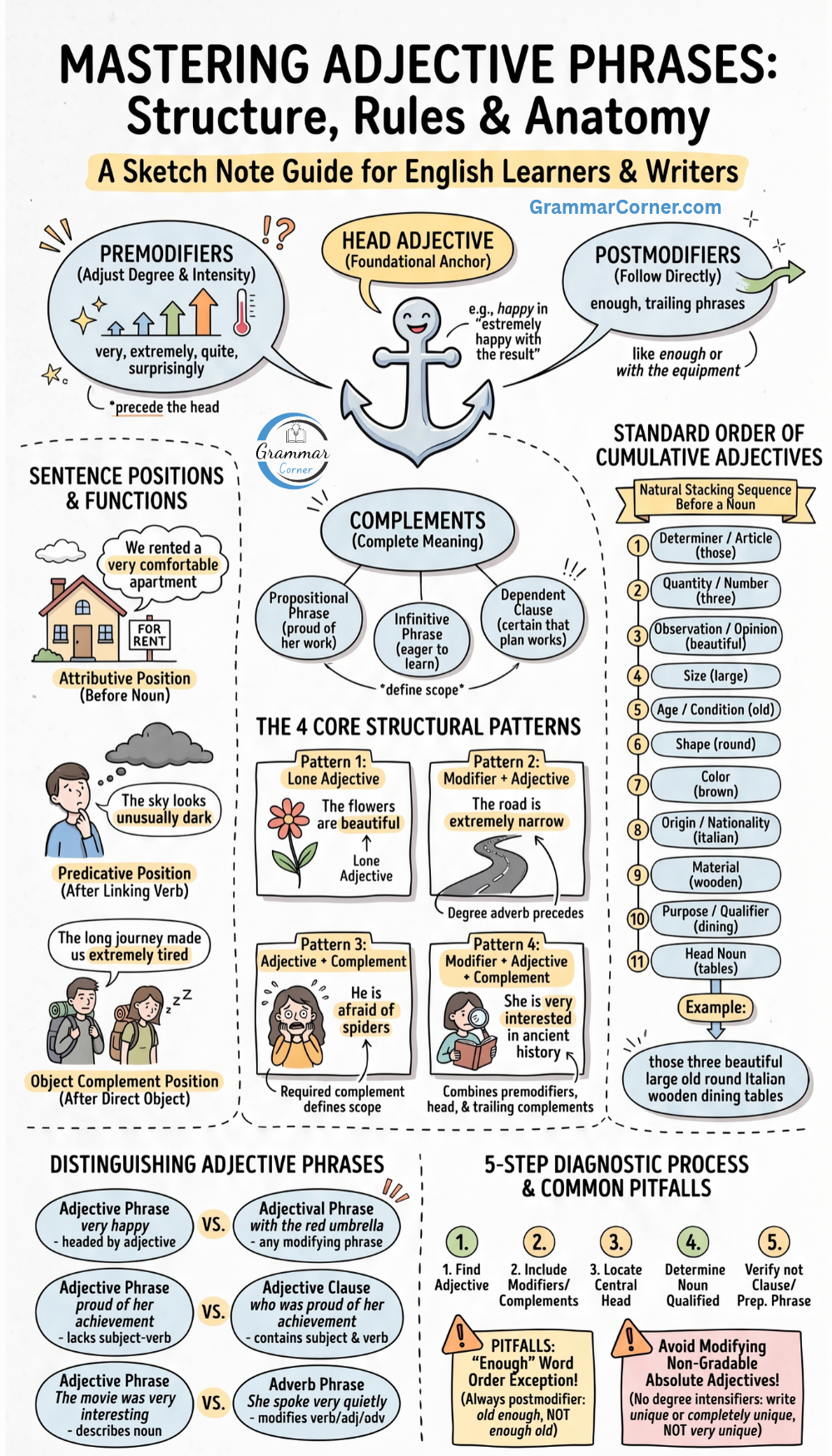
An adjective phrase is a group of words whose central, defining word is an adjective. The adjective serves as the head of the phrase, and surrounding words may appear before or after it to modify, intensify, or complete its meaning.
Compare how the base adjective expands with surrounding words:
In each variation, the core word is beautiful. The additional elements enrich the phrase by clarifying degree, time, or circumstance.
The adjective hot is the head of the phrase. The adverb very acts as a pre-modifier that specifies the exact degree.
The adjective proud is the head word, while the prepositional phrase of her achievement serves as a complement completing its meaning.
An adjective phrase can consist of a single lone adjective (“The child is happy.”) or an expanded multi-word structure (“The child is extremely happy with the results of the competition.”). The total word count does not define the phrase—the presence of the head adjective does.
The Head Adjective
The head is the foundational anchor that gives the whole phrase its grammatical classification:
- In “a very expensive car” ➔ Head: expensive
- In “She is quite certain about the answer” ➔ Head: certain
- In “They were eager to begin the journey” ➔ Head: eager
Modifiers and complements can be added before or after, but the head adjective remains the grammatical core.
How an Adjective Phrase Is Built
Adjective phrases commonly follow these fundamental structural patterns:
✨ Quick Challenge
In the sentence “The students were remarkably enthusiastic about the project,” which word is the head of the highlighted adjective phrase? Tap your answer.
See the full answer
Answer: “enthusiastic”
In the phrase remarkably enthusiastic about the project:
- remarkably = Adverb modifier (specifying degree)
- enthusiastic = Head Adjective (the core grammatical anchor)
- about the project = Prepositional complement (completing the meaning of enthusiastic)
Adjective Phrase Structure
Understanding how adjective phrases are assembled makes identifying them in complex sentences straightforward.
An adjective does not require additional modifiers to form an adjective phrase:
A modifier placed before the head adjective indicates degree, frequency, or attitude:
- The test was quite difficult.
- The road is extremely narrow.
- She looks very tired.
Certain adjectives require following structures to complete their core meaning:
- He is afraid of spiders.
- She is interested in photography.
- They are ready to leave.
An adjective phrase can combine premodifiers, the central head, and trailing complements:
• Head Adjective: interested
• Complement: in ancient history
Parts of an Adjective Phrase
An adjective phrase can feature up to four functional elements:
1. Head Adjective
The head is the central anchor word that defines the entire phrase:
- beautiful
- extremely beautiful
- beautiful enough
- beautiful in its simplicity
Across all four variations, beautiful remains the head.
2. Premodifiers
Premodifiers precede the head adjective and typically express degree or intensity. Common adverbs include:
- very cold
- surprisingly easy
- extremely useful
- rather expensive
3. Postmodifiers
Postmodifiers follow directly after the head adjective:
- happy enough
- beautiful to look at
- different from mine
- careful with the equipment
4. Complements
A complement provides the specific information required to complete an adjective’s semantic scope:
The complement of dogs specifies exactly what triggers the fear.
Common adjective + complement patterns include:
Examples of Adjective Phrases
| Sentence | Adjective Phrase | Head | Function |
|---|---|---|---|
| The room is very quiet. | very quiet | quiet | Describes the room |
| She seems extremely nervous. | extremely nervous | nervous | Describes she |
| The children are excited about the trip. | excited about the trip | excited | Describes the children |
| This problem is too difficult for beginners. | too difficult for beginners | difficult | Describes the problem |
| He was eager to help us. | eager to help us | eager | Describes he |
| The water feels surprisingly cold. | surprisingly cold | cold | Describes the water |
| My sister is proud of her work. | proud of her work | proud | Describes my sister |
| The task is easy enough for everyone. | easy enough for everyone | easy | Describes the task |
What Does an Adjective Phrase Do?
1. Modifying a Noun (Attributive Position)
An adjective phrase can appear before a noun to add descriptive detail:
- “We rented a very comfortable apartment.” ➔ Modifies apartment.
- “They bought an extremely expensive computer.” ➔ Modifies computer.
2. Describing a Subject After a Linking Verb (Predicative Position)
Adjective phrases frequently follow linking verbs (such as be, seem, become, feel, look, smell, taste, appear) as subject complements:
- “The children are very excited.”
- “The sky looks unusually dark.”
- “The soup tastes too salty.”
3. Describing an Object (Object Complement)
An adjective phrase can follow a direct object to describe its resulting state or quality:
- “The long journey made us extremely tired.” ➔ Modifies the object us.
- “The news made everyone very happy.” ➔ Modifies the object everyone.
4. Completing the Meaning of an Adjective
Complements supply necessary contextual scope to adjectives that cannot stand comfortably alone:
- “She is interested in science.”
- “He is responsible for the project.”
- “We are ready to leave.”
- “They are certain that the plan will work.”
Adjective Phrases Before and After Nouns
The syntactic position of an adjective phrase determines whether it functions attributively or predicatively within the clause.
Attributive Adjective Phrases
When an adjective phrase occurs within a noun phrase directly before the noun, it serves an attributive function:
- She bought a beautiful handmade table.
- We stayed in a very comfortable hotel.
Predicative Adjective Phrases
An adjective phrase can also occur after a linking verb to describe the subject as a subject complement:
- The house is very old.
- The students seem quite tired.
- The meal became surprisingly expensive.
Here, the adjective phrase describes the subject through the linking verb, performing a predicative function.
Why Position Can Change
The same core adjective can often move between both positions depending on sentence focus:
Note that some specific adjectives are restricted by meaning or convention to only one position (e.g., afraid is predominantly predicative).
Adjective Phrases with Modifiers
Modifiers adjust the strength, focus, or precision of the head adjective.
Degree Adverbs (Premodifiers)
Adverbs of degree precede the adjective to show how strong or noticeable the quality is:
- very cold
- extremely useful
- fairly simple
- remarkably clear
- really important
“Enough” After an Adjective (Postmodifier)
Unlike most degree adverbs, enough normally follows the adjective it modifies:
- The room is large enough.
- She is old enough to drive.
- The box is strong enough to hold the books.
Selecting the Right Degree Modifier
While modifiers like very, quite, really, and extremely all scale up the intensity of an adjective (e.g., very difficult vs. extremely difficult), they carry distinct stylistic tones and nuances. Select the modifier that matches your precise communicative intent rather than adding generic intensifiers to every adjective.
Adjective Phrases with Complements
A complement is not merely an optional modifier—it is a closely linked structural element required or strongly expected by the adjective to complete its meaning.
1. Adjective + Prepositional Phrase
Many adjectives pair with specific prepositions to form standard complement patterns:
- proud of her success
- interested in music
- responsible for the decision
- familiar with the process
- afraid of heights
2. Adjective + Infinitive Phrase
Infinitive phrases (to + base verb) frequently complete the semantic scope of an adjective:
- eager to learn
- ready to leave
- difficult to explain
- easy to understand
- pleased to meet you
In “The instructions were easy to follow,” the adjective easy is completed by to follow.
3. Adjective + Complement Clause
Certain adjectives take full dependent clauses as complements:
- We are certain that she is telling the truth.
- I am glad that you came.
- They were aware that the situation had changed.
When the Complement Is Necessary
Some adjectives can stand completely alone in simple descriptions, but require complements when establishing specific relationships:
➔ “She is happy with the results.” (Specific causal relationship)
➔ “He is interested in environmental science.” (Delivers the complete, precise meaning intended)
Adjective phrases provide flexible syntactic power—functioning attributively before a noun or predicatively after a linking verb, and expanding through degree modifiers and targeted complements to express exact relationships.
✨ Quick Challenge
Three of these four sentences contain an adjective phrase modified or complemented correctly. One contains a word-order error. Tap the sentence that has an error.
See the full answer
Answer: “She is enough old to drive.”
Unlike standard degree adverbs that precede the adjective (e.g., very old, extremely old), the word enough functions as a postmodifier and must always follow the adjective:
- ❌ enough old
- ✅ old enough to drive
Adjective Phrases with Comparative and Superlative Adjectives
Adjective phrases frequently incorporate comparative and superlative forms to evaluate degrees of difference across entities.
Comparative Adjective Phrases
Comparative adjective phrases express relative difference using morphological inflections (-er) or periphrastic markers (more / less):
- taller than his brother
- more useful than the old version
- less expensive than we expected
In a sentence:
“This laptop is more reliable than my old one.”
• Marker: more (denotes comparative degree)
• Complement: than my old one (provides the comparative benchmark)
Superlative Adjective Phrases
A superlative adjective phrase establishes the highest or lowest degree of a quality within a specific domain or group:
- the most interesting
- the least expensive option
- the most difficult part of the exam
Comparative Complements with “Than”
Comparative adjectives commonly take a complement phrase or clause introduced by than to complete the semantic relationship:
Adjective Phrase vs. Adjectival Phrase
While some sources use these terms interchangeably, precision requires distinguishing head structure from overall function:
- Adjective Phrase: A phrase whose grammatical head word is an adjective (e.g., very happy, proud of his work).
- Adjectival Phrase: Any phrase that performs an adjective’s modifying job, regardless of its structural head (e.g., a prepositional phrase modifying a noun).
The phrase with the red umbrella describes woman (adjectival function), but its grammatical head is the preposition with rather than an adjective.
Structural Comparison
| Structure | Example | Head | Function |
|---|---|---|---|
| Adjective phrase | very happy | happy (adj) | Adjectival |
| Adjectival prepositional phrase | with the red umbrella | with (prep) | Describes a noun |
| Adjective clause | who lives next door | Clause structure | Describes a noun |
Adjective Phrase vs. Adjective Clause
Both units can describe a noun, but an adjective clause contains a finite subject-and-predicate structure:
Side-by-Side Analysis
| Adjective Phrase | Adjective Clause |
|---|---|
| Headed by an adjective | Contains a subject-and-verb structure |
| proud of her achievement | who was proud of her achievement |
| Does not form a clause | Forms a dependent clause |
| More compact and direct | Can express fuller grammatical tense/mood |
Adjective Phrase vs. Adverb Phrase
An adjective phrase describes a noun, pronoun, or subject/object complement, whereas an adverb phrase modifies a verb, adjective, or other adverb:
| Phrase | Head | Classification |
|---|---|---|
| extremely beautiful | beautiful (adj) | Adjective phrase |
| very slowly | slowly (adv) | Adverb phrase |
| quite difficult | difficult (adj) | Adjective phrase |
| remarkably well | well (adv) | Adverb phrase |
Adjective vs. Adjective Phrase
An adjective is a lone lexical word (“a large house”), whereas an adjective phrase expands that head with degree modifiers, postmodifiers, or complements:
| Single Adjective | Expanded Adjective Phrase |
|---|---|
| beautiful | very beautiful |
| tired | extremely tired |
| useful | particularly useful |
| proud | proud of his achievement |
| ready | completely ready to leave |
Adjective Order in Longer Attributive Sequences
When multiple adjectives precede a noun in an attributive string, English adheres to a natural order of cumulative modifiers:
Full multi-category example:
“those three beautiful large old round brown Italian wooden dining tables”
Practical, everyday example:
“a beautiful small old wooden box”
Adjective Order Reference Guide
| Position | Category | Example |
|---|---|---|
| 1 | Determiner / Article | a, the, those, my |
| 2 | Quantity / Number | three, several, two |
| 3 | Observation / Opinion | beautiful, lovely, terrible |
| 4 | Size | large, small, tiny |
| 5 | Age / Condition | old, new, antique, ancient |
| 6 | Shape | round, square, oval |
| 7 | Color | brown, red, dark green |
| 8 | Origin / Nationality | Italian, French, Chinese |
| 9 | Material | wooden, silk, steel, leather |
| 10 | Purpose / Type Qualifier | dining, running, sleeping |
| 11 | Head Noun | table, box, shoes, bag |
Sentences rarely require every category at once, but following this order ensures natural, fluent English phrasing whenever stacking descriptive modifiers before a noun.
Common Patterns of Adjective Phrases
Recognizing standard structural templates helps you identify and construct adjective phrases with speed and precision:
| Pattern | Example |
|---|---|
| adjective | happy |
| modifier + adjective | very happy |
| adjective + enough | strong enough |
| adjective + prepositional phrase | proud of his work |
| modifier + adjective + prepositional phrase | extremely proud of his work |
| adjective + infinitive | ready to leave |
| adjective + clause | certain that he is right |
| comparative + than phrase | better than before |
| superlative phrase | the most useful |
Common Mistakes with Adjective Phrases
• “who is very proud of her son” ➔ Adjective clause (contains relative subject who and verb is).
Non-gradable or absolute adjectives do not take standard degree intensifiers:
• ✅ Precise: “unique” or “completely unique” (depending on style and context).
Compound modifiers before nouns may require hyphens to prevent ambiguity, but adverbs ending in -ly do not:
• ✅ Adverb with -ly (No Hyphen): “a highly respected teacher” (not “a highly-respected teacher”)
Certain adjectives leave meaning incomplete if the complement is omitted:
• “She is interested in the project.” ➔ Delivers the complete, specific relationship.
• “He is responsible for the final decision.” ➔ The complement defines the exact scope of responsibility.
How to Identify an Adjective Phrase
Use this 5-step diagnostic process to analyze any sentence:
• In “The room is extremely cold,” the base adjective is cold.
• proud of her achievement
• very difficult to understand
• In “remarkably easy to use,” the head is easy.
• In “The instructions are remarkably easy to use,” the phrase describes the subject instructions.
• If it contains a subject and a finite verb, it is an adjective clause.
Always verify both structural form and functional role.
Mastering adjective phrase patterns, avoiding misplaced modifiers, and applying necessary complements ensures precise, unambiguous descriptive writing.
Adjective Phrase Examples in Sentences
The table below illustrates complete adjective phrases across varied sentence positions, highlighting each phrase’s core head adjective:
| Sentence | Adjective Phrase | Head Adjective |
|---|---|---|
| The room is surprisingly spacious. | surprisingly spacious | spacious |
| She looks very confident. | very confident | confident |
| He is proud of his achievement. | proud of his achievement | proud |
| The instructions are easy to follow. | easy to follow | easy |
| They were extremely disappointed with the result. | extremely disappointed with the result | disappointed |
| This road is narrower than the other one. | narrower than the other one | narrower |
| We are ready to begin. | ready to begin | ready |
| The answer seems quite reasonable. | quite reasonable | reasonable |
| She is certain that he knows the truth. | certain that he knows the truth | certain |
| The children became very excited about the competition. | very excited about the competition | excited |
Practice Exercises
Identify the complete adjective phrase and its head adjective in each sentence:
- The movie was extremely entertaining.
- My brother is very interested in photography.
- The instructions were easy to understand.
- She felt quite nervous before the interview.
- The new system is more efficient than the old one.
- We were ready to start the meeting.
- The students seemed particularly pleased with their results.
- This question is too difficult for me.
- The manager was certain that the plan would succeed.
- The weather became surprisingly cold.
| No. | Adjective Phrase | Head Adjective |
|---|---|---|
| 1 | extremely entertaining | entertaining |
| 2 | very interested in photography | interested |
| 3 | easy to understand | easy |
| 4 | quite nervous before the interview | nervous |
| 5 | more efficient than the old one | efficient |
| 6 | ready to start the meeting | ready |
| 7 | particularly pleased with their results | pleased |
| 8 | too difficult for me | difficult |
| 9 | certain that the plan would succeed | certain |
| 10 | surprisingly cold | cold |
Quick Test: Adjective Phrase or Not?
Decide whether the highlighted word group in each sentence is an adjective phrase:
- The child is very sleepy.
- The child slept very peacefully.
- We found the box under the bed.
- The box was extremely heavy.
- She is proud of her work.
- They walked quite slowly.
| No. | Classification | Why? |
|---|---|---|
| 1 | Adjective phrase | The head word is the adjective sleepy. |
| 2 | No | The head word peacefully is an adverb (adverb phrase). |
| 3 | No | Under the bed is a prepositional phrase functioning adverbially (modifies verb found). |
| 4 | Adjective phrase | The head word is the adjective heavy. |
| 5 | Adjective phrase | The head word is the adjective proud. |
| 6 | No | The head word slowly is an adverb (adverb phrase). |
Frequently Asked Questions About Adjective Phrases
Here, sleepy is both the head and the complete adjective phrase.
- very happy
- extremely difficult
- surprisingly useful
• Infinitive complement: ready to leave
• Clause complement: certain that he is correct
The adjective phrase extremely happy describes him (the direct object).
• An adjective clause contains its own subject and finite verb (e.g., “who was very proud of her work”).
The adjective is interested, and in science completes its meaning.
- ready to leave
- difficult to explain
- happy to help
Identifying the head adjective, checking for attached modifiers and complements, and confirming what nominal element is being modified allows you to master adjective phrases in any sentence structure.