Adjectives That Start With W (Positive, Negative & Neutral)
What Are Adjectives That Start with W?
Some letters carry more descriptive value than others, and W is one of them. Think about how often you reach for words like warm, wise, weird, or worthwhile in a single day.
These aren’t rare vocabulary items you’ll use once a year. They’re the words that make a compliment land, a story feel real, or a job application sound genuine.
W adjectives are especially useful when you want to describe personality without sounding stiff.
A neighbour
a welcoming neighbour
A colleague
a witty colleague
A customer
a whiny customer
Whether you’re building vocabulary for school, polishing a resume, or looking for the right word in a short story, this letter has a lot to offer.
Quick Vocabulary Challenge
Which word does not belong in this group? Take five seconds.
The odd one out is wicked. The other three describe positive qualities — intelligence, humour, and kindness. Wicked means morally bad or cruel. Interestingly, in casual British and American slang it can also mean “excellent,” which is a good early reminder that context changes everything.
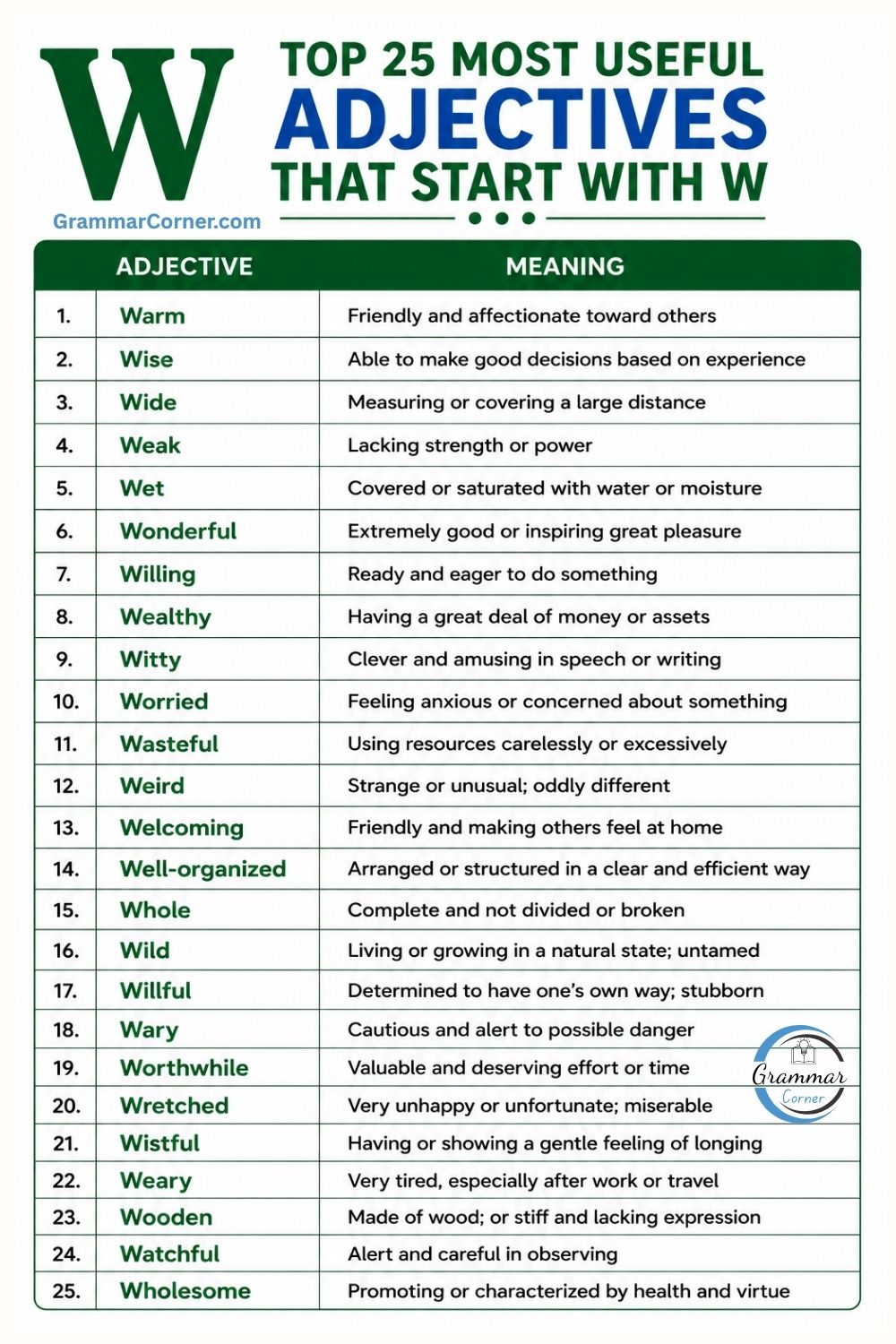
Top 25 Most Useful Adjectives That Start with W
These are the W adjectives you’ll actually use. They show up in conversation, classroom writing, workplace emails, and interviews. Learn these first, and the rest becomes easier.
| Adjective | Best Used For | Example Sentence |
|---|---|---|
| Warm | Describing friendly people Easy | Her warm greeting made the new intern feel less nervous. |
| Wise | Praising good judgment Easy | My grandfather gave me one wise piece of advice about saving money. |
| Wide | Measuring space Easy | The hallway isn’t wide enough for two people to pass comfortably. |
| Weak | Describing low strength Easy | The Wi-Fi signal is weak in the back bedroom. |
| Wet | Describing moisture Easy | Don’t sit there — the bench is still wet from the rain. |
| Wonderful | Expressing strong approval Easy | We had a wonderful time at the food festival last weekend. |
| Willing | Showing readiness to help Easy | She’s always willing to cover a shift when someone gets sick. |
| Wealthy | Describing money Intermediate | The wealthy client wanted the entire office redesigned. |
| Witty | Praising clever humor Intermediate | His witty response turned an awkward meeting into a friendly one. |
| Worried | Describing anxiety Easy | I’m worried about my exam results. |
| Wasteful | Criticizing poor use of resources Intermediate | Printing every email is wasteful and expensive. |
| Weird | Describing strangeness Easy | That documentary had a weird ending nobody understood. |
| Welcoming | Describing hospitality Intermediate | The café has a welcoming atmosphere on cold mornings. |
| Well-organized | Praising structure Intermediate | Her well-organized notes helped the whole study group. |
| Whole | Describing completeness Easy | He finished the whole project in three days. |
| Wild | Describing untamed things Easy | We spotted wild horses near the coastal road. |
| Willful | Describing stubborn determination Advanced | The willful toddler refused to put on her shoes. |
| Wary | Describing careful suspicion Intermediate | Be wary of job offers that ask for money upfront. |
| Worthwhile | Judging value Intermediate | The extra training turned out to be worthwhile. |
| Wretched | Describing misery Advanced | The refugees lived in wretched conditions for months. |
| Wistful | Describing gentle longing Advanced | She gave a wistful smile when the old song played. |
| Weary | Describing deep tiredness Intermediate | After the double shift, he was too weary to cook. |
| Wooden | Describing material or stiffness Intermediate | His wooden delivery made the speech hard to follow. |
| Watchful | Describing alertness Intermediate | The watchful lifeguard spotted the swimmer immediately. |
| Wholesome | Describing healthy goodness Intermediate | The show became popular for its wholesome humor. |
Quick Tip
Notice how many W adjectives describe character rather than appearance. That makes them especially valuable for interviews, recommendation letters, and personal essays.
Positive Adjectives That Start with W
Positive
Positive adjectives express approval, admiration, or a good quality. The words below work well when you’re describing a person’s character, work habits, or attitude.
| Adjective | Meaning |
|---|---|
| Warm | Friendly and affectionate toward others |
| Wise | Able to make good decisions based on experience |
| Witty | Clever and amusing in speech or writing |
| Welcoming | Making others feel comfortable and included |
| Willing | Ready and happy to do something |
| Wonderful | Extremely good or delightful |
| Worthy | Deserving respect, trust, or reward |
| Wholehearted | Completely sincere and committed |
| Well-mannered | Polite and considerate in behavior |
| Wholesome | Morally good and health-promoting |
| Wise-hearted | Combining intelligence with kindness |
| Winsome | Charming in an innocent, appealing way |
| Well-rounded | Skilled or knowledgeable in many areas |
| Watchful | Alert and attentive to what matters |
| Worthwhile | Valuable enough to justify the effort |
Word Spotlight: Winsome
Negative Adjectives That Start with W
Negative adjectives describe flaws, unpleasant qualities, or difficult situations. You’ll need them for honest writing, character development, and clear criticism — but use them carefully in professional settings, where a softer word often does more.
| Adjective | Meaning |
|---|---|
| Wicked | Morally bad or deliberately cruel |
| Whiny | Complaining constantly in an annoying tone |
| Wasteful | Using resources carelessly |
| Weak-willed | Lacking the strength to resist temptation or pressure |
| Wretched | Extremely unhappy or in very poor condition |
| Withdrawn | Unwilling to communicate or socialize |
| Wooden | Stiff and lacking natural expression |
| Worthless | Having no value or usefulness |
| Wrathful | Full of intense anger |
| Wayward | Difficult to control; behaving badly |
| Weaselly | Sneaky and untrustworthy |
| Woeful | Very sad, or shockingly poor in quality |
| Worrisome | Causing anxiety or concern |
| Wobbly | Unsteady; likely to fall or fail |
| Wanton | Deliberately cruel or reckless without reason |
Did You Know?
Wretched comes from an Old English word meaning “exile” or “outcast.” That history explains why it still carries a sense of deep, isolating misery rather than ordinary sadness.
Neutral Adjectives That Start with W
A neutral adjective simply describes a fact. It doesn’t praise or criticize — it tells you what something is like, and the reader decides whether that’s good or bad.
| Adjective | Meaning | Why It Is Neutral |
|---|---|---|
| Wide | Measuring a lot from side to side | A wide road and a wide crack are both just measurements |
| Wet | Covered or soaked with liquid | Good for a garden, bad for a phone — context decides |
| Wooden | Made of wood | Purely descriptive when referring to material |
| Weekly | Happening once a week | States frequency without judgment |
| Western | Relating to the west | A directional or geographic fact |
| White | Of the color white | A plain color description |
| Whole | Complete; entire | Neither positive nor negative on its own |
| Wintry | Cold and typical of winter | Pleasant to some, unpleasant to others |
| Woolen | Made from wool | A material fact |
| Wavy | Having curves or waves | Describes shape only |
| Written | Expressed in writing | Distinguishes a format, nothing more |
| Wireless | Working without cables | A technical description |
Which Word Fits Best?
The apartment listing said the kitchen was ______, so I expected more counter space than I got.
- a) wistful
- b) spacious
- c) wide
- d) wicked
Show Answer
Answer: c) wide. Wide is a neutral measurement word that fits a factual listing. Spacious would also work grammatically, but it doesn’t start with W. Wistful describes emotion, and wicked describes moral character — neither applies to a kitchen.
Adjectives That Start with W to Describe a Person
People are complicated, so it helps to have words for different dimensions — how someone looks, how they behave, how they think, and how they feel.
| Adjective | Meaning |
|---|---|
| Warm-hearted | Kind and generous toward others |
| Well-spoken | Able to express ideas clearly and politely |
| Wrinkled | Having lines on the skin, usually from age |
| Wiry | Thin but strong and muscular |
| Well-groomed | Neat and carefully maintained in appearance |
| Wide-eyed | Showing surprise, wonder, or innocence |
| Weathered | Showing signs of age or long exposure to hardship |
| Wise | Showing good judgment from experience |
| Well-read | Having read widely and knowledgeably |
| Worldly | Experienced and knowledgeable about life |
| Witty | Quick with clever humor |
| Wistful | Quietly longing for something past |
| Wary | Cautious because of possible danger |
| Withdrawn | Emotionally distant or socially quiet |
| Willing | Ready to cooperate or help |
| Watchful | Paying careful attention |
| Well-liked | Popular and respected by others |
| Welcoming | Making others feel at ease |
| Weak | Lacking physical or moral strength |
| Whimsical | Playfully unpredictable in a charming way |
❌ He is a very wide man.
✅ He is a heavily built man.
Why: Wide describes objects and spaces, not people’s bodies. Using it for a person sounds unnatural and slightly rude. For physical build, use stocky, broad-shouldered, or heavily built.
Adjectives That Start with W to Describe Character and Personality
Character adjectives describe who someone is rather than what they look like. These are the words that show up in reference letters, character sketches, and honest conversations about people.
Wise
Makes sound decisions based on real experience, not just knowledge.
Warm
Naturally friendly and emotionally open with others.
Witty
Thinks quickly and expresses humor cleverly.
Willful
Determined to have one’s own way, even against advice.
Wholehearted
Commits fully to people and causes without holding back.
Wary
Approaches new people and situations with careful caution.
Whimsical
Playful and unpredictable in a light, charming way.
Well-meaning
Has good intentions, even when results fall short.
Worldly
Understands how life and society actually work.
Withdrawn
Keeps thoughts and feelings private; avoids social contact.
Wayward
Resists rules and guidance; hard to direct.
Watchful
Notices details and stays alert to what’s happening.
Whiny
Complains often and in an irritating way.
Wholesome
Lives by simple, decent values.
Weak-willed
Gives in easily to pressure or temptation.
Commonly Confused: Willful vs. Willing
These two look similar but mean almost opposite things.
Willing = ready to cooperate. She was willing to stay late and finish the report.
Willful = stubbornly determined to do things one’s own way, usually against advice. His willful refusal to follow the safety checklist cost the team a week.
If you mix these up in a recommendation letter, you’ll accidentally insult the person you’re praising.
Adjectives That Start with W to Describe Yourself
Self-description is a balancing act. You want words that sound confident but honest. The adjectives below work well in interviews, resumes, LinkedIn summaries, and application essays — as long as you can back them up with an example.
| Adjective | Meaning | Best Setting |
|---|---|---|
| Well-organized | Keeps work and time under clear control | Resumes, interviews |
| Willing | Ready to take on new tasks and learn | Interviews, cover letters |
| Well-spoken | Communicates clearly and professionally | Client-facing roles |
| Warm | Approachable and friendly with people | Teaching, healthcare, service roles |
| Well-rounded | Capable across several different areas | College applications |
| Watchful | Notices details others miss | Quality control, finance, safety roles |
| Wholehearted | Fully committed to work and team | Scholarship and personal essays |
| Well-prepared | Ready before deadlines and meetings | Interviews |
| Well-informed | Keeps up with the field | Industry-specific roles |
| Work-focused | Stays on task and productive | Performance reviews |
Quick Note
Avoid stacking three or four positive adjectives in a row about yourself. “I’m a hardworking, well-organized, wholehearted, willing team player” reads as a list of claims. One adjective plus one concrete example (“I’m well-organized — I rebuilt our filing system and cut retrieval time in half”) is far more convincing.
Progress Check
- You’ve now covered roughly 70 W adjectives across positive, negative, neutral, personality, and self-description categories.
- Next up: workplace vocabulary, leadership words, and creative writing options.
Adjectives That Start with W to Describe Someone at Work
Workplace language needs to be precise. A vague compliment helps nobody in a performance review, and a poorly chosen word in a reference letter can quietly hurt someone’s chances.
| Adjective | Suitable For |
|---|---|
| Well-organized | Performance reviews, resumes, project roles |
| Willing | Reference letters, entry-level hiring |
| Well-prepared | Interview feedback, meeting evaluations |
| Well-spoken | Client-facing and presentation roles |
| Warm | Team culture feedback, service roles |
| Watchful | Compliance, auditing, safety, editing |
| Well-informed | Research, strategy, consulting |
| Wholehearted | Reference letters, team commitment notes |
| Work-oriented | Productivity discussions |
| Well-respected | Leadership recommendations |
| Wide-ranging | Describing broad skills or experience |
| Workable | Describing practical, usable solutions |
| Well-timed | Describing good judgment on delivery and pacing |
| Well-connected | Business development, partnerships |
| Weekly | Describing reporting or meeting schedules |
Real-Life Example
A manager is writing a reference for an employee who consistently spots errors in contracts before they go out — small things nobody else catches. Which adjective would you choose?
Watchful is the right choice. It points directly at sustained attention to detail. Wise suggests broad life judgment, which is too general here. Worldly refers to social and cultural experience, which has nothing to do with catching contract errors.
Adjectives That Start with W to Describe a Leader
Good leadership vocabulary describes behavior, not just personality. The words below show what a leader actually does — how they decide, communicate, and hold themselves accountable.
A wise leader weighs long-term consequences instead of chasing quick wins. A warm leader builds trust, which matters more than authority when a team is under stress. A well-spoken leader can explain a difficult decision in a way people actually understand.
Watchful leaders notice problems early. Well-organized leaders keep projects on schedule without constant crisis meetings. Willing leaders take on the unglamorous work rather than pushing it downward — a quality teams notice immediately.
Some leadership adjectives point to vision and confidence. A wide-ranging thinker connects ideas across departments. A well-respected manager carries influence without needing to raise their voice. A worthy leader earns trust through consistent behavior rather than titles.
Two Cautions
Willful
Ignoring input, which reads as arrogance rather than conviction.
Wavering
Constantly changing direction, which damages team confidence faster than almost anything else.
| Adjective | Leadership Quality |
|---|---|
| Wise | Sound judgment and long-term thinking |
| Warm | Builds trust and psychological safety |
| Well-spoken | Communicates decisions clearly |
| Watchful | Spots risks before they escalate |
| Well-organized | Manages structure and deadlines |
| Willing | Shares the workload |
| Well-respected | Holds earned authority |
| Worthy | Deserves the trust placed in them |
| Wide-ranging | Thinks across boundaries |
| Wholehearted | Commits fully to the team’s success |
Adjectives That Start with W to Describe Someone at Work
Workplace language needs to be precise. A vague compliment helps nobody in a performance review, and a poorly chosen word in a reference letter can quietly hurt someone’s chances.
| Adjective | Suitable For |
|---|---|
| Well-organized | Performance reviews, resumes, project roles |
| Willing | Reference letters, entry-level hiring |
| Well-prepared | Interview feedback, meeting evaluations |
| Well-spoken | Client-facing and presentation roles |
| Warm | Team culture feedback, service roles |
| Watchful | Compliance, auditing, safety, editing |
| Well-informed | Research, strategy, consulting |
| Wholehearted | Reference letters, team commitment notes |
| Work-oriented | Productivity discussions |
| Well-respected | Leadership recommendations |
| Wide-ranging | Describing broad skills or experience |
| Workable | Describing practical, usable solutions |
| Well-timed | Describing good judgment on delivery and pacing |
| Well-connected | Business development, partnerships |
| Weekly | Describing reporting or meeting schedules |
Real-Life Example
A manager is writing a reference for an employee who consistently spots errors in contracts before they go out — small things nobody else catches. Which adjective would you choose?
Watchful is the right choice. It points directly at sustained attention to detail. Wise suggests broad life judgment, which is too general here. Worldly refers to social and cultural experience, which has nothing to do with catching contract errors.
Adjectives That Start with W to Describe a Leader
Good leadership vocabulary describes behavior, not just personality. The words below show what a leader actually does — how they decide, communicate, and hold themselves accountable.
A wise leader weighs long-term consequences instead of chasing quick wins. A warm leader builds trust, which matters more than authority when a team is under stress. A well-spoken leader can explain a difficult decision in a way people actually understand.
Watchful leaders notice problems early. Well-organized leaders keep projects on schedule without constant crisis meetings. Willing leaders take on the unglamorous work rather than pushing it downward — a quality teams notice immediately.
Some leadership adjectives point to vision and confidence. A wide-ranging thinker connects ideas across departments. A well-respected manager carries influence without needing to raise their voice. A worthy leader earns trust through consistent behavior rather than titles.
Two Cautions
Willful
Ignoring input, which reads as arrogance rather than conviction.
Wavering
Constantly changing direction, which damages team confidence faster than almost anything else.
| Adjective | Leadership Quality |
|---|---|
| Wise | Sound judgment and long-term thinking |
| Warm | Builds trust and psychological safety |
| Well-spoken | Communicates decisions clearly |
| Watchful | Spots risks before they escalate |
| Well-organized | Manages structure and deadlines |
| Willing | Shares the workload |
| Well-respected | Holds earned authority |
| Worthy | Deserves the trust placed in them |
| Wide-ranging | Thinks across boundaries |
| Wholehearted | Commits fully to the team’s success |
Adjectives That Start with W to Describe Things and Objects
| Adjective | Meaning | Example |
|---|---|---|
| Wireless | Working without physical cables | The wireless headphones lasted through a nine-hour flight. |
| Wooden | Made of wood | We replaced the plastic chairs with wooden ones. |
| Waterproof | Not damaged by water | Her waterproof jacket handled the monsoon downpour. |
| Wide | Measuring a lot side to side | The wide screen made editing photos much easier. |
| Worn | Damaged or thinned by long use | The worn armchair still gets used every evening. |
| Warm | Giving or holding heat | A warm bowl of soup is exactly right after a cold walk. |
| Woolen | Made from wool | He packed two woolen sweaters for the hill station. |
| Weighty | Heavy, or serious in importance | The weighty hardcover was awkward to read in bed. |
| Well-made | Built with care and quality | These well-made boots have lasted six winters. |
| Wobbly | Unsteady | Fold a napkin under the wobbly table leg. |
Learning Shortcut
Several W adjectives describe both objects and people — warm, wooden, worn, weighty. When applied to people, they usually shift meaning. A worn face means tired, not physically damaged. A wooden performance means stiff, not made of timber.
10 Adjectives That Start with W to Describe Feelings and Emotions
Positive Feelings
- Warm — comforted and affectionate
- Wonderful — filled with delight
- Wholehearted — fully emotionally committed
- Welcome — glad to be accepted
Negative Feelings
- Worried — anxious about an outcome
- Weary — deeply tired in body or mind
- Wretched — miserable and low
- Wrathful — burning with anger
Mixed or Neutral Feelings
- Wistful — gently longing for the past
- Wondering — curious and uncertain
- Watchful — alert without clear emotion
- Wavering — unsure between two feelings
Fill in the Blank
After the graduation ceremony ended, she looked at the empty classroom with a ______ smile, remembering four years of early mornings.
Show Answer
Answer: wistful. The sentence describes affection mixed with a sense of loss — the exact meaning of wistful.
Easy Adjectives That Start with W for Kids
These words are simple enough for primary school students and useful in everyday sentences.
| Word | Simple Meaning |
|---|---|
| Wet | Covered in water |
| Warm | A little hot, in a nice way |
| Wide | Big from one side to the other |
| Weak | Not strong |
| Wild | Living freely in nature |
| White | The color of snow |
| Windy | Having a lot of wind |
| Wonderful | Very, very good |
| Wooden | Made of wood |
| Wavy | Having curves like water |
Tip for Parents and Teachers
Ask children to find one wet, one wooden, and one wide thing in the room. Connecting adjectives to real objects builds vocabulary much faster than memorizing lists.
Adjectives That Start with W for Creative Writing
Fiction needs adjectives that carry atmosphere. These words work across genres — describing characters, settings, tension, and mood.
| Word | Meaning |
|---|---|
| Wistful | Quietly longing for something lost |
| Weathered | Marked by age, weather, or hardship |
| Wraithlike | Pale, thin, and ghostly |
| Windswept | Exposed to strong, constant wind |
| Withering | Shrinking, fading, or harshly critical |
| Wanton | Recklessly cruel or unrestrained |
| Whispered | Spoken very softly |
| Wretched | Miserable and pitiable |
| Wondrous | Inspiring awe and amazement |
| Waning | Gradually decreasing in strength |
Notice how these words do double duty.
withering
a dying plant or a devastating look
waning
a moon or a fading friendship
That flexibility is what makes an adjective valuable in fiction.
Choose the Better Adjective
You’re describing an abandoned lighthouse on a cliff in a mystery novel.
Windswept is the strongest choice. It carries setting, atmosphere, and isolation in one word. Wet is factual but flat, and weekly describes frequency — it makes no sense here.
Adjectives That Start with W for Resume and Interview Success
| Adjective | Meaning | Where to Use It | Where NOT to Use It |
|---|---|---|---|
| Well-organized | Manages tasks and time systematically | Resume bullet points, interview answers | Anywhere you can’t give a specific example |
| Willing | Ready to learn and take on tasks | Entry-level applications, cover letters | Senior roles — it can sound passive |
| Well-prepared | Ready in advance | Interview answers about your process | Resumes; it’s too vague on paper |
| Well-spoken | Communicates clearly | Client-facing and presentation roles | About yourself in writing; let the interview show it |
| Well-informed | Up to date in your field | Cover letters, technical interviews | Applications where you’re switching industries |
| Well-rounded | Capable in several areas | College and scholarship applications | Specialist roles that want depth |
| Watchful | Attentive to detail and risk | Compliance, auditing, safety, editing roles | Creative or sales roles, where it sounds odd |
| Wholehearted | Fully committed | Personal statements, essays | Formal resumes — too emotional |
| Well-versed | Highly knowledgeable in a specific area | Skills sections, technical roles | Anywhere you’re not genuinely expert |
| Work-focused | Stays productive and on task | Performance self-reviews | Interviews, where it sounds defensive |
Remember
Recruiters skim, and an adjective without evidence gets ignored.
Well-organized
Well-organized — managed three overlapping client projects with zero missed deadlines
Common Mistakes When Using Adjectives That Start with W
❌ She is a wise woman that gives good advices.
✅ She is a wise woman who gives good advice.
Why: Use who for people, and remember advice is uncountable — there’s no plural form.
❌ This is the most wide road in the city.
✅ This is the widest road in the city.
Why: Short adjectives form the superlative with -est, not with most. Same rule applies to wiser/wisest and warmer/warmest.
❌ I am very willful to help you.
✅ I am very willing to help you.
Why: Willful means stubborn. Willing means ready to help. These are frequently swapped by learners.
❌ He was wearied after the long journey.
✅ He was weary after the long journey.
Why: Weary is the adjective. Wearied is a verb form and sounds unnatural here.
❌ The weather is very wet today, so I feel wet.
✅ The weather is very wet today, so I got soaked.
Why: Repeating the same adjective in one sentence weakens the writing. Vary your word choice.
❌ That’s a wonderfull idea.
✅ That’s a wonderful idea.
Why: Wonderful has one l. The suffix -ful always takes a single l, as in helpful, careful, and useful.
❌ She gave me a warmly welcome.
✅ She gave me a warm welcome.
Why: Warmly is an adverb and can’t modify a noun. Use the adjective warm before welcome.
Practice Exercises
Exercise 1: Fill in the Blanks
The soup was still ______, so I ate it right away.
Be ______ of emails asking for your bank details.
His ______ remark made the whole room laugh.
After the twelve-hour drive, we were too ______ to unpack.
The old fisherman’s ______ hands told a long story.
Exercise 2: Choose the Correct Adjective
The toddler was so (willing / willful) that she refused to leave the park for an hour.
Our new manager has a (warm / wide) way of speaking that puts people at ease.
Throwing away half the food is (wasteful / worthless).
The bridge felt (wobbly / woolen) under our feet.
She’s (well-read / well-worn) enough to discuss almost any topic.
Exercise 3: Match the Adjective with Its Meaning
| Adjective | Meaning |
|---|---|
| 1. Wistful | a. Charming in a gentle, innocent way |
| 2. Wary | b. Complaining in an irritating tone |
| 3. Winsome | c. Quietly longing for the past |
| 4. Whiny | d. Cautious about possible danger |
| 5. Wholesome | e. Morally good and healthy |
Exercise 4: Correct the Mistake
He is the most wise person in our family.
The welcome was very warmly.
I’m willful to try the new software.
That was a wonderfull performance.
Exercise 5: Rewrite the Sentence
Replace the underlined word with a stronger W adjective.
The abandoned house looked sad and broken. → ______
She was very tired after the night shift. → ______
His comment was clever and funny. → ______
Show Answers
Exercise 1
- warm
- wary
- witty
- weary
- weathered
Exercise 2
- willful
- warm
- wasteful
- wobbly
- well-read
Exercise 3
- 1 – c
- 2 – d
- 3 – a
- 4 – b
- 5 – e
Exercise 4
- He is the wisest person in our family.
- The welcome was very warm.
- I’m willing to try the new software.
- That was a wonderful performance.
Exercise 5 (sample answers)
- The abandoned house looked wretched.
- She was weary after the night shift.
- His comment was witty.
Frequently Asked Questions
What are adjectives that start with W?
Adjectives that start with W are describing words beginning with the letter W. They describe nouns and pronouns by explaining qualities such as character, appearance, size, condition, or emotion. Common examples include warm, wise, wide, weak, witty, wet, and wonderful.
What are some positive adjectives that start with W?
The most useful positive W adjectives include warm, wise, witty, welcoming, willing, wonderful, worthy, wholehearted, well-mannered, wholesome, winsome, and well-rounded. These work well for describing personality, work ethic, and relationships.
What W adjectives describe a person’s personality?
Wise, warm, witty, wary, whimsical, willful, withdrawn, wholehearted, worldly, watchful, wayward, and well-meaning all describe personality rather than appearance. They’re especially useful in character writing and reference letters.
Which W adjectives should I use on a resume?
Well-organized, well-versed, well-informed, well-rounded, and watchful work well on resumes because they describe measurable professional strengths. Always pair each one with a specific achievement rather than letting it stand alone.
Is “wicked” positive or negative?
Wicked is negative in standard English, meaning morally bad or cruel. In informal British and American slang, it can mean “excellent,” as in that was a wicked concert. Use the standard meaning in formal writing to avoid confusion.
What’s the difference between “willing” and “willful”?
Willing means ready and happy to do something. Willful means stubbornly determined to have your own way, often ignoring advice. Despite looking similar, one is a compliment and the other is usually a criticism.
What are easy W adjectives for children?
Wet, warm, wide, weak, wild, white, windy, wonderful, wooden, and wavy are simple enough for primary school students and appear constantly in everyday speech.
Can W adjectives be used in comparative and superlative forms?
Yes. Short W adjectives take -er and -est: wide → wider → widest, warm → warmer → warmest, wise → wiser → wisest. Longer ones use more and most: more wonderful, most welcoming.
Are there rare W adjectives worth learning?
Winsome, wistful, wraithlike, wanton, woeful, and wondrous are less common but genuinely useful, especially in creative writing. They add precision that ordinary vocabulary can’t reach.
Do American and British English differ for W adjectives?
Spelling differences are minimal for W adjectives. The clearest gap is in usage: wicked as a slang compliment is far more common in British English, and whilst (a conjunction, not an adjective) appears in British writing where Americans use while.
Where should W adjectives go in a sentence?
Most adjectives appear either before a noun (a warm welcome) or after a linking verb (the welcome was warm). The first position is called attributive, the second predicative.
See also:
The Adjective Index from A to Z
Twenty-six guides, one for every letter of the alphabet. Click a letter to open its full list.