Adjective Clauses Worksheets With Answers
Adjective Clauses Worksheets
An adjective clause (also called a relative clause) is a dependent clause that describes a noun or pronoun: The girl who sings is my sister. Learn relative pronouns, relative adverbs, subject and object forms, omission, prepositions, and agreement across 10 interactive worksheets.
Quick Grammar Reference
- Adjective Clause
- A dependent clause (subject + verb) that describes a noun or pronoun.
- Who / Whom
- For people. Who is the subject; whom is the object.
- Which / That
- For things. That can also refer to people.
- Whose
- Shows possession: the girl whose dog barked.
- Where / When / Why
- Relative adverbs for place, time, and reason: the town where I live.
- Omitting the Pronoun
- An object pronoun can be dropped: the book (that) I read.
- Prepositions
- Formal: the man to whom I spoke. Informal: the man I spoke to.
- Agreement
- The clause verb agrees with the noun described: students who arrive.
Avoid these common mistakes: Do not use who for things: write the book which (NOT the book who). · Do not use that directly after a preposition: write with which. · Do not omit a subject relative pronoun. · Do not repeat the object: write the book I read (NOT the book I read it).
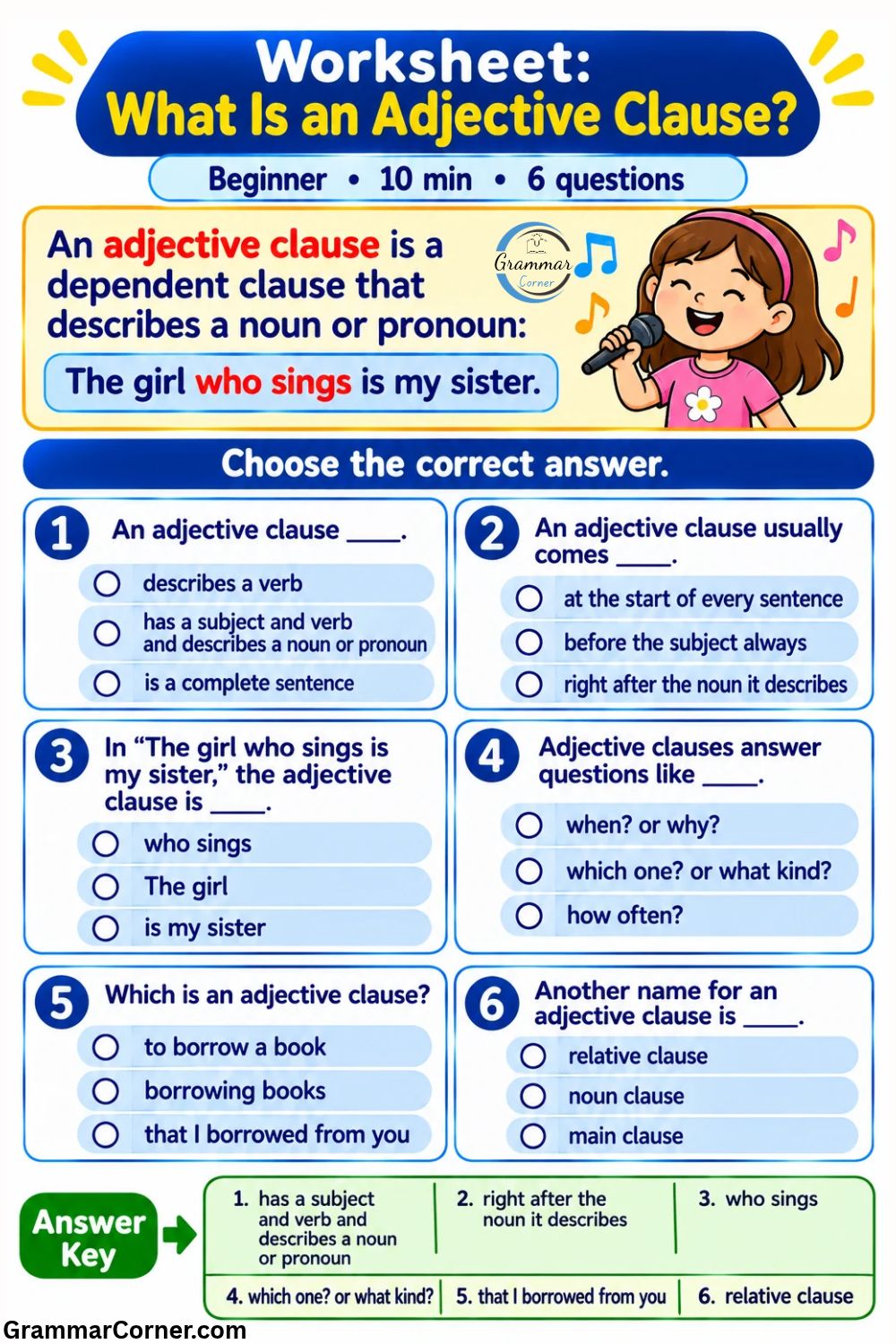
Worksheet 1: What Is an Adjective Clause?
An adjective clause is a dependent clause that describes a noun or pronoun: The girl who sings is my sister. Choose the correct answer.
Worksheet 2: Relative Pronouns
Adjective clauses begin with relative pronouns: who, whom, whose, which, that.
Worksheet 3: Identifying Adjective Clauses
Choose the complete adjective clause in each sentence.
Worksheet 4: Subject and Object Pronouns
A relative pronoun can be the subject or the object of its clause.
Worksheet 5: Relative Adverbs
Where refers to places, when to times, and why to reasons.
Worksheet 6: Omitting the Relative Pronoun
You can omit a relative pronoun when it is the object of the clause.
Worksheet 7: Prepositions in Adjective Clauses
A preposition can come before whom/which (formal) or at the end of the clause (informal).
Worksheet 8: Agreement in Adjective Clauses
The verb in an adjective clause agrees with the noun it describes.
Worksheet 9: Type the Relative Word
Type the relative word that completes each sentence. Use the clue to help you.
Worksheet 10: Adjective Clauses in Real Contexts
Choose the correct relative word for each real-life sentence.
Writing Challenge: People, Places and Things I Like
Write 5–8 sentences about people, places, and things you like. Use at least four adjective clauses with different relative words: who, that/which, whose, and where. Use the checklist below to assess your writing.
Sample Answer
My best friend is someone who always makes me laugh. I love the cafe where we meet on Fridays. She has a dog whose tricks are famous in our street. The book that she lent me is my favourite. It is a story I will never forget.